Short answer first, because I know that is what you actually came here to read. A Meta Quest 3 is not as good as Sandbox VR, and it is also not trying to be. When people ask me home VR vs the arcade, is a Quest 3 as good as Sandbox VR, they are really asking two different questions at once, and the honest answer changes depending on which one you mean. If you want a full-body, full-motion, walk-around-a-room-with-strangers night out, no home headset touches Sandbox VR yet. If you want great VR you can play any random Tuesday at 9pm in your socks, the Quest 3 is the best value in the hobby and it is not close.
My family found this out the hard way. We took the kids to Sandbox VR in Vegas, walked out grinning like we had been somewhere, then I came home and bought a Quest 3 thinking I had recreated it. I had not. But I also do not regret the headset one bit. Here is how the two actually stack up so you can spend your money the right way.
Quest 3 vs Sandbox VR at a glance
| Feature | Meta Quest 3 (home) | Sandbox VR (arcade) |
|---|---|---|
| Price | $599.99 for 512GB, one time | From about $39 per person, per session |
| Session length | As long as your battery lasts, roughly 2 to 2.5 hours | About 30 minutes per booking |
| Movement | Room-scale in your cleared space, mostly stick movement | Free-roam, you physically walk the whole arena |
| Body tracking | Head and two hands (Touch Plus controllers) | Full-body: head, hands, wrists, ankles |
| Haptics | Controller rumble only | Full haptic vest you feel on your chest and back |
| Players together | Online, or pass the headset | 2 to 6 people in the same physical room |
| Best for | Everyday play, fitness, mixed reality, solo or online | A group night out, big moments, first-timers |
Sources for those numbers are down in the verify section, and Blake, please re-check the Quest 3 price before this goes live because Meta bumped pricing on April 19, 2026 and it may move again.
What the Quest 3 does brilliantly
Let me defend the little guy for a minute, because the Quest 3 is genuinely excellent and I use mine far more than I have ever set foot in an arcade. It is a standalone headset, meaning no PC, no wires, no base stations screwed into your walls. You pick it up, you put it on, you are in VR in about thirty seconds.
The specs hold up in 2026. It runs the Snapdragon XR2 Gen 2 chip, pushes 2064 by 2208 pixels per eye through sharp pancake lenses, and supports up to a 120Hz refresh rate. Reviewers this year still call it the most well-rounded VR and mixed reality headset you can get for under a thousand dollars, and the full-color passthrough is the real headline. You can read your phone, grab a drink, or check on the kids without taking it off. That mixed reality trick is something no arcade rig gives you, because at the arcade you are strapped in for one purpose.
The content library is deep. Beat Saber, Resident Evil 4, Asgard’s Wrath 2, the fitness stuff like Supernatural. For a family, that library is the whole point. My kids rotate through it every week.
Two honest cons. Battery life sits around 2 to 2.5 hours, so a longer aftermarket head strap with a built-in battery is close to mandatory, budget another fifty to seventy dollars. And the stock strap is flimsy. Both are cheap fixes, but you should know going in.
What Sandbox VR does that your living room cannot
Now the arcade. Sandbox VR is not a headset, it is a system. You wear the headset, yes, but also a haptic vest, motion sensors on your wrists and ankles, and a small PC backpack that runs the whole thing. Their venues are built around private rooms they call holodecks, each one wired with motion-capture cameras. Sessions run about 30 minutes for groups of 2 to 6, and pricing starts around $39 a person.
Here is the part your Quest 3 will never do. At Sandbox VR you see your teammates’ full bodies, not floating hands. When a zombie grabs your shoulder, the vest thumps you on that exact spot. When you crouch behind cover, your avatar crouches, because your ankles are tracked. You physically walk across the room to flank someone. That combination of free-roam space, full-body capture, and haptic feedback is what makes people walk out saying they felt like they were actually there. The company crossed $300 million in lifetime revenue in March 2026 and announced plans for roughly 200 franchise locations by 2027, so clearly I am not the only one who felt it.
You are also paying for a night out, not a gadget. Six people laughing in the same room, the staff hyping you up, the group photo after. That social, in-person energy is the product. A Quest 3 is a wonderful solo or online machine, but it cannot put five of your friends in one physical arena.
So which should you actually buy
Think about how you will use it, not which is technically more advanced.
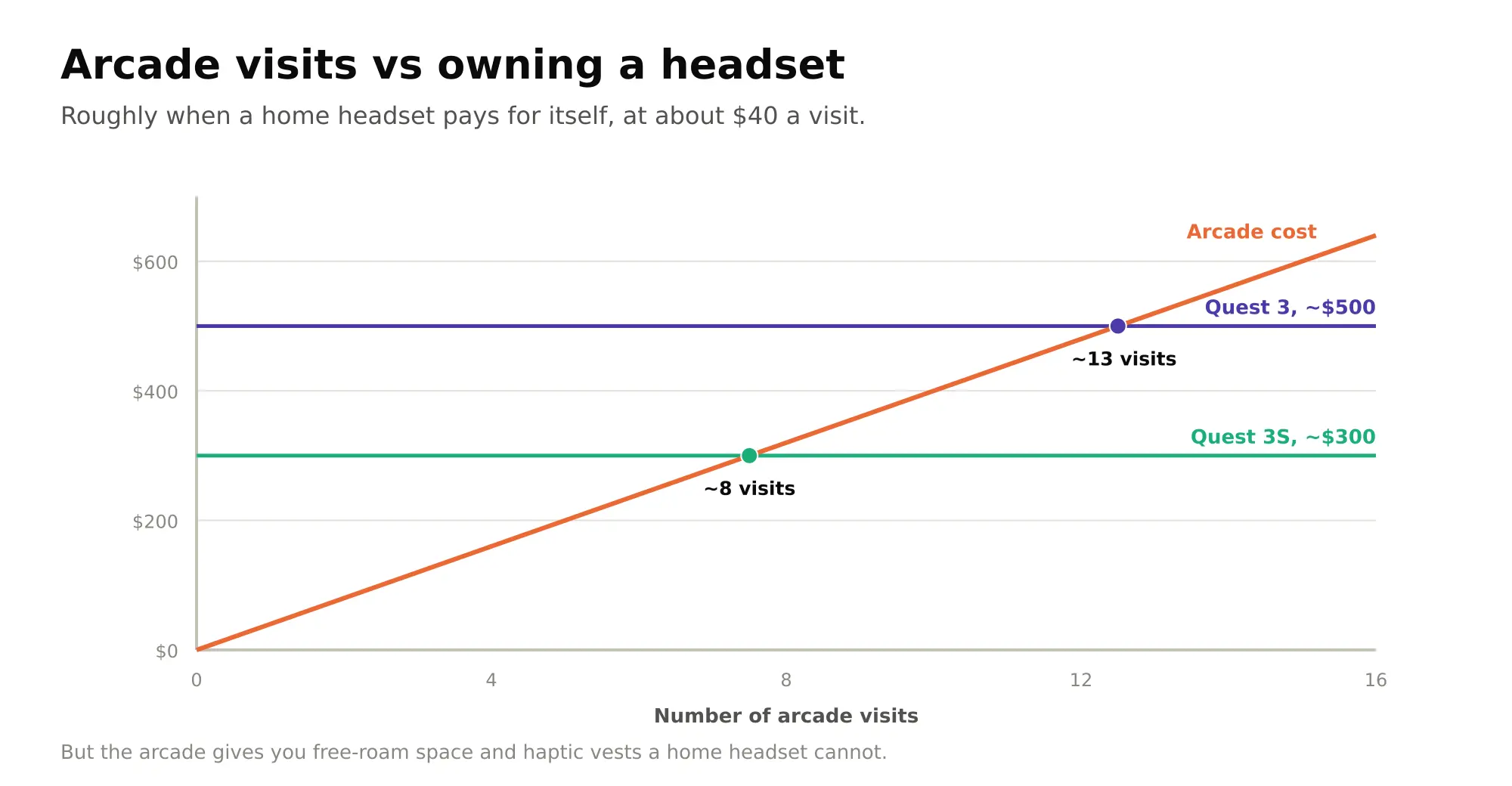
Buy the Quest 3 if VR is going to live in your house. If you want to play often, work out, watch movies on a giant virtual screen, mess with mixed reality, or hand it to the kids on a rainy day, the math is simple. One Sandbox VR trip for a family of four runs well over a hundred dollars for about half an hour. The Quest 3 pays for itself in a handful of visits and then keeps going for years.
Keep going to the arcade for the big stuff. Birthdays, out-of-town guests, that friend who swears they hate VR. Sandbox VR is the experience that converts skeptics, because the full-body immersion does the convincing for you. I treat it like bowling or an escape room: a great occasional outing, not a thing I do nightly.
The truth most gadget sites skip is that these are not competitors. I own a Quest 3 and I still book arcade sessions. If you have played free-roam VR at a place like Sandbox VR and loved it, a home headset will not replicate that, but it will keep the flame alive between visits. For a fuller look at what the arcade side feels like, read our Sandbox VR Vegas review, and if you are near Texas, our write-up of Fixation VR in Dallas shows another flavor of big-arcade VR. You can browse all our venue and gear guides from the homepage.
FAQ
Is the Quest 3 the same as playing at Sandbox VR?
No. The Quest 3 is head-and-hands VR you play at home. Sandbox VR adds full-body tracking, a haptic vest you feel, free-roam walking, and up to six people in one physical room. Different experiences, both worth it.
Can I add a haptic vest to my Quest 3 to feel like the arcade?
Partly. A home vest like the bHaptics TactSuit X40 works with the Quest 3 and adds chest and back feedback for around $350 to $400. It gets you closer, but it does not add the free-roam arena or full-body avatars.
How much does Sandbox VR cost compared to a Quest 3?
Sandbox VR starts around $39 per person for a roughly 30-minute session, so a family outing can easily top a hundred dollars. A Quest 3 is $599.99 one time for the 512GB model and you own it. Confirm current pricing, both have shifted in 2026.
Is a Quest 3 worth buying in 2026?
Yes, for most people. Reviewers still rate it the best all-around standalone VR and mixed reality headset under a thousand dollars, and a true successor is not expected until 2027 or later. Budget a little extra for a better strap with a battery.
Should I buy the Quest 3 or the cheaper Quest 3S?
The 3S at $349.99 shares the same chip and game library but uses lower-cost lenses and a lower-resolution display. If sharp visuals matter to you, get the Quest 3. If you are new and budget-minded, the 3S is a fine start.
Verdict
A Quest 3 is not as good as Sandbox VR, and Sandbox VR is not as convenient as a Quest 3. That is the whole story. Buy the Quest 3 as your everyday VR machine, keep the arcade for the nights you want to feel like you actually went somewhere, and stop thinking of it as either-or. My family does both, and honestly that combination is the best VR setup we have ever had.