Short answer: no, and yes, and it depends on what you are after. Home VR headsets do not replace a VR arcade trip if what you love is the full-body, walk-around, haptic-vest experience of location-based VR. But a home headset like the Meta Quest 3 absolutely replaces the arcade for everyday play, and it does it for no cost per session. I am Blake, a VR dad who has strapped into rigs at more than fifty real venues, and I have a home headset that my kids use every week, so I get asked this question constantly. Let me give you the honest, no-hype breakdown.
The real answer is that these are two different products that happen to share a name. One is a night out. The other is a living-room appliance. Understanding the difference saves you money and disappointment, so here is exactly where each one wins.
Head to head: home VR vs the VR arcade
| Factor | Home VR headset | VR arcade trip |
|---|---|---|
| Cost | One-time, roughly $349.99 to $600+ | Around $40 to $60 per person per session |
| Physical space | Small cleared room, about 2×2 meters | Warehouse-sized free-roam arena |
| Haptics | Controllers only | Full-body haptic vest, wrist and ankle trackers |
| Setup | Put it on and play | Staff-run, gear fitted for you |
| Game library | Thousands of titles | A handful of curated flagship experiences |
| Best for | Everyday play, whole family, any time | Special occasions, groups, the big wow |
| Social feel | Online or pass-and-play | Physically roaming together in one room |
Home headset prices reflect Meta’s April 19, 2026 update, when the Quest 3 rose to $599.99 and the Quest 3S to $349.99 because of a memory chip shortage. Arcade pricing varies by venue, so check locally.
What the arcade does that home VR simply cannot
Let me be direct, because the whole point of this blog is honesty. When my family played at Sandbox VR, we strapped into full-body haptic vests, clipped trackers to our wrists and ankles, and walked freely through a real physical room while motion-capture cameras tracked every step. When something exploded in the game, the vest thumped us in the chest and a fan blew air across our faces. We physically roamed a warehouse-sized space as a squad for about thirty minutes. You can read the whole thing in my Sandbox VR experience in Vegas.
No home headset does that. Here is what you leave behind when you play at home:
- The haptic vest. Feeling a hit land on your body is a huge part of the immersion, and controllers alone cannot fake it.
- The free-roam arena. Venues like EVA Esports give you a real, physically tracked warehouse to walk through. Your living room gives you about two by two meters.
- The operator-grade rigs. Staff fit the gear, calibrate it, and hand you props. Everything is tuned by people who do it all day.
- The event feeling. A VR arcade trip is a night out with friends or family, and that social, physically-in-the-same-room energy is genuinely hard to reproduce at home.
If those are the things that hooked you, then no, a home headset does not replace the arcade. It scratches a different itch. Keep booking the trips.
What home VR does that the arcade cannot
Now the other side, because home VR wins in ways the arcade never will.
It is always there. No booking, no driving, no waiting for a slot. My kids put the headset on after homework and they are boxing or building in seconds.
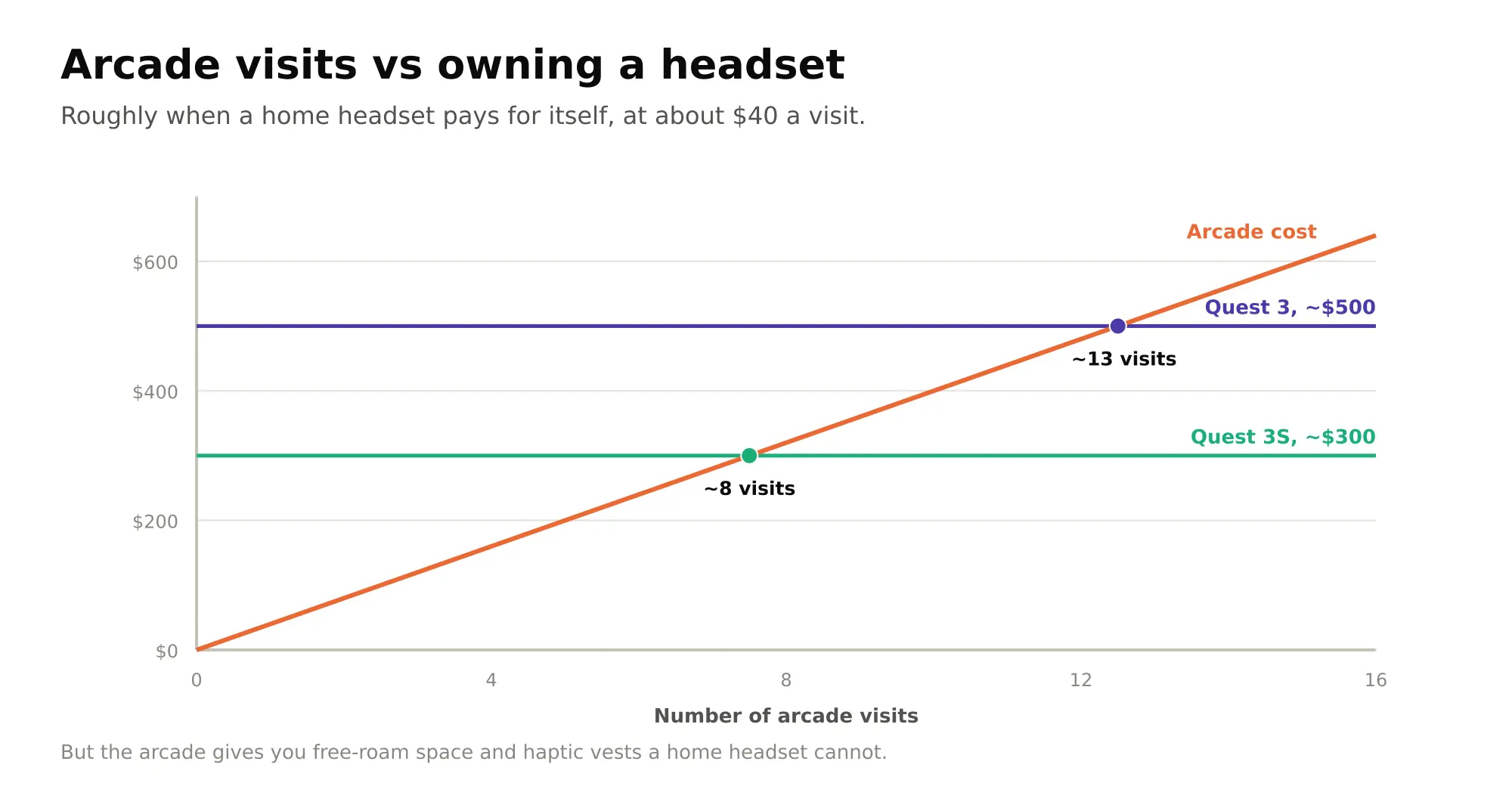
It costs nothing per session. A single Meta Quest 3S is $349.99 and then you are done paying. Compare that to roughly $40 to $60 per person for one arcade session. Two family trips to the arcade can cost more than a whole headset. After that, every hour at home is free.
The library is enormous. An arcade offers a handful of polished flagship experiences. A home headset opens thousands of games and apps across fitness, social, single-player, and creative tools. Reviewers in 2026 still call the Quest 3 the best all-around headset with the largest content library on any platform.
You can go deep. At home you can spend a hundred hours in one game, run a fitness routine every morning, or chat with friends across the country in social VR. The arcade is a thirty-minute burst. Home VR is a long, ongoing relationship.
So yes, home VR fully replaces the arcade for daily, casual, and long-form play. It just does it as a different kind of experience.
The home headset that gets closest
If your goal is to close the gap as much as possible, here is where I would spend in 2026.
The Meta Quest 3 at $599.99 is the standalone headset that feels the most premium. It uses pancake lenses for a sharp, even image at 2,064 by 2,208 pixels per eye, adds a depth sensor for solid mixed reality, and plays wire-free room-scale, which is the closest a home headset gets to arcade freedom. It also tethers to a gaming PC later if you want more.
If you want to spend less, the Meta Quest 3S at $349.99 runs the exact same chip and RAM as the Quest 3, so it plays every game with no restrictions. The only tradeoff is softer edges from its Fresnel lenses, which most families never notice mid-game. It is the best value way to bring arcade-style play home.
If you own a gaming PC and chase maximum fidelity, headsets like the $1,019 Bigscreen Beyond 2, with its 107-gram body and micro-OLED panels, deliver the sharpest picture in the home space, though that is enthusiast territory and PC-only. And the standalone Steam Frame from Valve, announced in November 2025 with a summer 2026 window, is worth watching, though its price is not final yet.
None of these add a haptic vest or a warehouse arena. But for presence, comfort, and picture quality, a Quest 3 in a cleared room gets you a long way toward the feeling, on your own schedule.
So, should you buy a headset or keep going to the arcade?
Do both, honestly, and here is the framework I use with friends.
Buy a home headset if you want VR often, want the whole family playing on a random Tuesday, care about the game library, or want to stop paying per session. That is most people, and the math favors it fast.
Keep the arcade in rotation if you love the full-body haptic free-roam experience, want a genuine night out, or are celebrating something with a group. A few venue trips a year plus a home headset is the setup I recommend to almost everyone, and it is the same conclusion I reach in my home VR setup guide for arcade lovers.
The two are not competitors. They are a great pair.
FAQ
Is home VR as good as the arcade?
For everyday play, yes, and it is cheaper and always available. For the full-body free-roam experience with a haptic vest and a real tracked arena, no. Home VR is room-scale in a small space, so it is a different kind of fun rather than a direct replacement.
How much cheaper is a home headset than the arcade over time?
A Meta Quest 3S is a one-time $349.99, while arcade sessions run roughly $40 to $60 per person. Two or three family arcade nights can equal the cost of a whole headset, and every hour at home after that is free.
Which home headset feels most like the arcade?
The Meta Quest 3 at $599.99, thanks to its sharp pancake lenses and wire-free room-scale play. The cheaper Quest 3S runs the same games and gets close too. Neither adds a haptic vest.
Should I stop going to the arcade if I buy a headset?
No. The best plan for most families is a home headset for daily play plus a few arcade trips a year for the full haptic free-roam experience with friends. They cover different needs.
Why did home headset prices rise in 2026?
A global memory chip shortage led Meta to raise prices on April 19, 2026, adding $100 to the Quest 3 and $50 to the Quest 3S. Confirm the live price before you buy, since the market keeps shifting.
The verdict
Do home VR headsets replace a VR arcade trip? They replace it for everyday, affordable, deep-library play, and a Meta Quest 3 or 3S will keep your family busy every week. They do not replace the haptic vest, the free-roam arena, or the night-out energy of location-based VR at a venue like Sandbox VR or EVA Esports. My advice after fifty-plus venues and a headset that never leaves our living room: buy the home headset for the everyday, and keep booking the arcade for the big nights. You do not have to choose.