The first time a haptic vest punched me in the chest, I was standing in a dark room at Sandbox VR in Las Vegas with a zombie lunging at me. My kids John and Jenette were three feet away giggling, and I actually flinched backward. That is the promise of haptic vests, and comparing arcade tech vs home VR is the question I get asked more than almost any other: can you buy that feeling for the living room, or does the real thing only live at the venue?
Short answer up front. Yes, you can get a genuinely good haptic vest at home for around $500, and it adds a lot. No, it does not fully replicate the operator-grade rig strapped to you at a free-roam arena, and the gap is mostly about the room, not the vest. Let me break down what each one actually does so you can decide where your money goes.
What a haptic vest actually is
A haptic vest is a wearable packed with small vibration motors that fire in patterns synced to what happens in the game. Get shot in the left shoulder, the left shoulder buzzes. Rain starts falling, a soft ripple runs down your back. Your brain fills in the rest, and suddenly VR stops being a screen on your face and starts feeling like a place your body is standing in.
The arcade version and the home version use the same core idea. The difference is everything bolted around it.
Arcade haptics: the full rig at a venue
At a location-based VR venue like Sandbox VR, the vest is one piece of a much larger system. You gear up with the headset, a PC backpack that runs the game on your body instead of a wire to a console, wrist and ankle trackers, and the haptic vest itself. Sandbox uses bHaptics-style vests as part of that loadout, tuned to their own experiences.
What that buys you is a room. Sandbox runs free-roaming games inside private spaces they call holodecks, large dedicated rooms where nobody is tethered to a cable and the play area is the whole floor. Sessions run about 60 minutes for groups of 2 to 6, and pricing starts around $39 per person. You physically walk the space, duck real corners, and the vest reacts while your feet are actually moving.
I have felt this at a few different spots now, and free-roam arenas like EVA Esports push the same idea with arena-scale battles where a whole team wears the gear at once. The vest hitting your chest matters more when you are sprinting across a real 200 square meter floor to flank someone. The hardware and the space are designed together.
Home haptics: the bHaptics TactSuit
For the living room, the name you will run into first is bHaptics. Their flagship home vest, the TactSuit X40, carries 40 individually controllable vibration motors and runs wireless over Bluetooth with battery life quoted around 18 hours. It works with Meta Quest 3, PC VR, and PSVR 2. Pricing sits in the $499 to $529 range depending on where you buy, and bHaptics showed off the current lineup at CES 2026.
The library is the good news. bHaptics supports more than 250 VR titles natively, including big ones you probably already own like Beat Saber, Arizona Sunshine 2, Dungeons of Eternity, Synth Riders, and Spatial Ops. You put the vest on, launch the bHaptics Player, start the game, and the feedback just happens. The company likes to cite that around 97 percent of testers reported feeling genuinely present with the suit on, and while that is a marketing number, my own experience tracks with the spirit of it. It is a real jump in immersion, not a gimmick.
Arcade vs home haptic vests at a glance
| Feature | Arcade vest (Sandbox VR, EVA Esports) | Home vest (bHaptics TactSuit X40) |
|---|---|---|
| Motors / feedback points | Operator-tuned, integrated with full rig | 40 individually controllable motors |
| Play space | Free-roam room, real walking | Your living room, roomscale or standing |
| Setup | Staff gears you up, zero fuss | You strap in and pair over Bluetooth |
| Cost | Around $39+ per person, per session | Around $499 to $529, one-time |
| Game library | Curated venue exclusives | 250+ compatible titles you own |
| Best for | Group nights, wow-factor, special occasions | Frequent solo or family play at home |
| Social feel | Whole group geared up together | You, or one at a time unless you buy several |
So what does the venue actually do better
Two things, and neither is really the vest itself.
First, the space. When a haptic hit lands while you are physically running, your inner ear, your legs, and your chest all agree that something is happening. At home you are standing in a cleared-out living room with a coffee table shoved against the wall. The vest fires the same, but your body has less to corroborate it with.
Second, the shared loadout. At the venue everyone in your group is wearing the gear at the same time. When my whole family is kitted up and reacting together, the haptics become part of a social moment. At home, one vest covers one person. If you want the family all buzzing at once, you are buying multiple suits, and that adds up fast.
I wrote more about that arcade feeling in our look at Immersive Gamebox, where the room itself does a lot of the work even with lighter body tech.
What the home vest does better
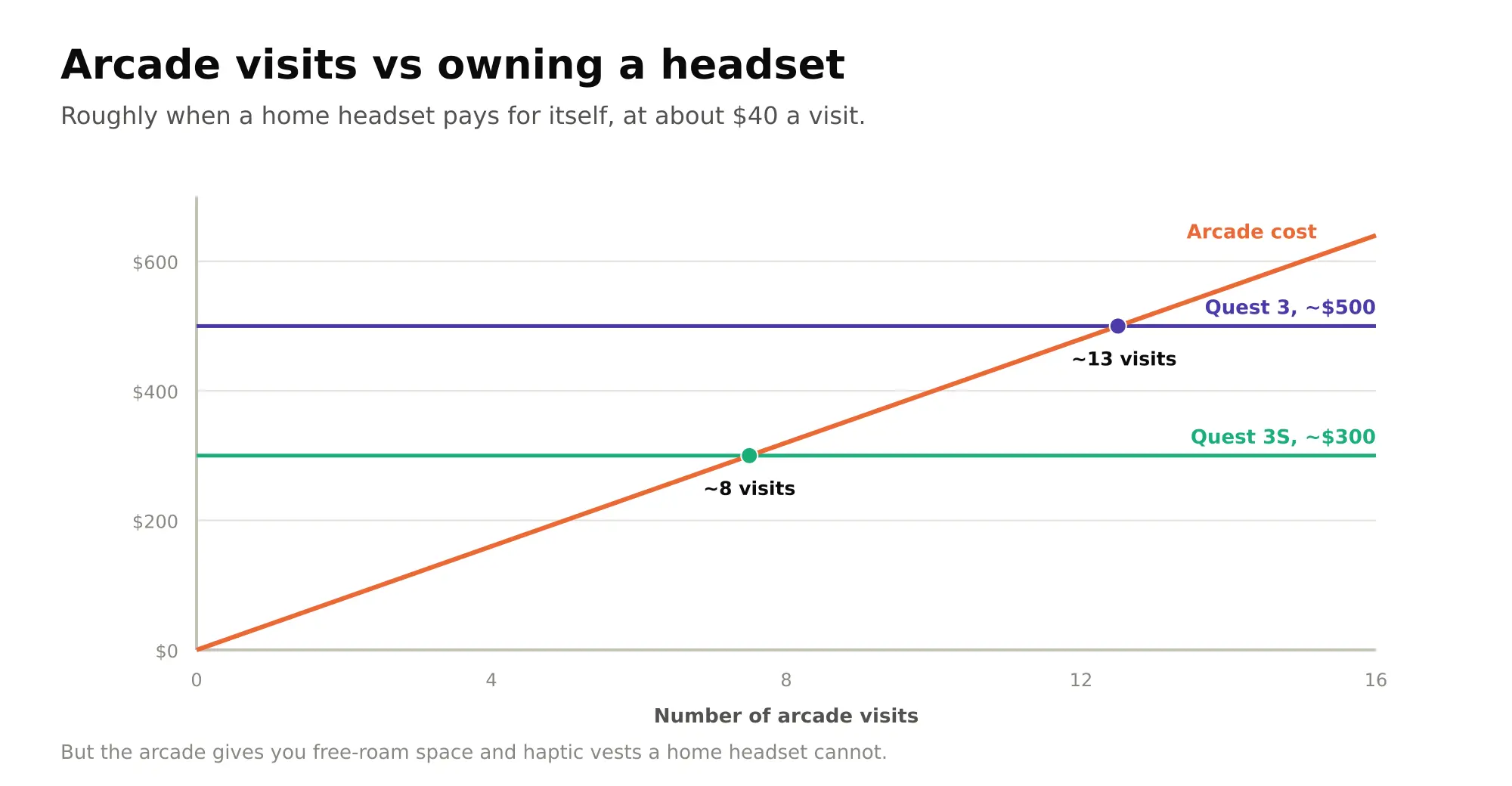
Do not sleep on the home side. A venue session is 60 minutes and then you hand the gear back. A TactSuit lives in your closet and works with games you already play, any night you want, no booking and no drive. For a family that plays VR regularly, the cost math flips. A handful of arcade visits for two people can equal the price of a vest you will use for years.
The library also keeps growing on its own. Every time bHaptics adds support for a new title, your $500 purchase quietly gets better without you spending another cent.
How to pick
Here is how I would frame it for my own family.
Buy a home haptic vest if you already own a Quest 3 or PSVR 2, you play VR most weeks, and you want deeper immersion in the games you love without leaving the house. One person, frequent use, the TactSuit earns its keep.
Skip the home vest and just go to the venue if VR is an occasional treat, you mostly want the group experience, or you love the free-roam walking that no living room can give you. The vest without the room is only part of what made that Sandbox session special.
For a lot of families, the honest answer is both. Own one vest for regular home nights, and keep the venue for birthdays and special occasions when you want everyone geared up and the room doing the heavy lifting. You can find more of our venue write-ups and buying guides over on the homepage.
FAQ
Does a home haptic vest feel the same as the one at Sandbox VR?
The vibration feedback is genuinely close, since venues and home vests use similar bHaptics technology. What you cannot copy at home is the free-roam room and the whole group wearing gear together. The vest is most of the magic. The space is the rest.
Is the bHaptics TactSuit X40 worth $500?
If you play VR regularly and own a compatible headset, yes. It supports 250-plus games you likely already have, it is a one-time cost, and the immersion jump is real. If VR is a once-in-a-while thing, that money is better spent on a few arcade visits.
Will a haptic vest work with my Meta Quest 3?
Yes. The TactSuit line works with Meta Quest 3, PC VR, and PSVR 2 through the bHaptics Player app. You pair it over Bluetooth and supported games trigger feedback automatically.
Can my whole family use one vest?
Only one person at a time. Each suit covers one player, so for simultaneous family play you would need multiple vests. This is exactly why the venue still wins for group nights, since everyone is geared up at once.
Do I need a haptic vest to enjoy home VR?
No. Home VR is great without one. A vest is an immersion upgrade, not a requirement. Start with the headset and games, and add a vest later if you find yourself wanting to feel the action, not just see it.