Location-based VR is virtual reality you play at a dedicated venue instead of at home, in a physical space built to match the virtual world, usually with a wireless headset, full-body tracking, and a haptic vest so you feel the action. It is also called location-based entertainment VR, or LBE VR for short. The big difference from home VR is space and gear: you physically walk through a mapped arena with other players, rather than shuffling around a six-foot square in your living room.
I am Blake, and I have played location-based VR at more than 50 real venues across 13-plus US cities. My family and I keep going back because it delivers something a home headset simply cannot. So let me explain what location-based VR actually is, how it works, the formats you will run into, and whether it is worth booking.
The simple definition
Location-based VR brings people together in a shared physical space where the technology blurs the line between real and virtual. Instead of one person alone in a headset at home, you get a group moving through the same virtual world at the same time, in a real room designed to sync with what you see.
Three things make it different from home VR:
- Space. Home play areas are roughly six by six feet. Location-based arenas run from 200 to over 2,000 square feet, so you actually walk, run, duck, and explore.
- Gear you would not buy for the couch. Think wireless headsets, backpack PCs, tracked controllers, and haptic vests that thump with each hit.
- People in the same room. You share the physical space with your group, hearing real voices and reacting together, not chatting through headsets from separate houses.
How location-based VR works
The magic is in the tracking and the mapping. Here is the plain-English version of what is happening while you play.
The venue maps a physical arena to match the virtual layout at scale. Walls, floor markers, and the play boundary in the game line up with the real room, so when you reach out and touch a virtual wall, something is really there. Full-body motion capture reads your movements and mirrors them onto your in-game avatar with almost no delay, so your teammates see you crouch when you crouch and wave when you wave.
On your body you wear the kit. A wireless headset frees you from cables. A backpack PC, usually around seven or eight pounds, runs the experience so you are not tethered to a fixed computer. A haptic vest delivers vibration and pressure that match on-screen events, so a hit lands on your chest and not just on the screen. Spatial audio places sound directionally, footsteps behind you, a teammate calling from your left, which is a bigger deal for immersion than most people expect.
Put it together and the venue can track multiple players at once with near-zero delay, letting a group coordinate naturally inside a shared world. That is the whole trick, and it is why it feels so different from strapping on a headset at home.
The main formats of location-based VR
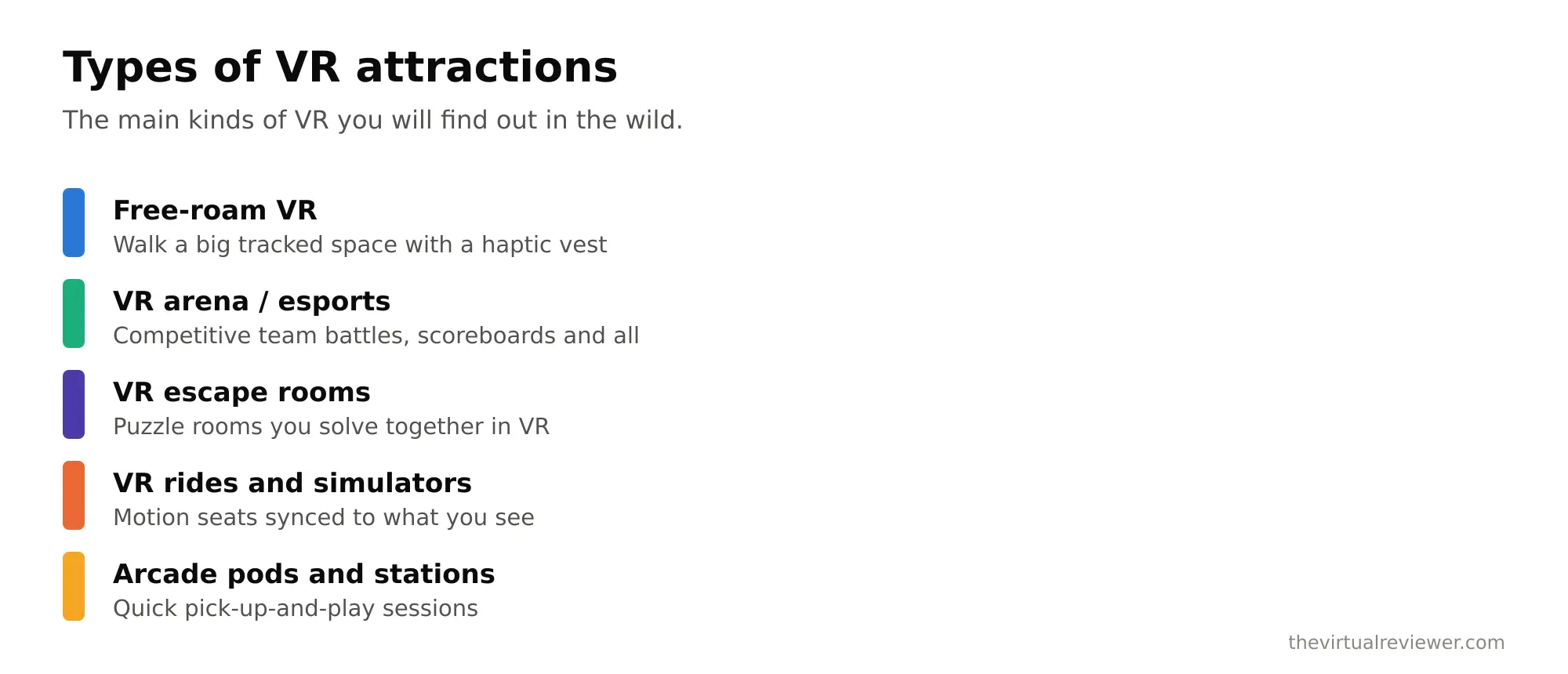
“Location-based VR” is an umbrella. Under it you will find a few distinct experiences, and knowing them helps you pick.
| Format | What it is | Players | Feel |
|---|---|---|---|
| Free-roam arena | Walk untethered through a large mapped space | 2 to 8 | Big, physical, exploratory |
| Full-body haptic | Motion capture plus haptic vest, cinematic missions | 2 to 6 | Story-driven, intense |
| Multi-station / room | Projection or fixed-station group games | Up to 6 | Social, party-friendly |
| Booth / single-station | One spot, short arcade titles | 1 to 2 | Quick, casual, budget |
Free-roam arena VR
This is the “warehouse-scale” experience. You wear a wireless headset and a backpack PC and physically walk through an arena that can be 40 times larger than a home play space, with up to eight players in the same virtual world seeing each other as avatars. Chains like Zero Latency built their name here. It is my pick when the group wants to feel like they are really inside another place. I got into the free-roam feel in my EVA Esports review, which is a good look at a free-roam arena in action.
Full-body haptic VR
This is the Sandbox VR camp. You still move through a space, but the star is the full-body motion capture plus a haptic vest that makes virtual impacts feel physical. It leans cinematic and story-driven, groups of two to six on a mission together. I wrote up our night in my Sandbox VR review, and the haptics are the thing my kids still talk about.
Multi-station and booth VR
Not every location-based VR is a giant arena. Multi-station rooms and projection setups are more social and party-friendly, and simple booths give a quick, cheap taste. These are great entry points, especially for first-timers or younger kids, even if they do not hit the same high as free-roam. My Fixation VR review covers a big VR arcade that mixes formats under one roof.
Location-based VR versus home VR
This is the question I get most: I have a headset at home, so why pay to play VR somewhere else?
Home VR is fantastic and I own it. But it lives in a small space, usually a six-by-six-foot area, with teleport or joystick movement to get around bigger worlds, and it is mostly a solo thing. Location-based VR trades the convenience of your couch for space you cannot replicate at home, gear you would not buy for personal use, and the social energy of a group physically in the room with you.
The way I put it to friends: home VR is where you practice and play on a Tuesday night. Location-based VR is the night out. One does not replace the other. If you have loved VR at a venue and are wondering whether a home headset will match it, the honest answer is that home gear gives you convenience and range of games, but it will not give you the arena or the haptic vest. Those stay at the venue.
Is location-based VR worth it?
For my family, absolutely, with realistic expectations. A single session runs longer than a movie is worth in memories, because you are inside the story together rather than watching it. The full-body formats especially land with people who think they have “done VR” because they tried a phone-holder headset years ago. This is a different thing.
Where I set expectations: it costs more than a home session, sessions are around 30 minutes of active play, and the best formats have age or height minimums, so it is not always right for the littlest kids. Pick the format to match your crew and it delivers. Book a nervous first-timer into an intense haptic mission and you might scare them off. Start them in a lighter room and let them work up.
FAQ
What does location-based VR mean?
Location-based VR (LBE VR) means virtual reality you play at a dedicated venue rather than at home. The venue provides a physical space mapped to the virtual world, plus gear like wireless headsets, full-body tracking, and haptic vests, so a group can move through a shared world together.
How is location-based VR different from home VR?
Home VR uses a small play area, usually about six by six feet, and is mostly solo. Location-based VR gives you a much larger arena to physically walk through, professional gear you would not buy for home, and other players in the same room. It is built for groups and immersion.
What is free-roam VR?
Free-roam VR is a type of location-based VR where you walk untethered through a large arena, from 200 to over 2,000 square feet, wearing a wireless headset and a backpack PC. Up to eight players can share the same virtual space and see each other as avatars.
Do I need experience to try location-based VR?
No. Venues gear you up and coach you, and there are formats for every comfort level, from quick booths for first-timers to intense free-roam missions. Start with a lighter format if you are nervous, then work up to the full-body arenas.
How much does location-based VR cost?
It varies by format, roughly $8 to $20 for a booth, $21 to $30 for a multi-station room, and $39 to $70 per person for premium free-roam or full-body haptic sessions, for about 30 minutes of active play.
The bottom line
So, what is location-based VR? It is virtual reality lifted out of your living room and into a real venue built to make it bigger, more physical, and more social. The space, the gear, and the people in the room with you are the whole point, and they are exactly what a home headset cannot copy. If you have never tried it, start with a format that fits your group and see why my family keeps going back.
Related reads
- What is a VR arcade
- Free-roam VR explained
- Best VR in Madison
- Home VR vs the arcade: is a Quest 3 as good as Sandbox VR