If you want the best VR headset for fitness in 2026, here is my straight answer: the Meta Quest 3, with the cheaper Quest 3S right behind it as the budget pick. Both are wireless, both run every major VR workout app, and being untethered is the single most important thing when you are throwing punches and dodging around your living room. A cable is the enemy of a good sweat session. Let me walk you through why the Quest line wins, which apps are worth your money, and the two cheap accessories that make VR fitness actually sustainable.
I have played a lot of high-intensity VR, both at home and in free-roam arenas where you are moving your whole body for real. So I take the “does this actually make you sweat” question seriously. Some of these apps genuinely torch calories. Some are marketing. Here is the honest breakdown.
Why wireless wins: Quest 3 and Quest 3S
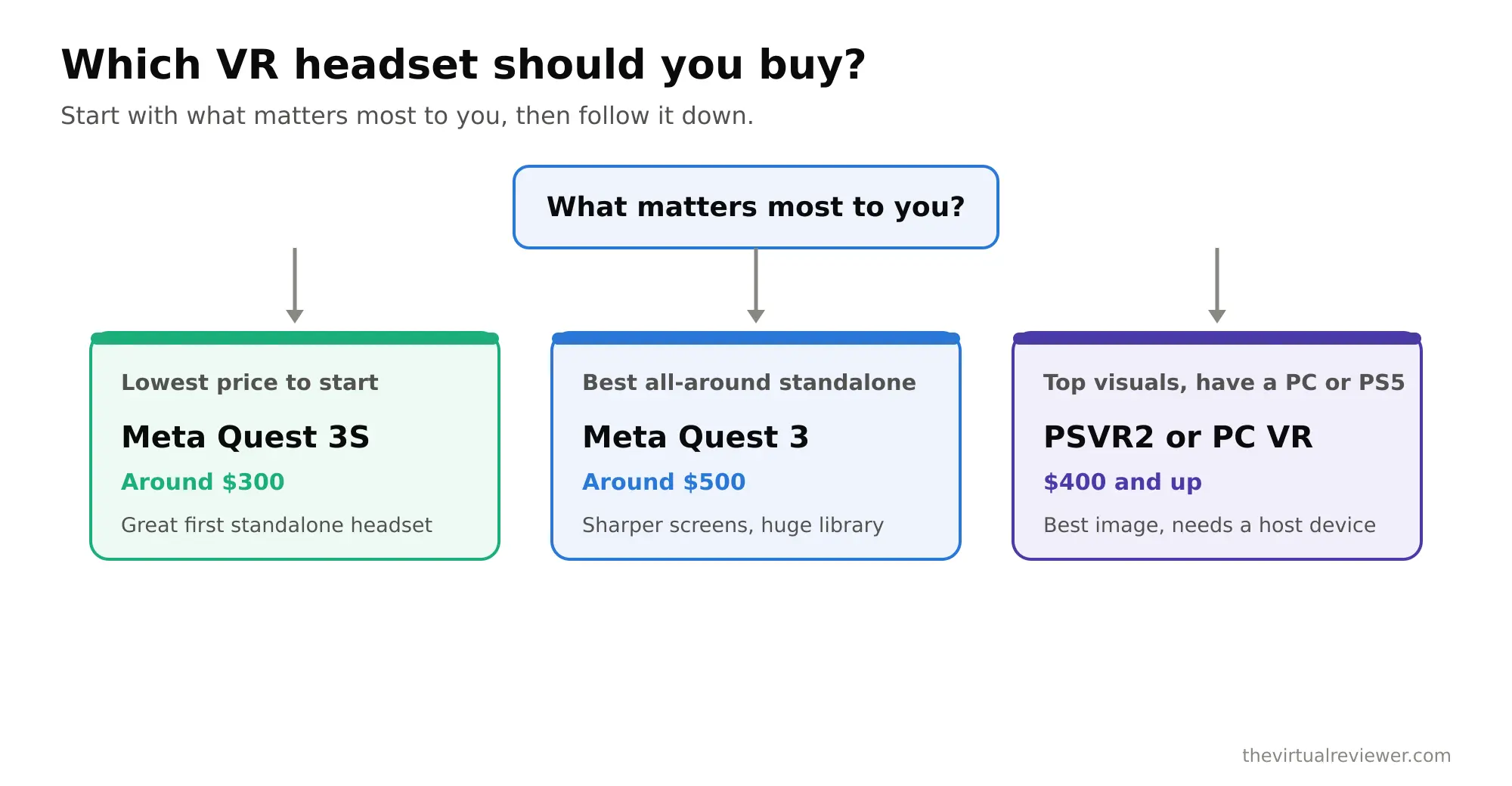
For fitness specifically, standalone and wireless beats everything. You do not want a cable tugging at the back of your head while you duck a jab or reach overhead. That rules out PC-tethered setups and makes the Meta Quest family the natural home for VR workouts.
Between the two current Quests, the Quest 3 is the pick if you can afford it. Its slim pancake lenses sit closer to your face, which lowers the front weight and cuts the neck-straining wobble you get when you are moving fast. During a punchy Supernatural or boxing session, that lighter, more balanced feel is the difference between finishing strong and stopping because your neck is done.
The Quest 3S at around $349 runs the exact same fitness apps perfectly. You give up a little: the older lens design makes it slightly bulkier and more front-heavy, so it wobbles a touch more during fast movement. For most people it is completely fine, and it is the best value entry into VR fitness. Confirm current pricing, since Meta bundles these often.
Comparison table
| Headset | Best for | Wireless? | Weight/fit for workouts | Price (verify) |
|---|---|---|---|---|
| Meta Quest 3 | Best overall fitness | Yes | Slim pancake lenses, less wobble | ~$499 |
| Meta Quest 3S | Budget fitness | Yes | Same apps, slightly bulkier front | ~$349 |
| PlayStation VR2 | PS5 owners, seated/stationary | No (tethered) | OLED, but cable limits movement | ~$399 |
The apps are where the workout lives
The headset gets you moving, but the app decides your workout. Here are the ones worth knowing in 2026, and a straight read on each.
Supernatural
Supernatural is the polished, instructor-led cardio app: coaches, real music, boxing and flow workouts in scenic locations. It runs about $18.99 a month. Two important things to flag for 2026. First, Meta announced in January that it was ending new content and feature updates for Supernatural, though the existing app and library stay available. Second, there is good news on top of that: the service is set to return under a new independent company as the original founders and coaches reunite, with the Meta-operated version staying live through late 2026. If you love it, it is not dead. But go in with eyes open and confirm the current subscription and ownership status before you commit a card.
FitXR
FitXR is the value pick at $12.99 a month, or about $9 a month billed annually. It offers boxing, HIIT, dance, and more in a class format, and it is actively updated. If you want a Supernatural-style instructor-led experience for less and without the uncertainty, this is the one I would try first in 2026.
Beat Saber
Beat Saber was never marketed as a fitness app, but on Expert and Expert+ it is one of the most demanding cardio workouts in VR. Players regularly report burning 400 to 600 calories an hour on high-difficulty tracks. It is a game first, which is exactly why people keep coming back to it. The fun hides the effort.
Les Mills Bodycombat
Les Mills Bodycombat brings the real gym brand’s coaching to Quest as a one-time purchase rather than a subscription, with paid DLC that adds workouts and mechanics. If subscriptions annoy you, a buy-once boxing-cardio app is a nice fit, and the coaching quality is high.
Thrill of the Fight
For pure intensity, Thrill of the Fight is real boxing simulation, not a rhythm game. Reports put it around 9 to 15 calories a minute, closer to actual boxing than most fitness classes. It is exhausting in the best way.
My advice: mix an instructor-led app (FitXR or Supernatural) with a rhythm game (Beat Saber or Synth Riders) so you do not burn out on one format. Variety is what keeps a VR fitness habit alive past week three.
The two accessories you actually need
This is where a lot of people quietly quit VR fitness, and it is completely avoidable. The default Quest face interface is foam. Foam plus sweat equals a soggy, gross headset and a ruined pad. Spend a little up front:
- A sweat-friendly face cover. A silicone or wipeable vented interface that you can clean after every session. This one accessory single-handedly makes VR fitness sustainable.
- A better head strap. The default soft strap lets the headset shift when you move hard. An aftermarket rigid strap (some with a battery in the back that also counterbalances the weight) keeps everything locked and stable during fast movement.
Neither is expensive, and together they turn VR from “fun sometimes” into something you will actually do three times a week.
How many calories does VR fitness really burn?
Real talk, because the numbers get hyped. High-intensity sessions in Supernatural or Les Mills tend to average somewhere around 300 to 500 calories an hour depending on effort. Beat Saber on the hardest difficulties can push 400 to 600. Thrill of the Fight, at 9 to 15 calories a minute, is the top of the range if you go hard. Those are real workouts, comparable to a solid cardio class. The catch, like any workout, is that the number depends entirely on how hard you push. VR makes pushing hard fun, which is the whole point.
So we loved VR at the arcade. Can home VR be my gym?
Here is the honest comparison, because I have done both. At a free-roam venue like Sandbox VR or the arena floor at Fixation VR, you are physically walking, running, and ducking across a real space, sometimes wearing a haptic vest. That is a full-body workout you cannot fully replicate standing in your living room, and it is a blast.
But for actual fitness as a habit, home VR wins on the thing that matters most: it is there every single day, for free after you buy it, with no booking and no drive. The arcade is the epic occasional session. Your Quest is the Tuesday-morning workout you will actually do. Use the arcade for the big group cardio adventure and browse our venue reviews at The Virtual Reviewer to find one near you. Use the home headset to build the routine.
FAQ
What is the best VR headset for fitness in 2026?
The Meta Quest 3. It is wireless, runs every major fitness app, and its slim lenses reduce front weight and wobble during fast movement. The Quest 3S at around $349 is the budget pick and runs the same apps, just slightly bulkier.
Is VR a real workout, or is that hype?
It is real. High-intensity VR sessions commonly burn 300 to 600 calories an hour depending on the app and your effort, comparable to a good cardio class. The key is difficulty and intensity, same as any workout.
Should I get Supernatural or FitXR?
FitXR is cheaper at $12.99 a month and actively updated, so it is the safer 2026 pick. Supernatural is more polished but Meta paused its updates in January 2026, though it is returning under an independent company. If you want certainty and value, start with FitXR.
Do I need special accessories for VR fitness?
Two are worth it: a sweat-friendly wipeable face cover so you are not soaking the stock foam, and a rigid aftermarket head strap so the headset stays put when you move hard. Both are inexpensive and both make the habit sustainable.
Can I use PSVR2 for fitness?
You can, but it is tethered to a PS5, and a cable is a real drawback when you are moving fast and turning. For fitness specifically, a wireless Quest is the better tool. PSVR2 is better for seated or stationary experiences.
The bottom line
The best VR headset for fitness in 2026 is the wireless Meta Quest 3, with the Quest 3S as the value pick that runs all the same workouts. Pair it with FitXR or Supernatural for coached cardio and a rhythm game like Beat Saber for the days you want to have fun and forget you are exercising. Buy the sweat cover and the better strap. Then let the arcade be your occasional epic session and let the Quest be the workout you actually do every week.