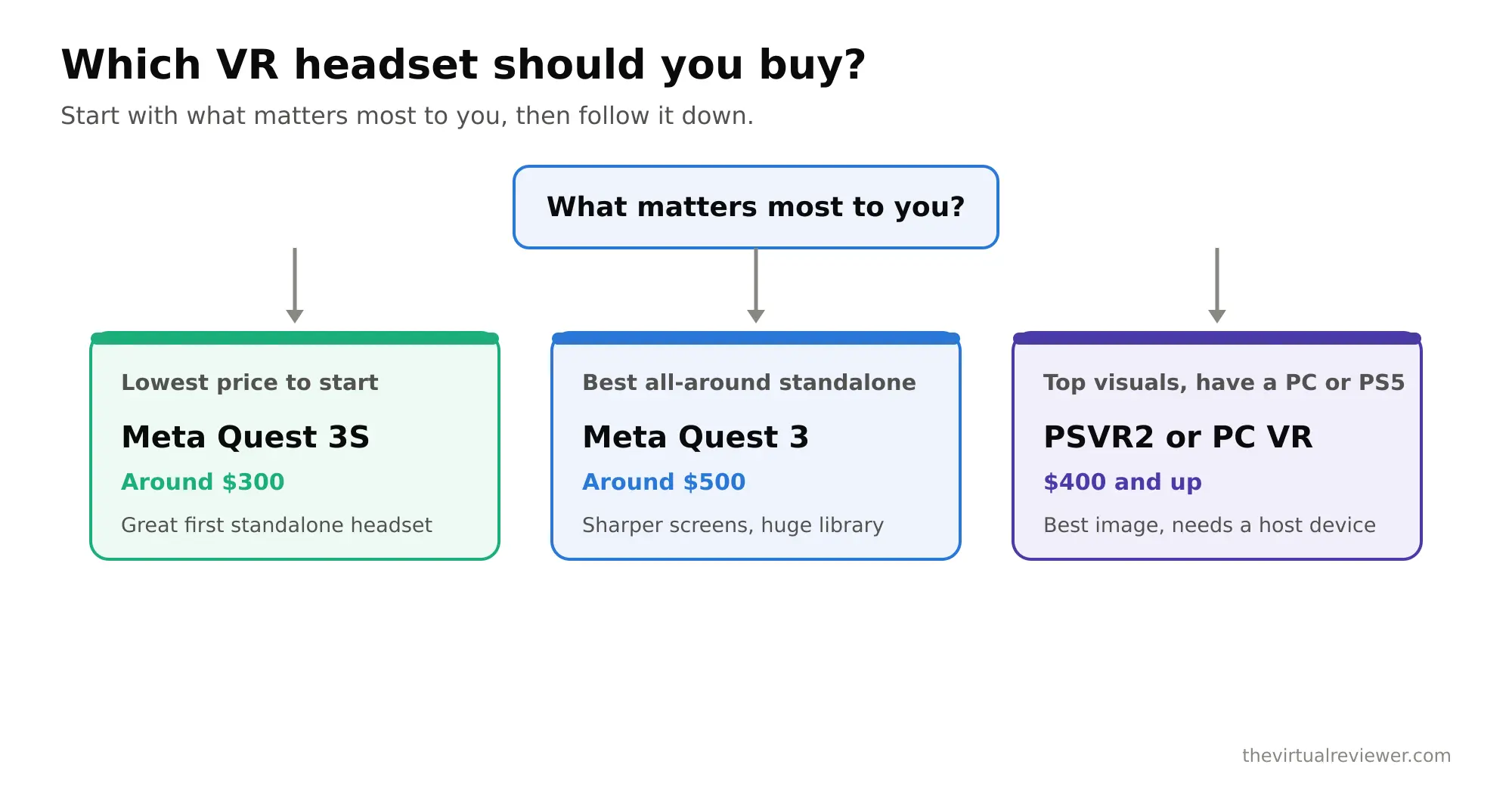
If you want the short answer, the best VR headset 2026 for most families is still the Meta Quest 3. It plays standalone with no wires, hooks up to a gaming PC when you want more muscle, and it has the biggest game library in VR. But “best” depends on what you already own and what you fell in love with. My family and I have played location based VR at more than 50 real venues, so when I test home gear I am always asking the same thing: does this get us anywhere near the free roam, full body feeling we get at a good arcade?
That arcade lens matters, and I will come back to it. First, here is how the current lineup shakes out in the middle of 2026.
The short list at a glance
| Headset | Price (2026) | Display | Resolution per eye | Best for |
|---|---|---|---|---|
| Meta Quest 3 | ~$599 (512GB) | LCD, pancake lenses | 2064 x 2208 | Best all around, standalone plus PC VR |
| Meta Quest 3S | ~$299 to $399 | LCD, Fresnel lenses | 1832 x 1920 | Cheapest solid entry into VR |
| PlayStation VR2 | ~$399 to $549 | OLED HDR | 2000 x 2040 | PS5 owners who want the best colors |
| Valve Steam Frame | Not final (est. ~$1,000) | LCD, standalone streaming | High res, per eye TBC | Big Steam libraries, PC VR fans |
| Samsung Galaxy XR | ~$1,799 | micro-OLED | Very high | Android XR, media, mixed reality |
| Apple Vision Pro | ~$3,499 | micro-OLED | 3660 x 3200 | Spatial computing and media, not games |
Prices moved this year. Meta raised Quest 3 and Quest 3S prices in April 2026, blaming a global memory chip shortage, so a Quest 3 that used to sit at $499 now runs closer to $599. Blake, double check the exact sticker on the day you publish because these numbers are still shifting.
Best overall: Meta Quest 3
The Quest 3 is the one I point most people toward. It runs on the Snapdragon XR2 Gen 2 chip, uses sharp pancake lenses for edge to edge clarity, and gives you color passthrough so you can see your living room and blend virtual objects into it. Standalone, it plays hundreds of native titles. Plug it into a VR ready PC over a USB-C cable or Air Link, and it opens up the full SteamVR library too.
That flexibility is why it keeps winning. You are not locked to one console or one store. For a family that wants one headset the kids and the grown ups can share, it is the safe pick.
The honest catch: it is a face computer with a battery, so sessions run around two hours before a charge, and the LCD panels, while crisp, do not have the inky blacks of OLED.
Best for PS5 owners: PlayStation VR2
If you already own a PS5, the PSVR2 is tempting. The dual OLED HDR panels are the best looking displays on this list under two grand. Deep blacks, punchy color, and real HDR make games like Gran Turismo 7 genuinely jaw dropping. It also adds eye tracking with foveated rendering, headset haptics that rumble against your face, and adaptive triggers in the controllers.
Here is my worry, and it is a real one for 2026. Sony has clearly cooled on PSVR2. Reports this year point to the platform winding down, major studios stepping back, and even Beat Saber ending support. The hardware is great. The road ahead for new games looks thin. There is an official PC adapter for about $60, but it disables eye tracking, HDR, and the haptics, so it is a compromise. Buy the PSVR2 for the library that exists today, not for a big future.
The wild card: Valve Steam Frame
The most exciting new headset of 2026 is Valve’s Steam Frame, the device long rumored as “Deckard.” Valve revealed it in late 2025 as a standalone headset that can also stream your entire Steam library wirelessly from a PC. On paper it looks like the best parts of a Quest 3 and a PSVR2 in one body.
The problem is timing and price. Valve pushed its final date and pricing because of the same memory shortage hitting everyone, and it now expects to land in the first half of 2026 at a price higher than first hoped, with estimates floating around $1,000. If you are a PC gamer with a deep Steam backlog, this is the one to watch. If you want something you can buy and hand to your kids this weekend, it is not that yet. Blake, confirm whether it has actually shipped by your publish date.
The premium and the spatial computers
Two headsets sit in a different tier. The Samsung Galaxy XR runs Android XR with micro-OLED panels and leans into media, productivity, and AI, around $1,799. The Apple Vision Pro, at roughly $3,499, is the best spatial computer for movies and work, but it is not really a gaming headset and there is no controller ecosystem built for action VR. Both are impressive. Neither is what I would hand a ten year old who wants to swing a lightsaber.
The arcade lens: what home gear still cannot do
Here is the part most gadget sites skip. No headset on this list, not even the $3,500 Vision Pro, gives you what a good location based venue does. When we strapped into the haptic vests and walked a real physical arena at Sandbox VR in Vegas, the ceiling was your play space and every hit landed on your chest. At a free roam arena like EVA Esports, you run, duck, and flank teammates across a real room with no wall in the way.
Home VR gives you a great seated or room scale experience. It does not give you a 30 by 30 foot arena or an operator grade haptic suit. So my honest guidance to families is this: buy a Quest 3 for the everyday fun, and keep the arcade for the big nights out. They are different tools. The headset in your closet handles Tuesday. The venue handles the birthday party.
How to pick
- You want one headset that does everything and works out of the box: Meta Quest 3.
- You want in cheap and do not pixel peep: Meta Quest 3S. See my full best budget VR headset breakdown.
- You already own a PS5 and want the best image today: PlayStation VR2. I go deep on that matchup in Meta Quest 3 vs PSVR2.
- You are a PC gamer with a big Steam library and patience: wait for the Steam Frame.
- You want media and spatial computing, money is no object: Samsung Galaxy XR or Apple Vision Pro.
FAQ
What is the best VR headset in 2026 overall?
For most people it is the Meta Quest 3. It plays standalone, connects to a PC for higher end games, and has the deepest library. The Quest 3S is the value pick, and the PSVR2 is the OLED pick for PS5 owners.
Do I need a gaming PC or a console for VR?
No. The Quest 3 and Quest 3S are fully standalone, so they run on their own with no PC and no console. A PC just unlocks extra higher fidelity games if you want them later. The PSVR2 does require a PS5.
Why did VR headset prices go up in 2026?
A global memory chip shortage pushed component costs up across the industry. Meta raised Quest 3 and Quest 3S prices in April 2026, and Valve delayed the Steam Frame’s price and date for the same reason. Prices may keep moving, so check the current sticker.
Is the PSVR2 still worth buying?
It is a beautiful headset with the best OLED displays here, but Sony has largely stepped back from it in 2026 and new game support is thin. Buy it for the library that already exists, especially if you own a PS5 and can find it on sale, not for a big future roadmap.
Can any home headset match a VR arcade?
Not really. Free roam venues give you a full physical arena and haptic vests that home gear cannot match. Home VR is fantastic for everyday play. For the full body, walk around experience, the arcade still wins. I treat them as two different things.
Bottom line
The best VR headset 2026 for most families is the Meta Quest 3, with the Quest 3S right behind it on value and the PSVR2 as the OLED option for PlayStation homes. Keep an eye on the Steam Frame if you are a PC gamer. And remember that even the best home rig is a companion to the arcade, not a replacement for it. Start at our homepage for more venue reviews and buying guides.