If you just walked out of a VR arcade with your heart still pounding and you are already Googling how to get that feeling at home, I have been exactly where you are. The best home VR setup after loving arcade VR starts with one honest truth: you are not going to fit a full free-roam arena in your living room, and that is fine. You can still build a home rig that keeps your family playing every single week for a fraction of what those arcade sessions cost over a year. I am Blake, a VR dad who has strapped into haptic vests at more than fifty real venues, and I want to help you spend your money in the right order.
Here is the short version. For most families, the Meta Quest 3S is the smart first purchase in 2026. If clarity matters to you and the budget allows, step up to the Quest 3. And if you have a gaming PC and want jaw-dropping visuals, that is where headsets like the Bigscreen Beyond 2 or a PC-connected PlayStation VR2 come in. Below I break down why, how the home experience actually compares to the arcade, and how to build the setup without wasting a dollar.
Home VR setup at a glance
| Setup | Price (2026) | Best for | Needs a PC or console | Arcade feeling it gets closest to |
|---|---|---|---|---|
| Meta Quest 3S (128GB) | $349.99 | First family headset, easy setup | No | Room-scale standalone play |
| Meta Quest 3 (512GB) | $599.99 | Sharper visuals, mixed reality | No | Cleaner image, bigger library |
| PlayStation VR2 + PC adapter | $399 headset plus adapter | PS5 owners, OLED color | Yes (PS5 or gaming PC) | Deep, cinematic single-player |
| Bigscreen Beyond 2 | $1,019 | PC VR enthusiasts, best clarity | Yes (gaming PC) | The crispest, lightest high-end feel |
| Steam Frame | Not final, summer 2026 window | SteamOS fans, wireless PC streaming | Standalone plus PC streaming | To be confirmed at launch |
Prices reflect Meta’s April 19, 2026 pricing update, when memory chip shortages pushed the Quest 3 up by $100 and the Quest 3S up by $50. Always double check the live price before you buy.
Why the arcade felt so much bigger than home ever will
Let me set expectations honestly, because that is the whole point of this blog. When my family played at Sandbox VR, we were wearing full-body haptic vests, wrist and ankle trackers, and headsets fed by Hollywood-style motion capture cameras mounted around a real physical room. We walked freely, felt every explosion thump us in the chest, and even caught air from fans triggered by the game. You can read what that was actually like in my Sandbox VR experience in Vegas. Places like EVA Esports run big free-roam arenas where you and a squad physically roam a warehouse-sized space together.
No home headset does that. Full stop. You do not get the haptic vest, you do not get the giant tracked arena, and you do not get an operator handing you a rifle prop. So if your goal is to recreate that specific free-roam, full-body arcade night, the honest answer is that home VR is a different thing, and I cover that gap in more detail in my piece on whether home VR headsets replace a VR arcade trip.
What home VR gives you instead is volume and freedom. It is always there, it costs nothing per session after you buy it, and the game library is enormous. That trade is worth making, and here is how to make it well.
Start here: the Meta Quest 3S
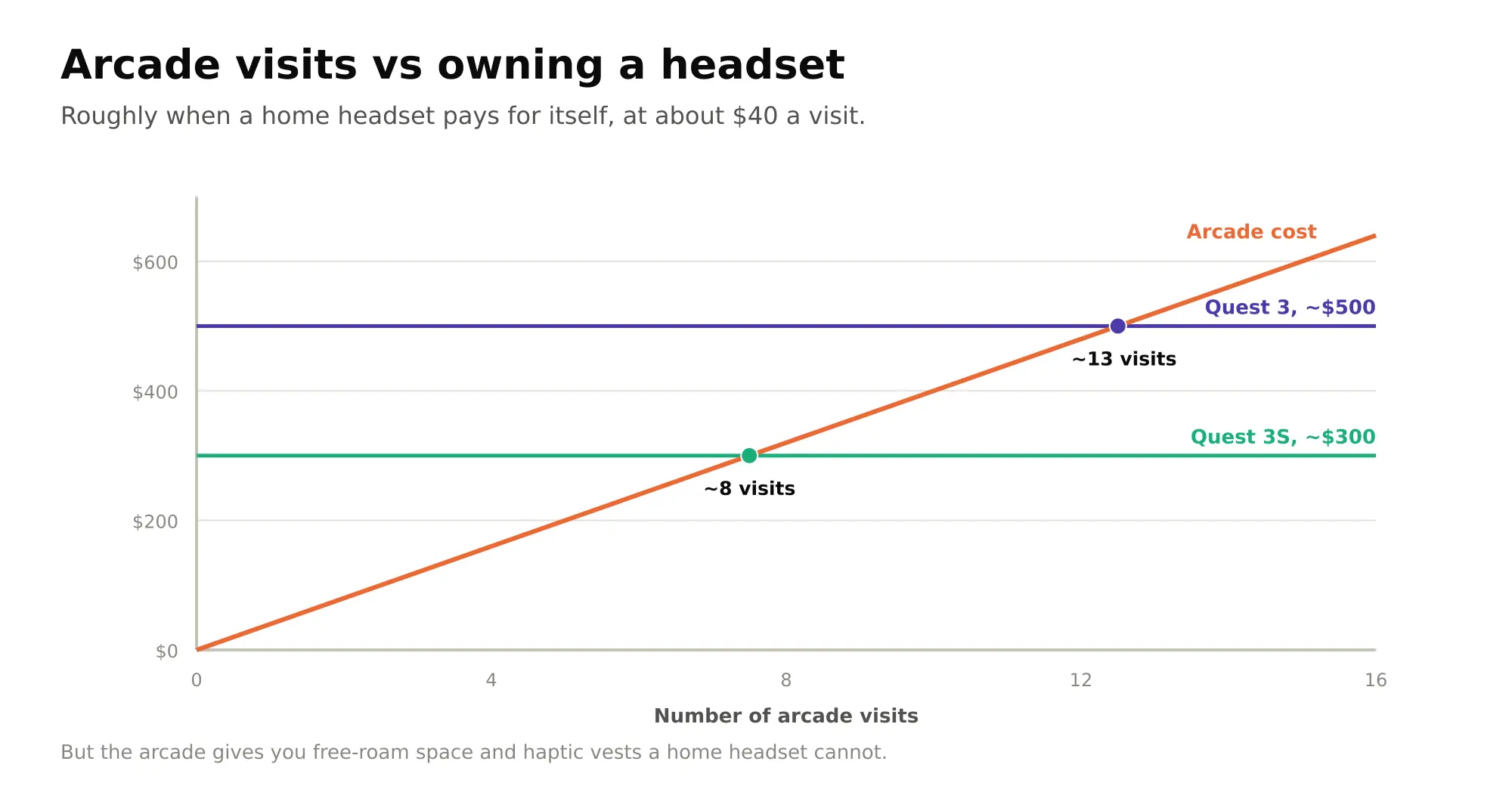
For nearly every family coming off an arcade high, the Meta Quest 3S is where I point them first. At $349.99 for the 128GB model it is the cheapest way into modern VR, and it does not cut the corners that matter. It runs the exact same Snapdragon XR2 Gen 2 chip and 8GB of RAM as the pricier Quest 3, which means every game and app that runs on the Quest 3 runs just as well here, with no restrictions. That surprised me when I first read it, and reviewers across 2026 keep confirming it.
The compromise is the lenses. The 3S uses older Fresnel lenses, so the image is sharp in the center and gets a little soft toward the edges. In practice, my kids never once complained about it. For a family that wants to swing lightsabers, box, and play social games, the 3S delivers the standalone room-scale play that feels the most like the arcade, no wires and no PC required.
Plan a clear play space. You want roughly a two by two meter open area, rugs pushed back, ceiling fans off, and pets shooed out. That open floor is the closest thing you get to the arcade’s free-roam room, so make it count.
Step up: the Meta Quest 3
If you found yourself annoyed by any blur at the arcade, or you just want the best all-around standalone headset, the Meta Quest 3 at $599.99 is the one. It swaps in pancake lenses for a crisp image edge to edge, bumps resolution to 2,064 by 2,208 pixels per eye, and adds a depth sensor for genuinely good mixed reality. Reviewers in 2026 still call it the best all-around VR headset on the market, and it has the largest content library of any VR platform.
The Quest 3 is also the family rig that grows with you. It plays standalone out of the box, but plug it into a gaming PC or stream wirelessly and you get access to the big SteamVR catalog too. If you think anyone in the house will chase higher-end games later, the Quest 3 is the safer long-term buy.
Going all in: PC VR for the visual chasers
Some of you came out of the arcade wanting maximum fidelity, and that road runs through a gaming PC. Two paths stand out in 2026.
The budget-friendly one is a PlayStation VR2. Sony dropped it to $399, and with the official PC adapter it becomes a SteamVR headset with gorgeous OLED panels and true blacks, the cheapest route to OLED PC VR. Just know that on PC it loses the eye tracking, HDR, and haptics that make it special on a PS5, so if you own a PS5, use it there first.
The enthusiast pick is the Bigscreen Beyond 2. At $1,019 it weighs just 107 grams, uses 2,560 by 2,560 micro-OLED panels per eye, and includes eye tracking. It is a custom-fit, PC-only headset for people who want the sharpest, lightest experience money can reasonably buy. This is not a first headset. It is the upgrade you earn into after you know you love VR.
Keep an eye on the Steam Frame too. Valve announced it in November 2025 as a standalone, streaming-first SteamOS headset, with a summer 2026 release window. Pricing is not final yet, so I would not plan a budget around it, but it could reshape the middle of the market when it lands.
How to build the setup without wasting money
Here is the order I would spend in.
First, buy the headset that matches your budget honestly, not aspirationally. A Quest 3S you use every week beats a PC rig that intimidates half the family.
Second, budget for two comfort upgrades: a better head strap and a bigger battery. The stock strap and roughly two and a half hours of battery are fine for short sessions, but a strap with a rear battery makes longer play far more comfortable, and it is the single upgrade my family noticed most.
Third, wait on everything else. Full-body trackers, treadmills, and haptic vests exist for home use, but they are pricey, finicky, and still do not match the operator-tuned gear at a venue. If you crave the full haptic free-roam feeling, it is genuinely cheaper and better to just book another arcade trip a few times a year and keep the home rig simple.
FAQ
Can I get the free-roam arcade feeling at home?
Not the full version. Home VR gives you room-scale play in a small cleared space, but you will not get the haptic vest, the warehouse-sized tracked arena, or the physical props. For that, keep visiting venues like Sandbox VR or EVA Esports and use home VR for everyday play.
Is the Quest 3S good enough, or should I spend more?
For most families the Quest 3S at $349.99 is plenty. It runs the same games as the Quest 3 with no restrictions. Spend up to the Quest 3 only if edge-to-edge sharpness and mixed reality matter to you.
Do I need a gaming PC for home VR?
No. The Quest 3S and Quest 3 both work fully standalone. A PC only becomes worthwhile if you want the highest-fidelity SteamVR games, which is where the PSVR2-plus-adapter or Bigscreen Beyond 2 come in.
How much space do I really need?
A cleared area of about two by two meters covers most games. Push back furniture, kill ceiling fans, and set a guardian boundary. More space is nicer but not required.
What about the price increases in 2026?
Meta raised prices on April 19, 2026 because of a global memory chip shortage. The Quest 3 went up $100 and the Quest 3S went up $50. Prices can shift again, so verify the current number before buying.
The setup I would build
If I were starting fresh today for a family of four, I would buy a Meta Quest 3S, add a battery head strap, clear a corner of the living room, and keep an arcade night on the calendar a few times a year for the full haptic free-roam hit. That combination gives you daily VR at home plus the occasional big arcade blowout, and it is the most fun per dollar you can get in 2026. Start small, play often, and upgrade only when the whole family is asking for it.