The Ray-Ban Meta Gen 2 is a pair of camera-and-audio smart glasses that starts at $379 and, importantly, has no screen inside the lenses. If you came here expecting a tiny display floating in front of your eye, that is a different (and pricier) product. These are the ones you wear to look normal, snap a hands-free photo of your kids, take a call, and ask Meta AI a quick question. I have played location-based VR at more than 50 real venues, so I want to set expectations early: this is not a headset, and it will not drop you into a game. It is a really good everyday accessory that happens to be smart.
I have been following Meta’s glasses line closely since the first pair landed, and the Gen 2 refresh, announced at Meta Connect 2025 and available since September 17, 2025, is the version I would actually tell a friend to buy. Let me walk you through why, what is new, and who should skip it.
Ray-Ban Meta Gen 2 specs at a glance
Here is the quick reference table I wish every review led with.
| Spec | Ray-Ban Meta Gen 2 |
|---|---|
| Starting price | $379 (£379, €419) |
| Released | September 17, 2025 |
| Display in lens | None (audio, camera, and AI only) |
| Camera | 3K max photo/video, up to 1200p at 60FPS |
| Battery (glasses) | Up to 8 hours typical use |
| Charging case | About 48 extra hours |
| Weight | About 52g |
| Styles | Wayfarer, Headliner, Skyler |
| Water resistance | IPX4 (splash resistant) |
| Assistant | Meta AI, hands-free voice |
Confirm the exact figures against Meta’s spec page before you rely on them, because color and lens variants shift the numbers slightly.
What actually changed from Gen 1
Two upgrades carry this generation, and they are the two that matter most in real use.
First, the camera. Gen 1 topped out at 1080p video. Gen 2 jumps to a 3K sensor and adds a 1200p 60FPS mode. In plain dad terms, that means the clip of your kid’s first bike ride looks noticeably crisper and holds up better when you crop or share it. Sixty frames per second also smooths out fast motion, which is exactly when the older glasses looked their worst.
Second, battery life. Gen 1 realistically gave you around four hours, and heavy shooters drained it faster. Gen 2 is rated up to eight hours of typical use, roughly double, and the charging case holds about 48 more hours before it needs a wall outlet. This is the single change that moves the glasses from “fun for an afternoon” to “wear them all day at the theme park.” Battery anxiety was my biggest gripe with the first pair, so this is the fix I cared about.
The frame got a hair heavier, about 52 grams versus roughly 48 on Gen 1, which I honestly never noticed on my face. You still get the classic Wayfarer look plus the Headliner and Skyler shapes, so they read as normal sunglasses, not gadgets.
Living with them: the good parts
The best thing about these glasses is that they disappear. Nobody at the playground clocks them as tech. You press the capture button on the temple and you have a photo or short video from your own point of view, no phone raised, no moment interrupted. As a parent, that first-person angle is the whole pitch. My hands are usually full, and the camera being on my face instead of in my pocket means I actually catch the stuff I would have missed.
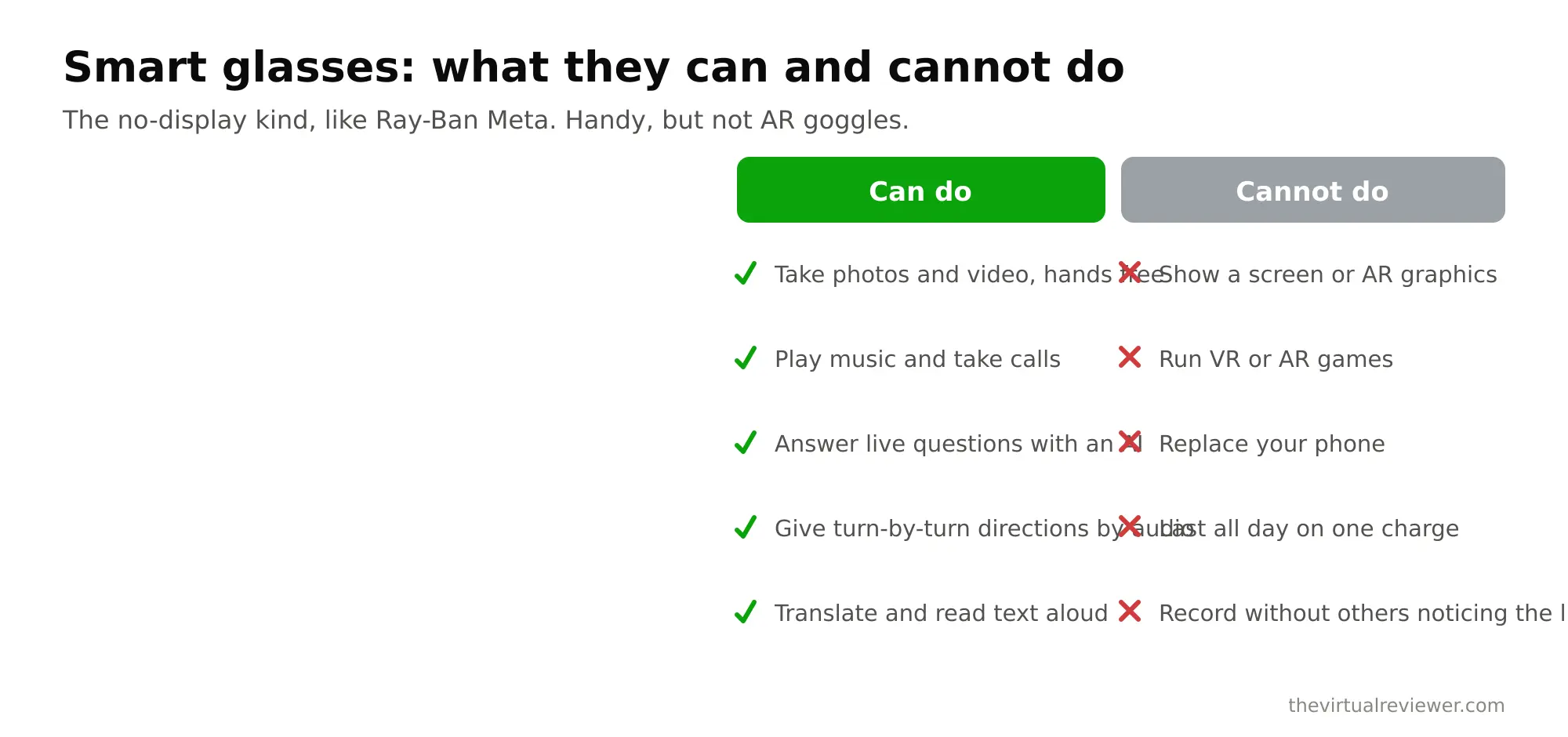
The open-ear speakers are good enough for podcasts on a walk and phone calls in the driveway. They leak a little sound at high volume, so they are not for a quiet office, but for outdoors they work. Meta AI handles the simple “hey, what is this building” or “translate that sign” tasks, and the live translation feature is genuinely handy on a trip. Just know that AI answers come through audio, since there is no display to show you anything.
The honest limits
Here is where I keep people grounded. There is no screen, so you cannot read a text, see a map, or watch a video on these. Everything visual still happens on your phone. If you want a heads-up display, Meta sells a separate, more expensive pair with an in-lens screen, and that is a different buying decision.
Battery, while much improved, is still finite, and shooting a lot of high-resolution video eats it faster than the eight-hour rating suggests. The IPX4 rating means splash and sweat resistant, not swim-proof, so do not take them in the pool. And privacy is a real thing to think about. There is a capture light, but you still owe the people around you basic courtesy about when you are filming.
The VR arcade lens: should you buy these after a great VR day?
This is the question I get most from families who just had a blast at a venue. You strapped into a haptic vest at Sandbox VR, ran around a free-roam arena, and now you are wondering if smart glasses bring any of that magic home. I want to be straight with you: they do not, and that is fine, because they are solving a completely different problem.
Location-based VR is about full immersion, being dropped inside another world with your whole body tracked. The Ray-Ban Meta Gen 2 is the opposite. It keeps you fully in the real world and just adds a camera, speakers, and a voice assistant. If your family loved the free-roam experience at a place like Fixation VR, the device that scratches that itch at home is a VR headset, not these glasses. What the glasses are great for is documenting the trip. Wearing them into the arcade lets you film your kid’s reaction from your eyeline while you both play, which a headset obviously cannot do because it is covering your face. I think of the two as teammates, not rivals. For more of how home gear stacks up against arcade rigs, our homepage hub has the full library.
Who the Ray-Ban Meta Gen 2 is for
Buy them if you are a parent or traveler who wants easy hands-free photos and video, likes the idea of podcasts and calls without earbuds, and wants to look like you are wearing regular Ray-Bans. The 3K camera and all-day battery make this the first version I would call genuinely easy to recommend at $379.
Skip them if you specifically want a display in your vision, if you need swim-proof durability, or if you were hoping for a VR-style experience. Those are jobs for other devices.
Verdict
The Ray-Ban Meta Gen 2 is the version that fixed the two problems holding the line back. A sharper 3K camera and roughly double the battery turn a fun novelty into something I would actually wear every day. At $379 it is not cheap, but it is priced like nice sunglasses that also happen to be a capable point-of-view camera and a decent audio setup. Just walk in knowing what it is not: no screen, no VR, no swimming. Judge it as the best everyday smart glasses for hands-free capture, and it earns the money.
FAQ
Does the Ray-Ban Meta Gen 2 have a display in the lens?
No. This is a no-display pair. Meta AI responses, notifications, and camera feedback all come through audio or your phone. If you want an in-lens screen, Meta’s separate display model is the one to look at.
How much better is the Gen 2 camera than Gen 1?
Meaningfully. Gen 1 maxed out at 1080p video, while Gen 2 shoots up to 3K and adds a 1200p 60FPS mode. Fast motion and cropped clips look clearly cleaner.
What is the battery life on the Ray-Ban Meta Gen 2?
Up to about eight hours of typical use per charge, with the case holding roughly 48 additional hours. Heavy video recording will drain it faster than the rated figure.
Can I wear these in the rain or pool?
They carry an IPX4 rating, which covers splashes and sweat. Do not submerge them or wear them swimming.
Should I buy these instead of a VR headset after a fun arcade trip?
They are not a substitute. A headset gives you the immersive, full-body experience you got at the arcade. These glasses are for capturing and narrating real life. Many families end up wanting both for different reasons.