The best VR headset for beginners in 2026 is the Meta Quest 3S. It’s the easiest to set up, It’s standalone so you need no PC or console, it plays the biggest game library in VR, and It’s the most affordable way into the hobby at $349.99 new. If clarity and comfort matter more than price to you, the step-up Meta Quest 3 at $599.99 is the better long-term buy with sharper lenses. And if you already own a PlayStation 5, the PSVR2 at around $399 is a gorgeous option. But for most first-timers, most families, and most budgets, the Quest 3S is the one I hand people first.
I’m a VR dad who has played at more than fifty real venues with my wife Patty and our kids John and Jenette, and I have watched a lot of nervous first-timers put on a headset for the first time. The truth is the “best beginner headset” is the one that gets set up in ten minutes and does not overwhelm anyone. Let me break down the real choices.
Beginner VR headsets compared
| Headset | Price (2026) | Standalone? | Lenses | Best for beginners who… |
|---|---|---|---|---|
| Meta Quest 3S | $349.99 | Yes | Fresnel | Want the easiest, cheapest start |
| Meta Quest 3 | $599.99 | Yes | Pancake | Want the sharpest picture long term |
| PlayStation VR2 | ~$399 | No (needs PS5) | Fresnel, OLED | Already own a PlayStation 5 |
Prices from Meta and 2026 retailer listings, updated after the April 2026 price increase. Blake, confirm live pricing before publishing.
Why standalone matters so much for beginners
If you take one thing from this guide, take this: for a beginner, standalone is everything. A standalone headset like the Meta Quest 3S or Quest 3 has the computer built right into it. You charge it, put it on, and you are in VR. There are no cables to a PC, no base stations to mount in the corners of a room, no console to boot up, and no confusing setup wizard that scares people off before they ever play.
That’s exactly why I steer beginners toward the Quest line over PC VR. PC headsets can look stunning, but they demand a powerful gaming computer, wires, and patience. That’s a hobbyist’s setup, not a first headset. The PSVR2 splits the difference: It’s easier than PC VR, but it still needs a PlayStation 5 plugged in, so it only makes sense if you already own one.
Meta Quest 3S: the beginner pick
The Quest 3S is my default recommendation for a reason. At $349.99 It’s the cheapest new way into real VR, and “real” is the key word. It runs the same Snapdragon XR2 Gen 2 chip as the pricier Quest 3, has the same 8GB of RAM, uses the same Touch Plus controllers, and plays the exact same enormous library of games. A beginner on a Quest 3S is not playing a watered-down version of VR. They are on the full Meta Quest platform.
It also does full-color mixed reality passthrough, which is a genuinely great feature for nervous first-timers. You can see your real room in color while you play, so stepping into VR feels less like being blindfolded and more like adding a layer to the room you already know. For kids especially, that eases the “where am I” jitters.
The trade-offs are the ones you would expect from the cheaper model. The 3S uses Fresnel lenses, so the picture is sharp in the middle and softer at the edges, and it offers only three fixed IPD settings (58, 63, and 68mm) for matching the distance between your eyes. If your eyes land between those presets, the image will not be perfectly crisp. For casual first sessions, most people never notice. For heavy readers and long movie nights, it adds up.
Meta Quest 3: the buy-once upgrade
If you can stretch the budget, the Quest 3 at $599.99 is the headset I would call the best all-around VR device on the market. The single biggest upgrade over the 3S is the lenses. The Quest 3 uses pancake lenses that stay sharp edge to edge, with a larger clear viewing area and a more forgiving sweet spot, so a slight shift on your face does not blur the image. It also has a smooth adjustable IPD dial instead of three fixed presets, which matters a lot if you wear glasses or share the headset across a family with different faces.
Everything else is shared: same chip, same controllers, same library, same passthrough. So the question is simple. Are you paying $250 more for a better window into the same world? Reviewers in 2026 keep landing on the same verdict, that there is no wrong choice here, only a budget-versus-clarity trade-off. If you spend a lot of time reading text, watching content, or in longer sessions, the Quest 3 is the more comfortable buy. If you mostly want to jump into games and keep the cost down, the 3S is plenty.
PSVR2: only if you own a PS5
The PlayStation VR2 deserves a mention because its OLED displays produce some of the best contrast and color in consumer VR, and Sony has cut the price to around $399 from its higher launch price. But It’s not a standalone headset. It plugs into a PlayStation 5 and runs PS5 games, so It’s only a smart beginner pick if you already have that console sitting under your TV. For a from-scratch beginner with no console, the added cost and the tether make the Quest line the easier road.
How to pick your first VR headset
Here’s my simple decision path.
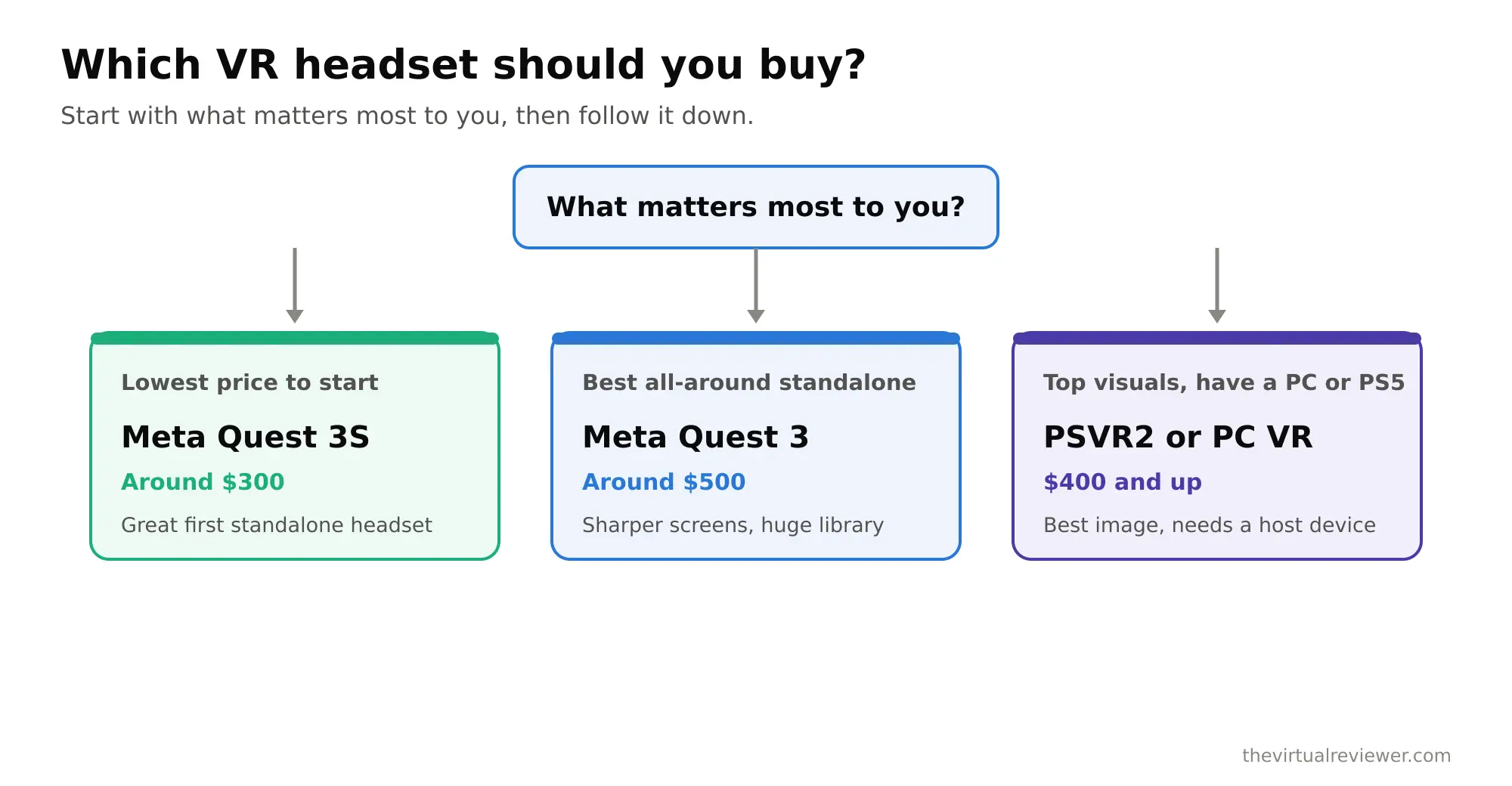
- You want the easiest, cheapest real VR: Meta Quest 3S. My top pick for most beginners and families.
- You want the sharpest picture and plan to keep it for years: Meta Quest 3. Worth the extra $250 for the pancake lenses and adjustable IPD.
- You already own a PlayStation 5: PSVR2. Beautiful OLED visuals if you are fine staying tethered to the console.
- You are on a hard budget under $300: look at a certified refurbished Quest 3S, which has sold for as little as ~$216.
A comfort tip from experience: whichever you pick, start new players with seated or standing experiences before free-roam games, keep the first sessions short, and use that mixed reality passthrough so nobody feels lost. VR legs take a session or two to find.
The arcade-to-home reality
A lot of beginners come to VR the same way my family did, by trying it at a venue first. If you loved the full-body, walk-around thrill of a free-roam floor at Sandbox VR or a haptic arena like EVA Esports, I want to set an honest expectation. A home headset will not recreate that. The vests that punch back, the room-scale space, and the operator-grade rigs are things no living room matches.
What a Quest does give you is the same core magic on tap, any night you want it, for the price of a couple of family arcade sessions. My honest advice: buy a beginner headset for everyday play, and keep the venues for the big group outings. They complement each other. For planning a trip, our homepage collects our venue and city guides.
FAQ
What is the best VR headset for a total beginner?
The Meta Quest 3S. It’s standalone, so no PC or console is needed, It’s the cheapest new headset at $349.99, and it runs the full Meta Quest library. It’s the easiest, lowest-risk way for a first-timer to try real VR.
Should a beginner buy the Quest 3S or the Quest 3?
Buy the 3S if budget matters most or you mostly want to game. Buy the Quest 3 if you want the sharpest picture from its pancake lenses, an adjustable IPD dial, and a headset you will keep for years. Both run the same chip and the same games.
Is VR hard to set up for a first-timer?
Not with a standalone Quest. You charge it, create an account, and follow a short in-headset guide to draw your play space. Most people are playing within fifteen minutes, no cables or extra hardware needed.
Is the Quest 3S good for kids?
It works well for families, with the caveat that Meta sets an age recommendation and you should supervise and use parental controls. The color passthrough helps kids feel grounded, and short seated sessions to start help avoid motion discomfort.
Do I need a powerful PC or a PlayStation for a beginner headset?
No, not for a Meta Quest 3S or Quest 3. They are fully standalone. Only the PSVR2 requires other hardware, specifically a PlayStation 5.
The bottom line
For 2026, the best VR headset for beginners is the Meta Quest 3S. It’s standalone, affordable at $349.99, and runs the full VR library on the same chip as the pricier model, so first-timers get the real thing without the real cost. Step up to the Quest 3 at $599.99 for sharper pancake lenses if comfort and clarity are worth $250 to you, or grab a PSVR2 if you already own a PS5. Start simple, start seated, and let VR do the rest.