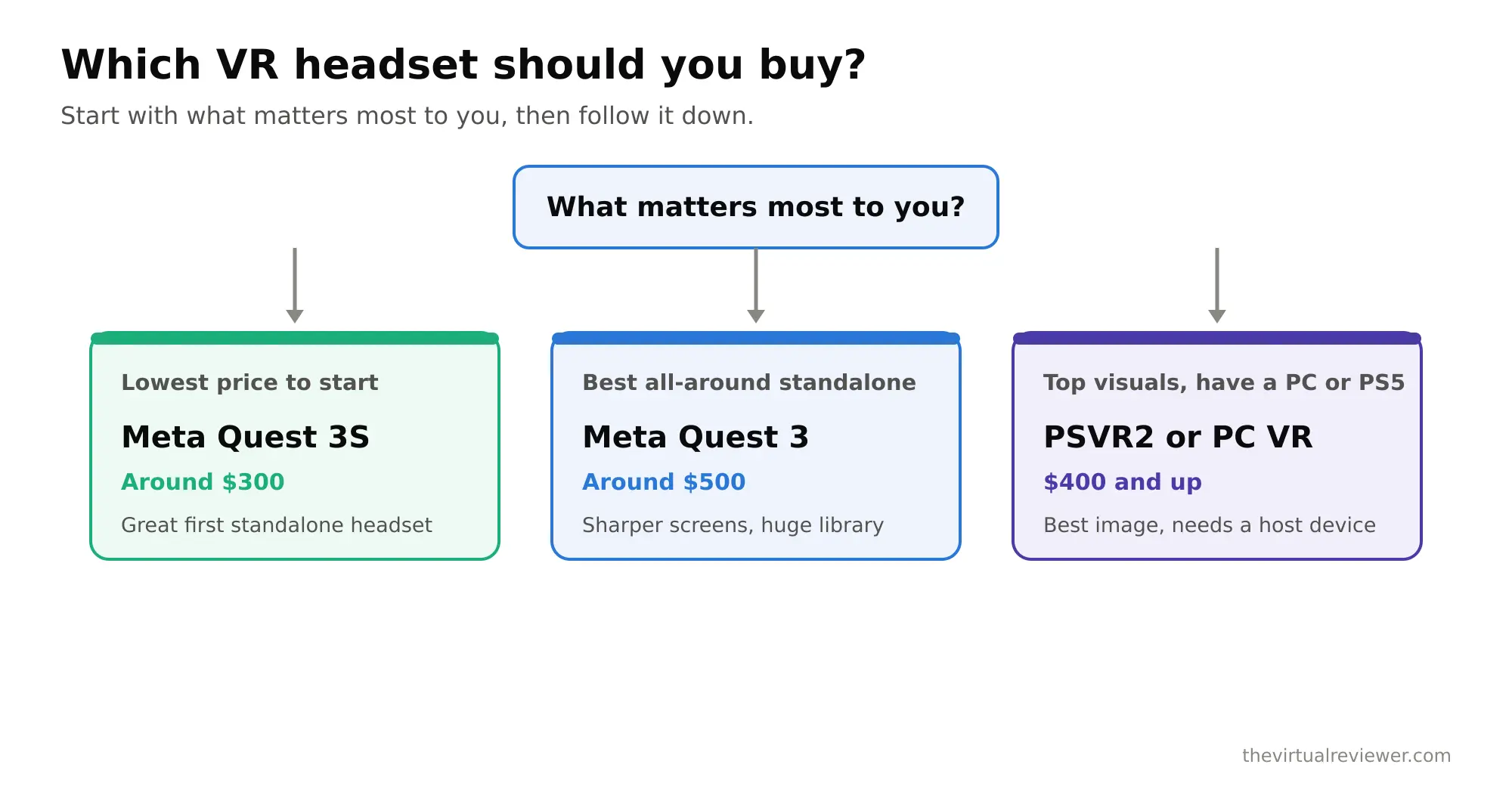
Short version first, because I know you are busy: the best VR headset for kids in 2026 is the Meta Quest 3S. It is standalone, it is the most affordable good headset you can buy, and it has real parental controls with app approval and screen-time limits built in. If you have a younger child or the budget for a nicer fit, the step-up Quest 3 is worth a look for one specific reason I will explain. And if you already own a PS5 and your kid is older, PSVR2 has a case too.
I am writing this as a dad, not a spec sheet. My kids John and Jenette have grown up around VR, and I have taken them to real arcades all over the country. Home VR and arcade VR are different animals, and I will get into that, but the questions parents actually ask me are always the same three: what age, is it safe, and which one do I buy. Let me answer those.
What age is VR okay for kids?
This is the part I want you to read before the shopping part.
Meta sets a minimum age of 10 for Quest, and it requires a parent-managed account for kids ages 10 to 12. That is Meta’s own rule, and it exists partly for legal and account reasons and partly for eye and fit reasons. Beyond Meta, most headset makers and a lot of pediatric guidance land around 12 to 13 and up, because young eyes are still developing and the headsets are physically sized for adult faces.
Here is my honest read. Ten is the floor, not the target. A mature 10 or 11 year old, supervised, on parent-approved apps, in short sessions, is fine. A 7 year old asking for a headset is a harder no from me, and the fit problems alone (the headset literally does not sit right on a small face) usually make it a bad experience anyway. Take them to a venue instead, where staff size the gear and sessions are short.
For reference, PSVR2 is rated 12 and up, and Apple Vision Pro is 13 and up. There is no mainstream headset built and rated for little kids, so anyone marketing one to your 6 year old is selling, not advising.
Comparison table
| Headset | Best for | Age guidance | Standalone? | Price (verify) | Why it makes the list |
|---|---|---|---|---|---|
| Meta Quest 3S | Most families | 10+ (parent-managed 10 to 12) | Yes | ~$299 to $349 | Cheapest good standalone, full parental controls |
| Meta Quest 3 | Best fit for younger/varied faces | 10+ (parent-managed 10 to 12) | Yes | ~$499 | Continuous IPD adjustment, sharper lenses |
| PlayStation VR2 | PS5 homes, older kids | 12+ | No (needs PS5) | ~$399 | Supervised living-room play, OLED, PS account controls |
Prices in VR shift with sales and bundles, so confirm the current number before you check out. I flag specifics in the Sources section.
Meta Quest 3S: the one I point most families to
The Quest 3S is the easy recommendation. It is a standalone headset, meaning no PC and no console. You charge it, put it on, and play. It runs the exact same enormous library as the pricier Quest 3, and it uses the same Meta parental controls: you can approve which apps your kid downloads, set daily screen-time limits, and block content by age rating from the parent side through Meta’s Family Center.
At roughly $299 to $349 depending on storage and sales, it is the least expensive way into good, current VR. For a first family headset that a 10 to 12 year old will share with siblings and parents, this is where I would start. Verify today’s price, because Meta runs bundles often.
The one compromise versus the Quest 3 is the lenses. The 3S uses an older lens design, so it is a touch bulkier up front and the image is not quite as crisp. For most kids playing active games, they will never notice.
Meta Quest 3: worth the jump for one reason
The Quest 3 costs more, around $499, and if money is tight the 3S is genuinely fine. But there is one feature that matters specifically for kids, and it is easy to miss on a spec sheet: continuous IPD adjustment.
IPD is the distance between your eyes, and it is different on a child’s face than an adult’s. The Quest 3 lets you slide the lenses smoothly to match, so it fits a wider range of faces, including smaller ones. The Quest 3S only offers a few fixed lens positions. For a shared family headset where a 10 year old and a grown-up both wear it, that continuous adjustment means the child is more likely to get a sharp, comfortable, correctly aligned image, which also cuts down on eye strain. Add sharper pancake lenses and better passthrough on top, and the Quest 3 is the better family headset if you can swing it.
PSVR2: for PS5 homes with older kids
If you already own a PS5 and your child is at least 12, PSVR2 is a reasonable pick. It plays tethered to the console in the living room, which I actually like for families: the cable keeps play in a shared, supervised space instead of behind a closed bedroom door. PlayStation account-level parental controls apply, so you manage it the same way you already manage their console.
The tradeoffs are real, though. It is not standalone, so it lives wherever the PS5 lives. The age recommendation is 12 and up, higher than Quest. And the library, while gorgeous with its OLED screen and eye tracking, is smaller than Quest’s. This is an older-kid, PlayStation-household option, not a first headset for a younger child.
Keeping kids safe in VR: my actual house rules
Hardware is only half of it. Here is how we handle it at home.
- Set the lens spacing correctly every time. A misaligned headset causes eye strain and headaches. If a younger kid is using it, adjust the IPD for them, do not leave it on the last adult’s setting.
- Keep sessions short. Twenty to thirty minutes, then a break. Active games sneak up on kids because they are having fun and sweating without noticing.
- Clear the play space. Kids swing their arms. Move the coffee table.
- Use the parental controls from day one. App approval, screen-time limits, and content blocking are all in Meta’s Family Center. Set them up before you hand the headset over, not after.
- Supervise, especially the social stuff. The games are usually fine. Open voice chat with strangers is where I pay attention. Lock that down for younger kids.
So we loved VR at the arcade. Should we buy one for the kids?
This is the real question, and it is the one I get most. Families come home from a birthday party at an arcade and the kids will not stop talking about it, so mom and dad wonder if a home headset recreates that.
Honest answer: partly. What the kids loved at a place like Sandbox VR or the free-roam floor at EVA Esports was full-body, walk-around, haptic-vest immersion with a whole crew, and no home headset does that. A Quest is seated or stand-in-place play in your living room. It is fantastic, my kids love ours, but it is a different experience.
So I tell parents: buy the headset for the everyday fun, the exercise games, the creativity apps, the “rainy Saturday” factor. Keep the arcade for the big group blowout that home gear cannot match. They are complements, not substitutes, and you can browse our full run of venue reviews over at The Virtual Reviewer to plan those arcade nights.
FAQ
What is the best VR headset for kids in 2026?
The Meta Quest 3S. It is standalone, the most affordable current headset, and has full parental controls. Step up to the Quest 3 if you want a better fit for a younger child, or consider PSVR2 if you own a PS5 and your kid is 12 or older.
What age can a kid start using VR?
Meta’s minimum for Quest is 10, with a parent-managed account required for ages 10 to 12. PSVR2 is rated 12 and up. Most guidance suggests waiting until at least 10 to 12 because of eye development and headset fit. Younger than that, I would stick to short, staff-supervised arcade sessions.
Are the parental controls actually good?
Yes. Through Meta’s Family Center you can approve apps, set daily screen-time limits, and block content by age rating from your own phone. Set them all up before your kid’s first session.
Quest 3S or Quest 3 for a child?
The 3S is cheaper and runs the same games. The Quest 3 adds continuous IPD adjustment, which fits a wider range of faces including smaller ones, plus sharper lenses. For a shared family headset with a younger kid, the Quest 3 fit advantage is worth the extra money if you can afford it.
Is VR safe for kids’ eyes?
Used correctly, short sessions with the lens spacing set properly, current evidence does not show lasting harm for kids at or above the recommended ages. The bigger real-world risks are eye strain from a misaligned headset and bumping into furniture, both of which good setup and supervision solve.
The bottom line
The best VR headset for kids in 2026 is the Meta Quest 3S for most families, the Quest 3 if you want the better fit for a younger or shared face, and PSVR2 for older kids in PS5 households. Respect the age guidance, set the parental controls before day one, keep sessions short, and set that lens spacing every time. Do that and home VR is a genuinely great thing to bring into the house. Just keep the arcade in the rotation too, because that full-body group magic is one thing a living room cannot copy.