Short answer first, because I know that is what you came for. A VR arcade session costs roughly $20 to $55 per person in 2026, and the price you pay depends almost entirely on which type of VR you book. A quick booth or single-station game sits at the low end, around $8 to $20. A premium free-roam experience with a wireless headset, full-body tracking, and a haptic vest lands at $39 to $55 per person for about 30 minutes of actual in-headset play.
I am Blake, and my family and I have booked VR at more than 50 real venues across the country. I have paid the cheap prices and the premium ones, and I have learned the hard way what you are really paying for. So let me break down how much a VR arcade session costs, what changes the number, and how to get the most play for your money.
The quick price breakdown
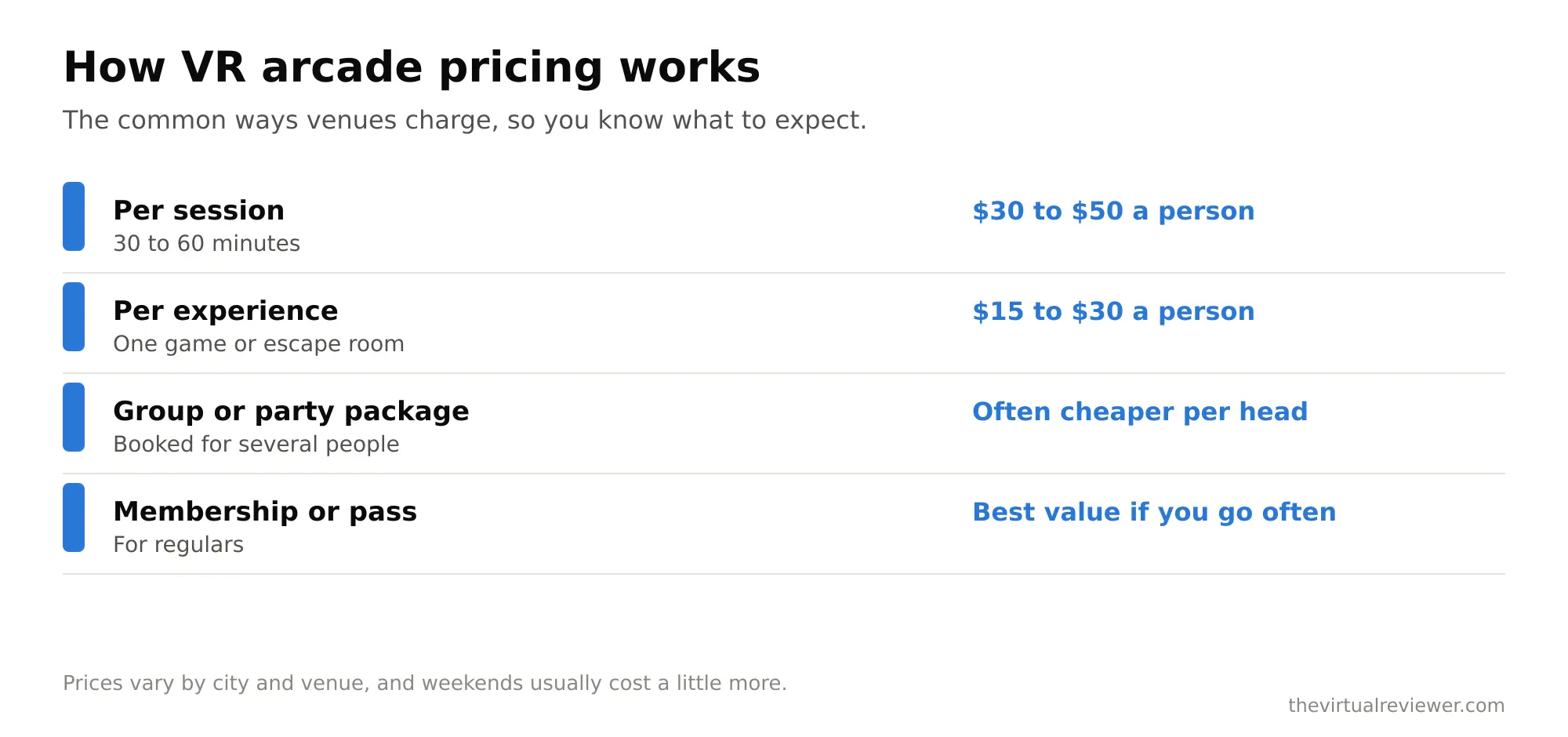
Here is what I see charged at real venues in 2026. Prices shift a little by city and by weekday versus weekend, so treat these as honest ranges, not a promise for your specific location.
| VR arcade type | Typical price per person | Session length (in headset) | Best for |
|---|---|---|---|
| Booth / single-station VR | $8 to $20 | 10 to 20 min | First-timers, quick play, kids |
| Multi-station arcade (Immersive Gamebox style) | $21 to $30 | 30 to 60 min | Small groups, parties, teens |
| Free-roam arena (Zero Latency style) | $45 to $70 | 30 min | Groups who want the big experience |
| Full-body haptic (Sandbox VR style) | $39 to $49 | 30 to 40 min | Story lovers, families, dates |
The gap between the cheapest and priciest VR is real, and it is not a rip-off. You are paying for space, tracking gear, and how many players the room holds at once.
What you actually pay at the big names
Let me get specific, because vague ranges only help so much.
Sandbox VR charges about $39 per person on weekdays (Monday to Thursday) and $49 per person on weekends (Friday to Sunday) for a single experience. Your in-headset play runs 30 to 40 minutes, but plan for 45 to 60 minutes total once you add check-in, gearing up in the haptic vest, and watching your team highlight video afterward. This is the full-body, motion-capture format, and it is the one I point families toward when they want the “wow.” I wrote up our own night at their Vegas location in my Sandbox VR review, and the price felt fair for what we got.
Zero Latency sits in the free-roam arena camp, where you and up to seven other players physically walk through a shared warehouse-scale space. Pricing varies by location, but I have seen roughly $45 per person on weekdays for a standard 30-minute session, with premium licensed titles running higher. Some smaller-run locations use tiered pricing like $19 for a 15-minute game and $39 for a 30-minute one on slower days.
Immersive Gamebox is the value pick of the premium bunch. It runs about $21 per person for a 30-minute game and $30 per person for 60 minutes, with up to six players per room. It is projection and touch based rather than a headset arena, so it is a different flavor, but the per-person cost is friendly. I covered a location in my Immersive Gamebox writeup if you want a feel for it.
Why free-roam costs more than a booth
If you have only ever done a $10 booth demo at a mall, the jump to $49 can sting. Here is where that money goes.
A booth or single-station game plants you in one spot. You wear a headset tethered to a fixed computer, you play a short arcade title, and the operator can cycle a lot of people through per hour. Low cost to run, low price to you. Great for a five-minute thrill.
Free-roam and full-body venues are a different animal. You get a wireless headset, a backpack PC that can weigh seven or eight pounds, tracked controllers, and often a haptic vest that buzzes and thumps with the action. The arena itself can run 200 to 2,000 square feet of mapped physical space, and the venue can only serve one group in that room at a time. Fewer players per hour plus expensive gear equals a higher ticket. You are paying for square footage and for the tech strapped to your body.
Extra costs to watch for
The sticker price per session is not always the whole bill. A few things I have run into:
- Replay discounts. Many venues drop the price for a second back-to-back game. If your group is having fun, the second round is often cheaper per person than the first.
- Weekend surcharge. As the Sandbox VR numbers show, Friday to Sunday can run $10 more per head than a Tuesday. If your schedule is flexible, a weekday visit saves real money.
- Party and group packages. Booking a private room for a birthday usually bundles the price and sometimes adds food or a party host. Ask, because the per-person math can beat walk-in rates.
- Waivers and age minimums. Not a cost, but plan for it. Most free-roam venues set a height or age floor (often around 8 to 13 years old), so check before you pay for a younger kid who cannot ride.
How to get the most play for your money
After a lot of receipts, here is how my family stretches a VR budget.
Book weekdays when you can. The savings are real and the arenas are quieter, which means less waiting and more relaxed staff who will actually coach you.
Go with a full group. Free-roam and haptic venues are priced per person but built for teams. Six players splitting a private arena feel like they got more than two players in the same room. The social part is the point.
Match the format to the crowd. Little kids and first-timers do great in a $15 booth or a 30-minute Gamebox room. Teens and adults who already love VR are the ones who will feel the $49 haptic session was worth every penny. I have burned money putting a nervous first-timer straight into a premium arena, so start smaller if you are unsure.
Watch for the highlight video. At haptic venues like Sandbox VR, the post-game team video is part of the price. It is honestly half the fun, so do not rush out the door.
Is a VR arcade session worth the price?
For my family, yes, with a caveat. A $49 haptic session is a genuine night out, not a quick errand. Compared to a movie for four plus popcorn, a shared VR arena often delivers more memory per dollar because you are inside the story together, not sitting in a row staring forward.
Where I would slow down is the impulse $10 booth demo. Those are fine, but they can leave a first-timer thinking “that was it?” and souring on the whole idea. If you have the budget, one good premium session beats three cheap ones.
FAQ
How much does a VR arcade session cost per person?
In 2026, expect $8 to $20 for a booth or single-station game, $21 to $30 for a multi-station room like Immersive Gamebox, and $39 to $70 for premium free-roam or full-body haptic experiences like Zero Latency or Sandbox VR.
How long is a VR arcade session?
Active in-headset time is usually 15 to 40 minutes depending on format. Budget 45 to 60 minutes total at premium venues once you add check-in, gearing up, and the post-game video.
Why is free-roam VR more expensive than booth VR?
Free-roam venues use wireless headsets, backpack PCs, haptic vests, and large mapped arenas that serve only one group at a time. More gear and fewer players per hour push the ticket price up compared to a fixed booth.
Can you save money on VR arcade prices?
Yes. Book weekdays instead of weekends, ask about back-to-back replay discounts, and look at group or party packages if you are bringing a full crew. Weekday pricing alone can save around $10 per person at some chains.
Is a VR arcade cheaper than buying a home headset?
Per visit, yes. A single session costs far less than a headset. But if you go often, a home system can pay off over time. The tradeoff is that home VR cannot match the free-roam space and full-body haptics you get at a venue.
The bottom line
How much does a VR arcade session cost? Plan on $20 to $55 per person for most real experiences in 2026, with premium free-roam and haptic sessions at the top of that range. Match the format to who you are bringing, book a weekday if you can, and go as a group. Do that, and the price stops feeling like a splurge and starts feeling like the best few hours you booked all month.
Related reads
- What is a VR arcade
- Free-roam VR explained
- Best VR in Madison
- Home VR vs the arcade: is a Quest 3 as good as Sandbox VR