We came home from a free-roam session buzzing, and my son John asked the exact question that leads to this whole article: if there is a VR arcade fifteen minutes away, is a home VR headset worth it, or should we just keep going back to the venue? I have chewed on this a lot, because the honest answer is not the one either the headset makers or the arcades want you to hear. They do different jobs. Let me walk you through how I actually think about it.
Direct answer first. A home VR headset is worth it even with a great arcade nearby, but only if you will use it more than a few times a month. The arcade delivers a big-night experience you literally cannot build at home. The headset delivers cheap, unlimited, spontaneous play. Most families who love VR end up wanting both, and the trick is knowing which one solves which problem.
What the arcade gives you that home never will
I want to be clear-eyed here, because I have played location-based VR at more than fifty real venues and the good ones do things a Quest simply cannot.
The biggest one is space. At a free-roam arena you walk a real room, sometimes 200 square meters, with no wires and no backpack tether. At Sandbox VR you gear up with a headset, a PC backpack, wrist and ankle trackers, and a haptic vest, then move freely through a private holodecky room for about an hour with a group of 2 to 6. At an arena like EVA Esports, a whole team roams together in the same physical battlefield.
That combination, real walking plus full-body haptics plus a group all geared up at once, is the arcade’s moat. Your living room cannot give you a 200 square meter room or put a haptic vest on all four family members. Sandbox sessions start around $39 a person and last roughly 60 minutes, and for a birthday or a special night that is money well spent.
What the home headset gives you that the arcade never will
Now the other side. A Meta Quest 3 or Quest 3S sits in your closet and works any night, no booking, no drive, no per-person fee. That changes the entire relationship you have with VR.
At the arcade, VR is an event you plan. At home, it is a Tuesday. My kids fire up Beat Saber for twenty minutes before dinner. That casual, low-stakes, whenever-you-want play is something a venue structurally cannot offer, because every visit costs money and time.
Home also owns the library breadth. A venue curates a handful of polished exclusives. A Quest opens a store of hundreds of games, from rhythm and fitness to mixed-reality shooters that use your actual living room as the map. There is even a wave of colocated mixed-reality laser tag you can run at home now, which is its own kind of fun the arcade does not replicate.
The 2026 headset pricing you should know
Prices moved this year, so plan with current numbers. Meta raised Quest prices on April 19, 2026, citing a memory chip shortage.
| Model | Price (June 2026) | Optics | Best for |
|---|---|---|---|
| Quest 3S 128GB | $349.99 | Fresnel lenses, center-sharp | Cheapest way into the full library |
| Quest 3S 256GB | $449.99 | Fresnel lenses | More storage, budget buyers |
| Quest 3 512GB | $599.99 | Sharper pancake optics, higher-res display | Best image quality and mixed reality |
Both headsets share the same Snapdragon XR2 Gen 2 chip, the same 8GB of RAM, the same controllers, and the exact same game library. The difference is the lenses and display. The Quest 3 gives you sharper pancake optics and a better mixed-reality sensor stack. The Quest 3S uses older Fresnel lenses that are crisp in the center and blur toward the edges. The common reviewer verdict in 2026 is that there is no wrong choice, just a budget-versus-clarity call. If you are eyeing the 256GB Quest 3S, adding $100 for a base Quest 3 gets you better optics and more storage at once.
The real math: when does a headset pay for itself
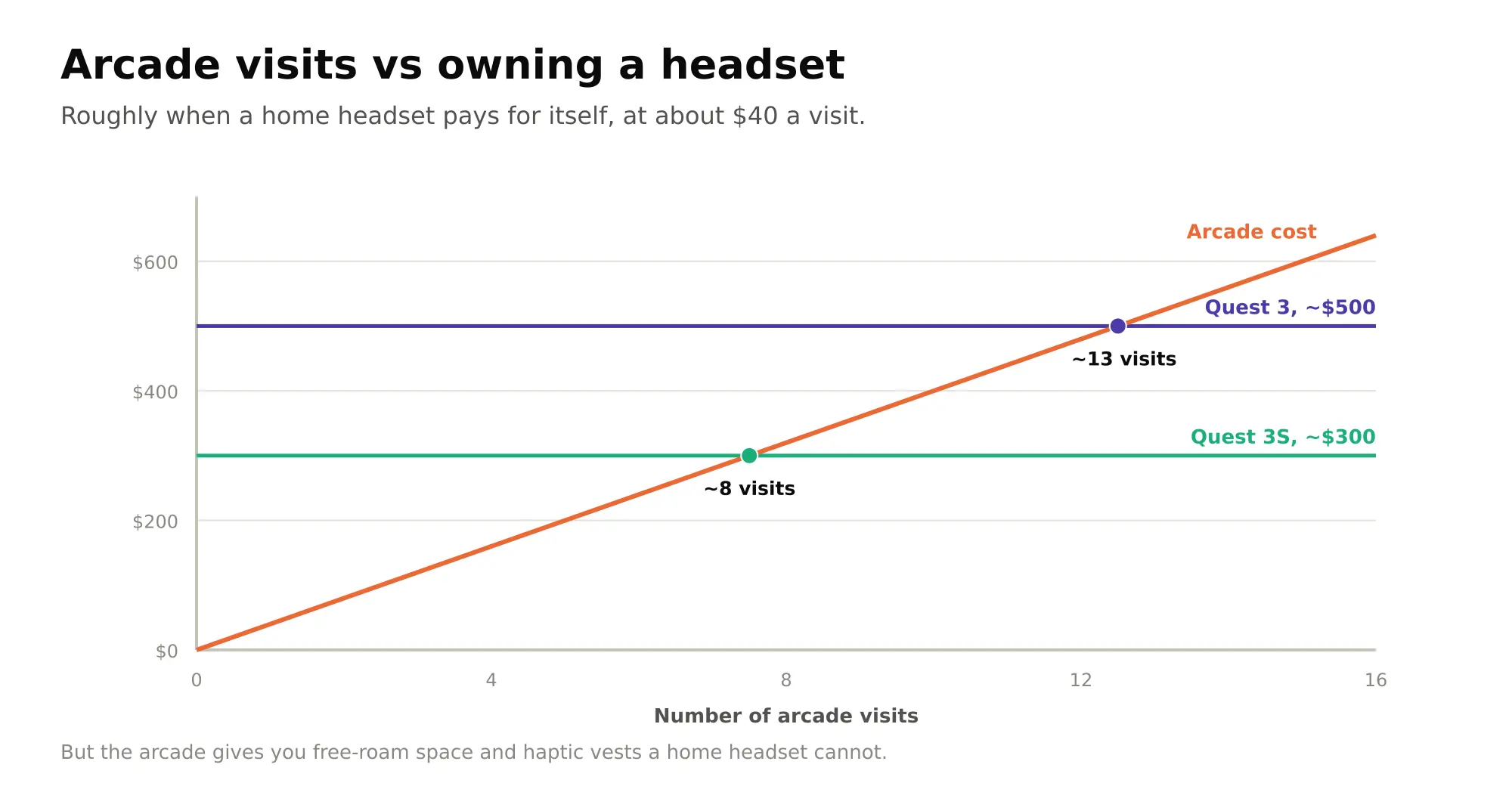
This is the part that actually decides it. Take arcade cost of roughly $39 per person per visit.
- A $349 Quest 3S pays for itself in about 9 solo arcade visits, or under 5 visits for a pair.
- A $599 Quest 3 pays for itself in about 15 solo visits, or 8 for a pair.
If your family goes to the arcade twice a month with two people, you are spending around $156 a month. A home headset covers that in weeks, not months, and then keeps paying you back for years.
So the question is not really “is a headset worth it.” It is “how often will we play.” Play weekly and the headset is a no-brainer that quietly saves you money. Play three times a year and you are better off keeping VR as a treat and spending on venue nights instead.
Where the two actually work together
Here is how it shakes out in practice, and it is what I would tell any parent who asks.
Buy the home headset for volume. It handles the everyday itch, the quick fitness sessions, the rainy-Sunday family game, the solo wind-down after work. Cheap per hour, always available.
Keep the arcade for the moments home cannot touch. Birthdays, out-of-town cousins, the free-roam adventure with the haptic vest and the real running. When I want the wow, I book a venue. When I want VR to just be part of normal life, I reach for the Quest. If you want a sense of the range of venues out there, our homepage collects the reviews from the cities we have covered, including big arcades like Fixation VR in Dallas.
How to pick your first home headset
Keep it simple. If budget is the top concern and you mostly want access to games, the Quest 3S at $349.99 is the smart entry point. If you care about the sharpest image and the best mixed-reality experiences, and you can stretch to it, the Quest 3 at $599.99 is the one you will not outgrow as fast. Everyone in your house plays the same library either way, so you are only choosing how clear the picture looks and how much storage you get.
FAQ
If my local arcade is amazing, do I even need a home headset?
You need it if you will play often. The arcade wins on wow-factor and free-roam space, but it charges per visit. A home headset makes VR a daily-normal thing at a fixed one-time cost. Frequent players save real money and get way more hours.
Which is cheaper over a year, arcade visits or buying a headset?
For anything more than occasional play, the headset. At around $39 per arcade visit, a $349 Quest 3S pays for itself in well under ten sessions for two people. After that, home play is essentially free.
Should I get the Quest 3 or the Quest 3S in 2026?
Get the Quest 3S ($349.99) if you want the cheapest entry to the full game library. Get the Quest 3 ($599.99) if you want sharper pancake optics, a higher-res display, and the best mixed reality. Same chip, same games, the difference is image quality and storage.
Can a home headset do the free-roam stuff I loved at the venue?
Not the same way. You do not get a 200 square meter wireless room or a group in haptic vests at home. Home VR does offer roomscale play and mixed-reality games that use your real space, which is fun and different, but the true free-roam arena stays a venue experience.
Is home VR good for the whole family or just one person?
It is great for the family, but generally one player at a time on a single headset, passing it around. That is a key contrast with the arcade, where everyone plays at once. For simultaneous group play, the venue still wins.