The short version, because I know you’re deciding between two very different price tags: for most families the answer isn’t either-or. A home headset is the cheaper way to get lots of casual play, and a VR arcade is the better way to get the big, physical, walk-around experiences you can’t recreate in the living room. The VR arcade vs home VR for families question really comes down to how often you’ll play and what kind of memories you’re buying. I’ve played location-based VR at more than 50 venues and I own home gear too, so I’ve lived on both sides of this.
Let me lay out the real numbers and the honest tradeoffs so you can spend your money where it counts for your crew.
The core difference in one breath
A home headset like a Meta Quest is a one-time purchase that gives your family unlimited short sessions at home, but it’s a single face-mounted headset with room-scale limits, and the maker says it’s for ages 10 and up. A VR arcade charges per person per visit, but it gives you free-roam space, haptic vests, guided safety, and games no home rig can run. One is convenience and volume. The other is a premium outing.
What each really costs a family
Here’s where a lot of families guess wrong, so let me put actual 2026 numbers on it.
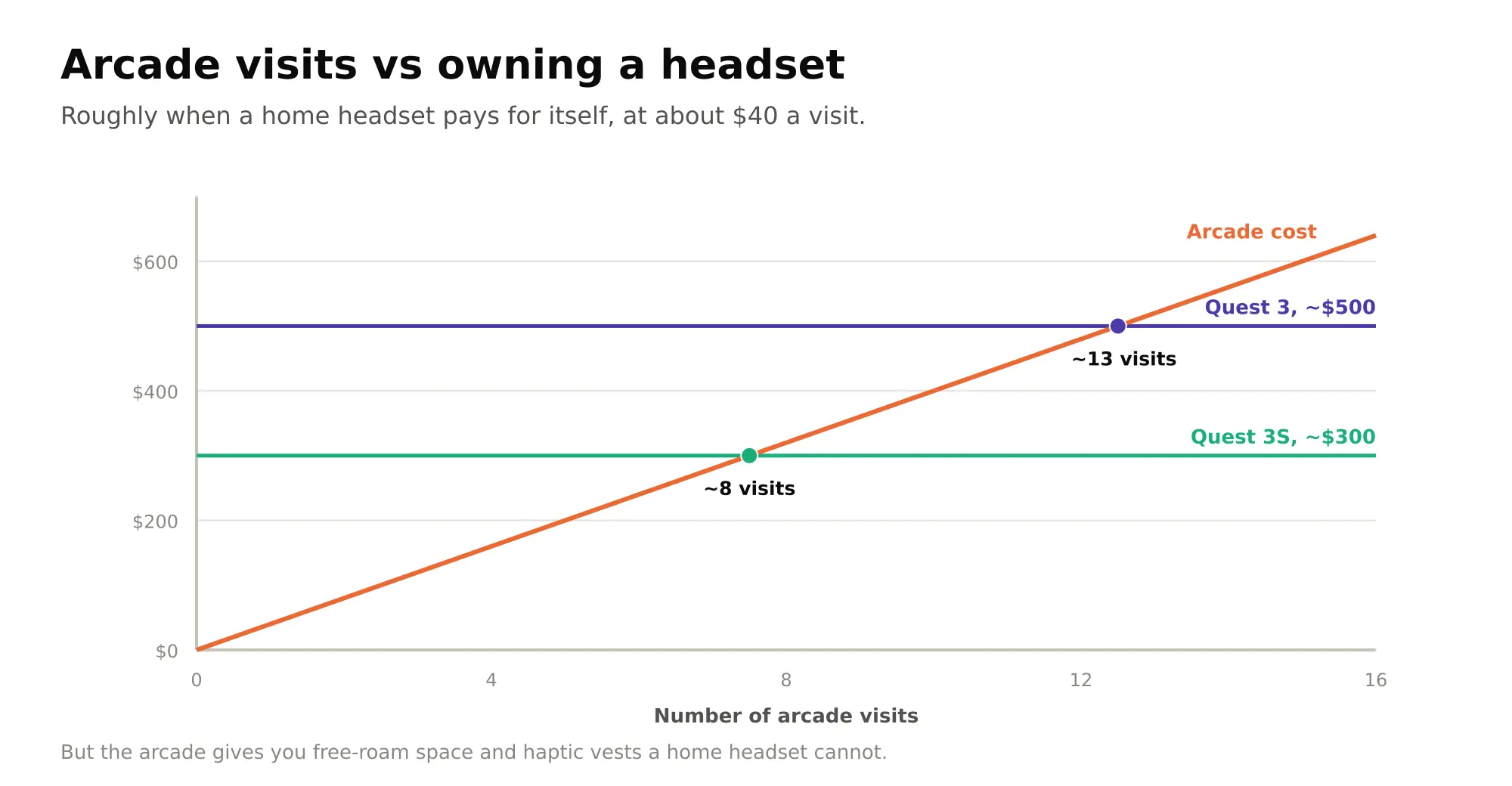
Home VR runs as a one-time buy. The Meta Quest 3S is the value pick at $349.99, and the Quest 3 sits at $599. Both are standalone, so there is no gaming PC or console to buy on top. But budget honestly for the extras, a better head strap runs roughly $50 to $80, a case is $30 to $60, and games add up fast. A realistic starter setup for a family lands somewhere around $430 to $750 all in, and then play is free after that. The catch is you own one headset, so the family takes turns.
VR arcades charge per person, per session. Entry-level booth-style experiences run about $8 to $12 a person, mid-tier free-roam and touch-wall rooms like Immersive Gamebox land around $22 to $35 per person, and premium haptic-vest experiences like Sandbox VR run roughly $40 and up. For a family of four, one big free-roam outing can easily be $120 to $180.
| Factor | Home VR (Meta Quest) | VR Arcade |
|---|---|---|
| Cost structure | One-time $350 to $750 all in | $8 to $50+ per person per visit |
| Family of four, one session | Free after purchase | Roughly $80 to $180 |
| Who can play at once | One person per headset | Your whole group together |
| Movement | Room-scale, cords or standalone | Free-roam, walk-around space |
| Extras | None | Haptic vests, props, guided safety |
| Youngest age | Meta says 10+ | Some venues seat kids as young as 3 to 7 |
| Best for | Frequent casual play | Big occasions and memories |
Where home VR wins
If your family will actually use it week after week, a home headset is the better value, full stop. After just a few arcade visits worth of spending, the headset has paid for itself and everything after is free. It shines for:
- Frequent, low-commitment play. Ten minutes after homework, no booking, no drive.
- Fitness and rhythm games that reward daily reps.
- Older kids and teens who can safely use it, since Meta pegs the minimum at 10 with parent managed accounts for ages 10 to 12.
- Solo play, since one person can pick it up anytime.
The honest downsides: it’s one headset, so siblings squabble over turns, and small kids under 8 shouldn’t be using it per the maker’s own guidance. I get into the age question in depth in our guide to VR for young kids under 8.
Where the arcade wins
A home headset can’t give you what a good venue does. This is the whole reason location-based VR keeps growing even as home headsets get cheaper. Arcades deliver:
- Free-roam space. You physically walk, run, and duck through a real room instead of standing in a play boundary.
- Haptic vests and props. When something hits you in a Sandbox VR game, you feel it. Nothing at home does that.
- Everyone plays together. Your whole family is in the same game at the same time, not passing one headset around.
- Trained guides and padded, cord-free rooms. The physical safety profile for a supervised session is genuinely better than a kid alone at home.
- Younger kids can join. Some venues seat little ones a home headset flat out excludes. Immersive Gamebox uses a light visor worn like a hat and runs games for kids as young as 3 to 5.
The tradeoff is obvious: you pay every single time, and a big family night out adds up. But you are buying a shared experience and a highlight reel, not just game time.
How I would actually decide for my family
Ask yourself three quick questions.
- How often will you really play? If the honest answer is a few times a month or more, buy a home headset, it pays off fast. If it is a handful of times a year, pay per visit and skip the purchase.
- How old are your kids? If your youngest is under 8, home VR is off the table per Meta’s guidance, so the arcade is your realistic option until they are older. If your kids are 10 and up, home VR opens up.
- What are you buying, habit or memory? A headset is a habit machine for regular short play. The arcade is a memory machine for birthdays, visiting cousins, and special nights.
For a lot of families the smart play is both in sequence. Try the arcade first to see if your crew even loves VR, because $150 for one night beats $600 on a headset that ends up in a closet. If everyone comes out grinning and the kids are old enough, then buy a Quest 3S for the everyday habit and keep the arcade for the big occasions. That’s roughly how it shook out in my house.
A note on the “we loved it at the venue” moment
This is the exact question I get most: “We had a blast at Sandbox VR, should we buy a headset for home?” Be clear-eyed about what you loved. If it was the free-roam running around and the vest thwacking your chest, a home headset will feel smaller, because it can’t do those things. If it was simply being inside a game and swinging at stuff, a Quest 3S at home will scratch that itch for a fraction of the per-visit cost. Match the purchase to the part you actually enjoyed. My full take on that specific venue is in our Sandbox VR review, and for the touch-wall style that works great for younger families, see our Immersive Gamebox review.
FAQ
Is a home VR headset cheaper than the arcade for families?
Over time, usually yes, if you play regularly. A home Quest 3S setup runs about $430 to $750 all in and then play is free, so it beats the arcade after roughly four to six family visits. If you only play a few times a year, paying per visit is cheaper.
Can my whole family play together on a home headset?
Not at once on a single headset, you take turns. VR arcades put your whole group in the same game at the same time, which is a big part of why families book them for special occasions.
My kids are little, is home VR even an option?
If your youngest is under 8, no. Meta sets the Quest minimum at 10. For little ones, a venue like Immersive Gamebox with a light visor and short supervised session is the realistic path until they are older.
What can a VR arcade do that a home headset cannot?
Free-roam walk-around space, haptic vests you feel, physical props, and trained guides in a padded room. A home headset keeps you in a small play boundary and cannot deliver full-body haptics.
Should we try the arcade before buying a headset?
I think so. One arcade night costs far less than a full home setup and tells you if your family actually loves VR. If everyone loves it and the kids are old enough, then buy the headset for everyday play.
However your family lands, there is no wrong answer here, just a right one for how you actually play. If you want to scout venues before you decide, our homepage has reviews across a bunch of cities to help you find a good first outing.
Related reads
- What is a VR arcade
- Free-roam VR explained
- Best VR in Madison
- Home VR vs the arcade: is a Quest 3 as good as Sandbox VR