Walking into your first VR arcade, here is what to expect: a short check-in with a waiver, about ten minutes of gearing up in a headset and often a haptic vest, a quick tutorial, then roughly thirty minutes of actually being inside a game, and a highlight reel at the end that you will want to show everyone. The whole thing runs about an hour, and you do not need to know a single thing about VR beforehand. The staff handle the tech. Your only job is to move around and have fun.
I have done this first-visit dance at more than 50 venues, with my wife Patty and my kids and plenty of nervous first-timers in tow. So let me walk you through exactly what happens, plus the handful of small things that make a first visit go smoothly instead of sideways.
The play-by-play of a first visit
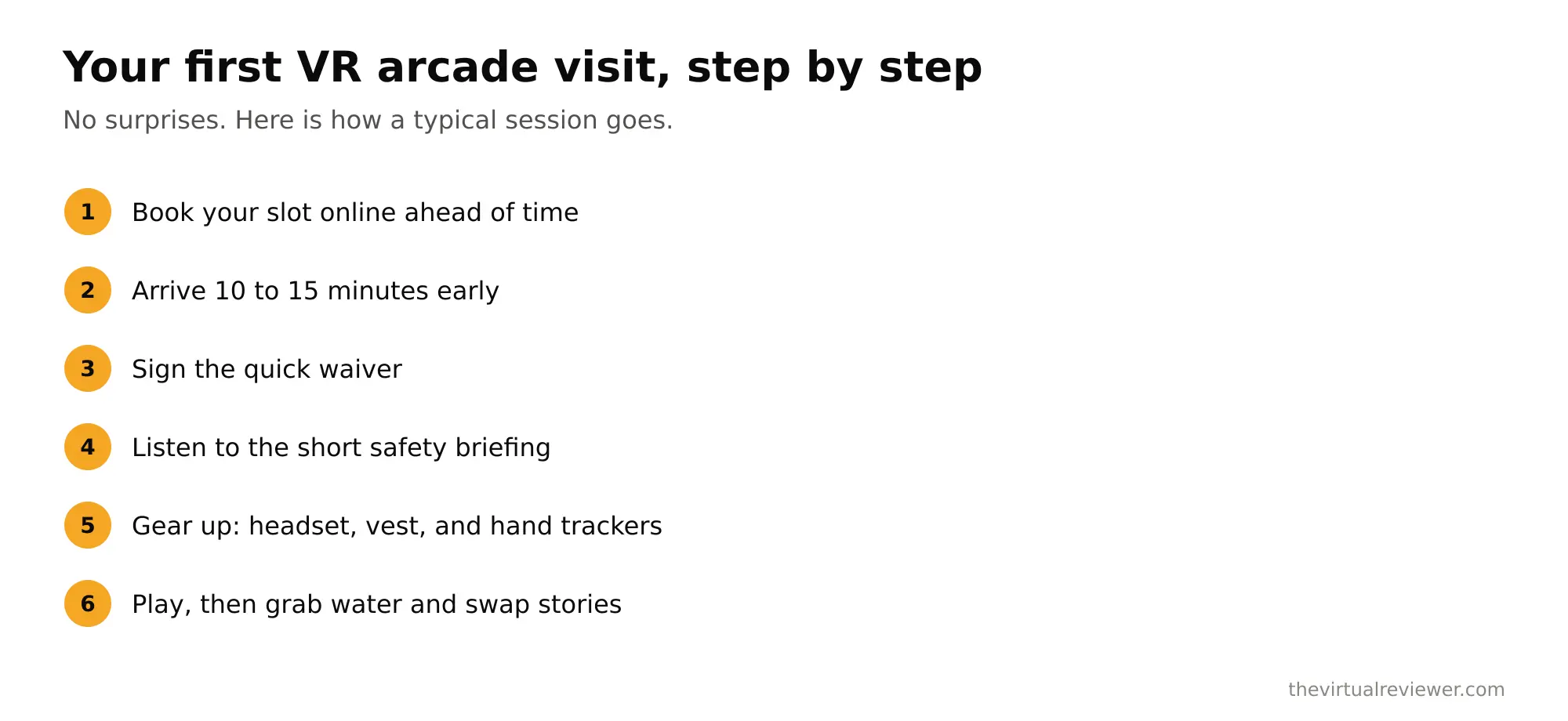
Almost every location-based VR venue follows the same rhythm. Knowing it takes away the nerves.
| Stage | Roughly how long | What happens |
|---|---|---|
| Check in and waiver | 5 to 10 min | Sign a liability waiver, guardians sign for under-18s |
| Gear up | 5 to 10 min | Headset on, haptic vest, wrist and ankle sensors, quick fit check |
| Tutorial | A few minutes | Staff teach you to look, move, and use controllers |
| Gameplay | Around 30 min | The main event, you are inside the world |
| Gear off and highlights | About 10 min | Take off gear, watch photos or a highlight reel |
That is the standard shape at free-roam spots like Sandbox VR, Zero Latency, and EVA. Arcade combos may run a shorter VR attraction next to bowling and food, but the gear-and-tutorial part is the same.
Check-in and the waiver
First thing, you sign a waiver. It is routine, the same kind you sign for trampoline parks or go-karts. Anyone under 18 needs a parent or guardian to sign for them, so if you are bringing kids, plan for that. Many venues let you sign online ahead of time, which I highly recommend. It gets your whole group moving faster and cuts the lobby chaos.
Arrive ten to fifteen minutes early. VR arcades run on scheduled sessions, and if you are late, you eat into your own play time or lose the slot. Early arrival also gives nervous first-timers a minute to watch a group finish up and realize it looks like a blast, not a stress test.
Gearing up, and yes, the vest is the good part
This is where a VR arcade separates itself from anything you can do at home, and it is the whole reason I keep coming back to these places. At a good free-roam venue you do not just put on a headset. You put on a haptic vest that physically buzzes and thumps when something happens in the game. Get “hit” by a virtual shot and you feel it in your chest. An explosion goes off nearby and the vest rumbles. That feedback is what turns watching a game into being in one.
You will also get tracked sensors on your wrists and ankles so your real movements, ducking, reaching, stepping to the side, show up in the game. All in, you are carrying maybe 20 pounds of gear for about an hour, which is worth knowing if you or a young kid tires easily.
This is exactly the thing you cannot replicate on a home headset, and it is why I tell people the arcade is worth the trip even if they own a Quest. I described how that full-body haptic setup feels in my Sandbox VR review, and the free-roam arena version in my EVA Esports writeup. If you want to see the scale of a big dedicated arcade before you go, my Fixation VR review walks through one.
The tutorial and gameplay
Before the real game starts, staff run a short tutorial. They teach you how to look around, how to move, whether the game uses teleport or smooth walking, and how the controllers work. Do not skip mentally checking out here. Two minutes of paying attention now saves you fumbling later.
Then comes the main event, usually about half an hour. In free-roam VR you physically walk through the space. You can duck behind cover for real, step to the edge of a virtual ledge, and turn to see a teammate right beside you. Your body does the moving, and that is the sense of presence that home VR, where you mostly stand in one spot, cannot match.
A staff member is watching the whole time, both for safety and to help if anyone gets stuck. You are never really on your own in there.
Motion sickness: the honest talk
Some first-timers feel a little queasy, and I would rather you hear that from me than be surprised. It is usually mild, and it usually fades fast. A few things that genuinely help:
- Keep the first session shorter if you are prone to motion sickness. Ten to fifteen minutes is plenty to test the waters.
- Pick gentler games to start. Slower movement is easier on your inner ear than fast, spinning action.
- Take the headset off the moment you feel off. Do not push through it. The feeling passes quickly once you are back in the real room.
- Ginger ahead of time helps some people, the same way it does for car sickness.
The good news is that most people adapt with a few sessions. What felt disorienting the first time barely registers by your third visit. If you have a kid who is unsure, start them short and let them build up.
How to prep before you go
A little prep makes the visit smoother. Here is my short checklist:
- Wear closed-toe shoes. Many venues require them and will turn away sandals. You are moving around, so comfortable sneakers are ideal.
- Dress in layers you can move in. VR gets physical and you warm up. Skip anything stiff or restrictive.
- Glasses wearers, check frame size. Big frames may not fit under a headset. Small frames usually do, and some rigs adjust focus. Contacts are the safe bet if you have them.
- Confirm age and height rules. Free-roam venues often want players at least 48 inches tall, and some set a minimum age of 13. Sandbox VR suggests 6 and up with that height floor.
- Book ahead. Walk-ins are sometimes fine, but sessions fill up, especially weekends. Reserving locks your slot.
- Eat light beforehand if you tend toward motion sickness. A heavy meal right before does you no favors.
What it costs and how long you will be there
Budget for roughly $45 to $60 per person for a free-roam session before tax, with weekends running higher than weekdays. Plan on being at the venue for about an hour and a half door to door once you factor in check-in, gear, play, and the highlight reel. If you want to find an open venue near you first, my homepage city guides list real, verified spots by area.
FAQ
Do I need any experience to go to a VR arcade?
None at all. The staff gear you up and run a tutorial before you play. First-timers are the norm, not the exception, and the games are built to be picked up in minutes.
How long does a VR arcade session last?
The full visit is about an hour: roughly ten minutes to gear up, a short tutorial, around thirty minutes of gameplay, and about ten minutes to remove gear and watch highlights. Arrive ten to fifteen minutes early.
Will I get motion sick at a VR arcade?
You might feel mildly queasy the first time, but it usually passes fast. Keep your first session shorter, start with gentler games, and take the headset off the moment you feel off. Most people adapt after a couple of visits.
What should I wear to a VR arcade?
Closed-toe shoes, which are often required, and comfortable clothes you can move and warm up in. If you wear glasses, check that the frames fit under a headset or bring contacts.
How much does a first VR arcade visit cost?
Free-roam sessions commonly run about $45 to $60 per person before tax, more on weekends. Arcade combos price by package. Confirm on the venue’s own site, since rates vary by city.
The bottom line
Your first VR arcade visit is a lot less intimidating than it looks from the parking lot. Sign the waiver, let the staff strap you into the vest, listen to the quick tutorial, and then just move. The haptic feedback and the freedom to physically walk through a game are things you cannot get at home, and that is exactly why it is worth going. Wear the right shoes, book ahead, take it easy if you are motion-sensitive, and you will walk out already planning the next trip. Start with a venue I have already vetted over on my reviews and city guides.