Short answer first, because that is probably why you clicked: in 2026 a VR headset costs anywhere from about $349 for an entry-level standalone up to $3,499 for Apple’s high-end unit, with the sweet spot for most families sitting between $399 and $599. That is the honest range. But the sticker price is only half the story, and after years of playing VR at real venues and running headsets at home, I can tell you the second half, the hidden costs, is where people get surprised.
So let me lay out what a VR headset actually costs today, model by model, then walk through the extras nobody puts on the price tag. I will also answer the question I get most from other parents, which is whether buying a headset for home is even worth it when you can just pay for a session at an arcade.
VR headset prices in 2026 at a glance
Prices below are current as of mid-2026 and reflect Meta’s April 2026 price increase, which pushed several models up in response to a global memory chip shortage. Sales and bundles move these around, so treat them as the standard retail floor.
| Headset | Price (2026) | Type | Needs a PC or phone? | Best for |
|---|---|---|---|---|
| Meta Quest 3S (128GB) | $349 | Standalone | No | Families, first headset, best value |
| Meta Quest 3S (256GB) | $449 | Standalone | No | Same, more storage |
| Sony PlayStation VR2 | $399 | Console-tethered | Yes, PS5 | PS5 owners who want premium games |
| Meta Quest 3 (512GB) | $599 | Standalone | No | Best all-around, sharper lenses |
| Bigscreen Beyond 2 | $1,019 | PC-tethered | Yes, gaming PC + trackers | PC VR enthusiasts, sim players |
| Apple Vision Pro | $3,499 | Standalone (mixed reality) | No | Premium productivity and media |
The budget tier: $349 to $449
If you have never owned a headset and you just want to see what the fuss is about, this is where you start. The Meta Quest 3S at $349 is the headset I point almost every new family toward. It is fully standalone, meaning no PC, no cables, no phone required. You put it on and you are in. It runs the same enormous Quest game library as its pricier sibling, and for kids who mostly want rhythm games, mini golf, and social apps, it is more than enough. The 256GB version at $449 just gives you room for more games.
The tradeoff versus the Quest 3 is the lenses and the visual sharpness. The 3S uses older-style lenses and a slightly lower-resolution look, so text and distant detail are not as crisp. For most casual players, honestly, you will not notice or care.
The sweet spot: $599
The Meta Quest 3 at $599 is the one I would buy if the budget stretches. You get sharper pancake lenses, better resolution, and stronger mixed-reality passthrough, which is the feature that lets you see your real room in color with digital stuff layered on top. That passthrough is genuinely fun for the whole family and it makes the headset safer for kids because they can see the coffee table.
Is the extra $250 over the 3S worth it? If you plan to use the headset a lot and you care about visual quality, yes. If it is an occasional-weekend toy, the 3S saves you real money that you could put toward comfort accessories or a couple of trips to a venue.
The console option: $399
If your household already owns a PlayStation 5, the PlayStation VR2 at $399 is a strong deal in 2026. It uses OLED screens, which give you deep blacks and punchy color that the LCD-based Quest headsets cannot match, plus proper headset haptics and adaptive-trigger controllers. Sony’s exclusive games are excellent. The catch is that it only works tethered to a PS5, so it is not portable and it is not standalone. If you have the console, though, it punches above its price.
The enthusiast and premium tiers: $1,000 and way up
Now we leave family territory. The Bigscreen Beyond 2 starts at $1,019 and is aimed squarely at PC VR enthusiasts. It is astonishingly light at around 107 grams, with sharp micro-OLED panels, but it needs a capable gaming PC and external base stations to track it, which adds cost on top of the headset. This is a headset for sim racers, flight-sim pilots, and people who already have a VR-ready PC.
At the very top sits the Apple Vision Pro at $3,499. It is a remarkable piece of hardware, but it is not a gaming headset and it is not aimed at kids. It is a premium mixed-reality computer for productivity and media, and at that price it is a purchase almost no family needs. I mention it mainly so you know the true ceiling of the market when someone asks how much a VR headset “costs.”
The hidden costs nobody quotes you
Here is the part I wish someone had told me. The headset price is not the total price. Budget for these:
- A comfort strap and battery, $50 to $100. The stock strap on a standalone headset is fine for a demo, not for long sessions. This is the first thing most people buy after the headset, and it is close to mandatory.
- A carry case, $25 to $40. If the headset leaves the house or has kids around, protect the lenses.
- Games, $0 to $40 each. There is a solid free tier, but the games you will actually keep playing usually cost $20 to $40. Budget a hundred bucks or so to start a library.
- Optional prescription lens inserts, $50 to $80. If anyone in the house wears glasses and does not want to jam them under the headset.
Add it up and a “real” starter setup around a $349 Quest 3S usually lands closer to $500 once you have a strap, a case, and a few games. On a Quest 3, figure $750 to $800 all in. That is not a knock on VR, it is just the honest math so you are not caught off guard.
Buy a headset, or just pay for venue sessions?
This is the question that actually matters, and my answer surprises people. A home headset and a location-based venue are not the same product, and you might want both.
A standalone headset is brilliant for everyday play, low friction, and it lives in your living room. But it cannot give you what I strap into at a venue, which is a free-roam arena the size of a room, a haptic vest that lets you feel hits, and operator-grade tracking. When my family plays something like the free-roam experiences I wrote about at Sandbox VR or the big arcade floor at Fixation VR in Dallas, that is an experience a $349 home headset simply cannot reproduce.
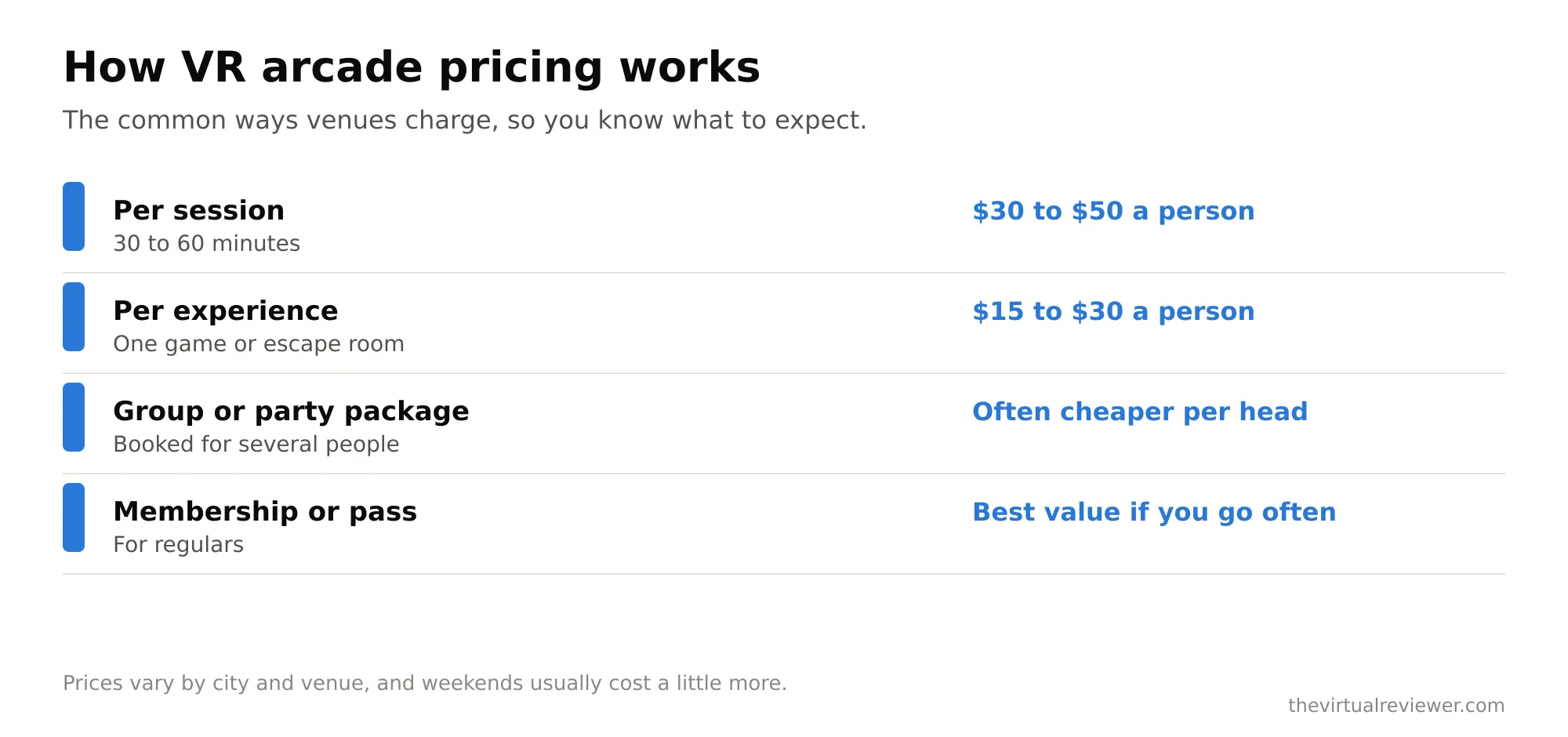
So think of it this way. A venue session usually runs $30 to $50 per person for a themed adventure. A Quest 3S costs about the same as one family outing. If you want frequent, casual play at home, buy the headset, it pays for itself fast. If you want the big, physical, once-in-a-while thrill, save it for a venue. In my house we do both, and neither one makes the other pointless. My full list of places worth visiting lives on the homepage.
How to pick without overthinking it
If you want the simplest answer: buy a Quest 3S at $349 as your first headset. It is standalone, it is cheap enough to try VR without regret, and it runs everything. Move up to the Quest 3 at $599 only if you know you will use it a lot and you care about sharper visuals. Get the PSVR2 at $399 only if you already own a PS5 and want premium tethered games. Everything above $1,000 is for enthusiasts and productivity users, not first-time family buyers.
Whatever you pick, budget an extra hundred or two for a comfort strap, a case, and a few games. That is the real number.
FAQ
What is the cheapest VR headset in 2026?
The Meta Quest 3S at $349 is the cheapest current-generation standalone headset worth buying. It is fully self-contained, needs no PC or phone, and runs the full Quest library. Older or off-brand headsets exist for less, but they lack the software support and comfort that make VR actually enjoyable.
Why did Quest prices go up in 2026?
Meta raised prices on April 19, 2026 because of a global memory chip shortage that pushed up component costs. The Quest 3S 128GB moved from about $300 to $349, and the Quest 3 512GB moved from about $500 to $599. Watch for sales, which can bring these back toward the old numbers.
Do I need a gaming PC to use VR?
Not for a standalone headset. The Quest 3 and Quest 3S run entirely on their own hardware with no PC needed. You only need a gaming PC for enthusiast headsets like the Bigscreen Beyond 2, and you only need a PS5 for the PlayStation VR2.
How much should I really budget total?
Add roughly $100 to $200 to the headset price for a comfort strap, a carry case, and a few games. A Quest 3S starter setup realistically lands near $500 all in, and a Quest 3 setup near $750 to $800. The headset alone is not the whole cost.
Is it cheaper to buy a headset or go to a VR arcade?
It depends on how often you play. A venue session runs about $30 to $50 per person, roughly the price of a single Quest 3S. If you want frequent home play, the headset pays for itself quickly. If you want the big free-roam, haptic-vest experience only now and then, a venue is the better value and gives you something no home headset can.