Is VR safe for kids? The short honest answer is yes, for the most part, when you follow the age limits, keep sessions short, and stay involved. I am a dad of two, John and Jenette, and I have played VR at more than 50 real venues, so this is a question I have wrestled with in my own house, not just in theory. The research we have in 2026 is reassuring on the physical side, the bigger risks are about content and time, and both of those are things you as a parent can actually control.
Below I will walk you through the real age requirements, what the studies actually say, how long kids should be in a headset, and the setup steps I would not skip. My goal is to give you the same straight talk I would give a friend at a barbecue who just found a Quest under the tree.
The quick answer table
| Question | The honest answer |
|---|---|
| Minimum age for Meta Quest | Under 10 not allowed; 10 to 12 with a parent-managed account; 13+ standard account |
| Daily time limit Meta suggests | About 2 hours max, with frequent breaks |
| Does short supervised use damage eyes | No evidence of permanent damage in current research |
| Biggest real risks | Inappropriate content, social contact with strangers, motion sickness |
| Parent’s most important job | Supervise content, set time limits, use Family Center controls |
What the age rules actually are
Meta sets a hard floor. Children under 10 cannot use a Meta Quest 2 or 3, and parents cannot create accounts for them. For kids ages 10 to 12, Meta offers parent-managed accounts with parental oversight, and those work on the Quest 2 and 3. Once a child turns 13, they can use a standard Meta account, though the exact age can vary by country.
Meta lowered the floor to 10 back when it introduced parent-managed accounts, and it pointed to a growing body of research suggesting VR is safe for those additional age groups. I think that is fair, but “allowed at 10” is not the same as “right for every 10-year-old.” You know your kid. Some are ready earlier than others, and the rules are a floor, not a recommendation.
What the research actually says
This is the part parents most want to hear, so let me be specific. A peer-reviewed 2025 study published in Frontiers in Virtual Reality looked at children aged 10 to 12 and found that moderate and daily VR use did not negatively affect their visual, physical, or cognitive functioning. More broadly, researchers have found that changes in things like postural stability, vision, hand-eye coordination, and visually induced motion sickness from kids using VR appear to be relatively mild and clinically nonsignificant.
The American Academy of Ophthalmology has said that using VR in line with basic safety guidelines poses no risk to eye development, health, or proper functioning. Current research shows no evidence of permanent eye damage from short-term supervised use. The one common short-term issue is cybersickness, the nausea or dizziness some kids feel during or right after a session, and that normally fades once the headset comes off.
None of this means VR is a free-for-all. Children’s visual systems are still developing, which is exactly why the experts who study this keep saying the same three words: supervised, short, moderate. The physical safety data is encouraging, but it assumes you are following the guidelines, not handing a kid a headset for three hours alone.
The risks that actually matter
If I am being straight with you, the physical stuff is not what keeps careful parents up at night. It is content and contact.
Consumer watchdog groups, including the U.S. PIRG Education Fund, have warned that even with parental controls turned on, a Quest can expose young users to inappropriate content and to strangers in social spaces. VR social apps can put a child in a room with adults they do not know. That is the single biggest reason I supervise, especially in multiplayer and social apps. The immersion that makes VR magical also makes a bad interaction feel a lot more real and a lot closer than it would on a phone screen.
The second real risk is time. Because VR is so absorbing, kids lose track of it completely. That is where physical symptoms like eye strain, sore necks, and posture problems creep in, and it is why the time limits below matter as much as any content filter.
How long should kids be in VR
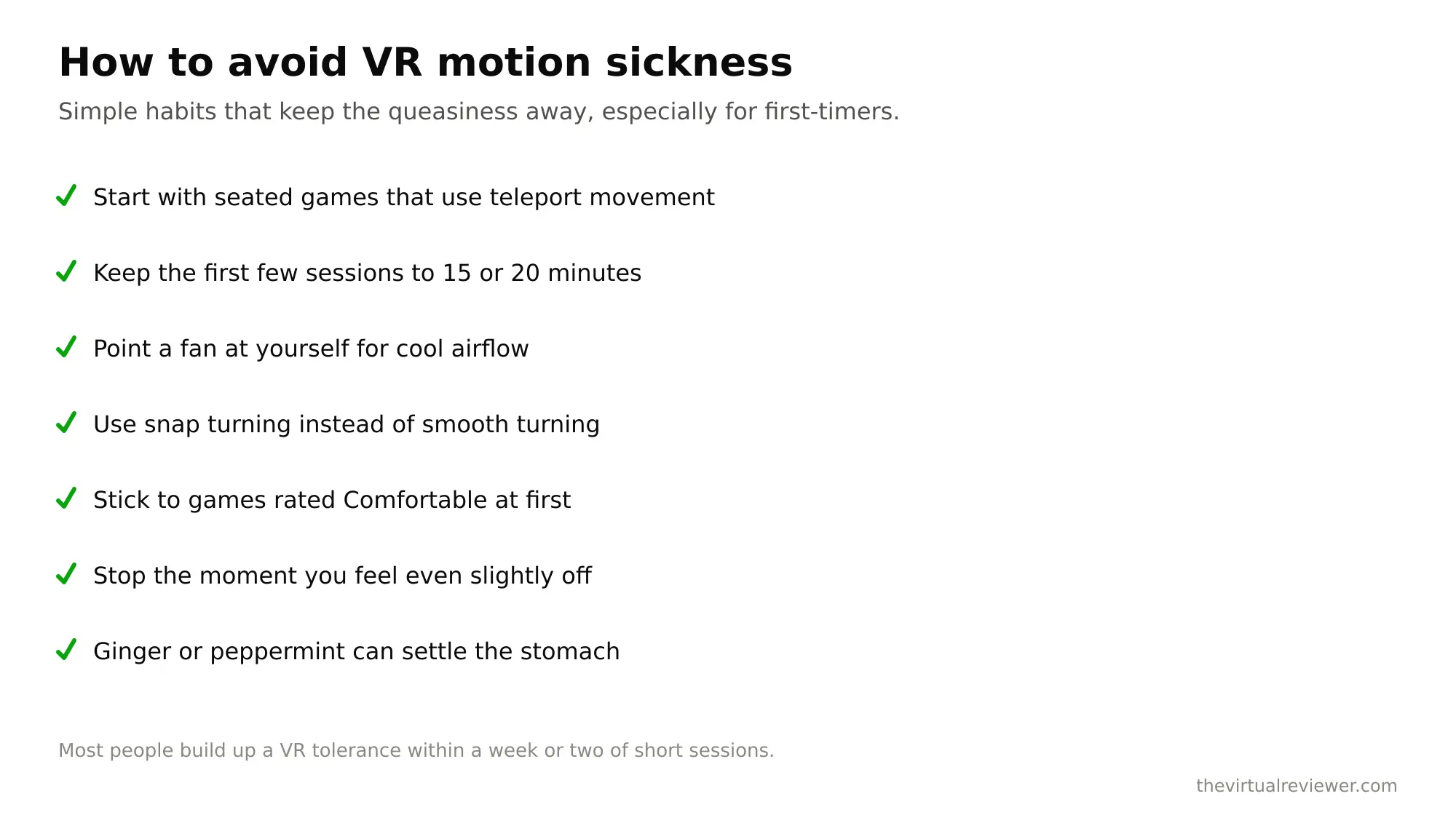
Meta recommends a maximum of about 2 hours of screen time per day and lets parents set that as a default. Honestly, for younger kids I would aim lower than the ceiling. The research on cybersickness suggests taking substantial breaks, around 15 minutes, between sessions so symptoms do not build up. Younger children need more frequent and longer breaks than teens.
In our house the rule is simple: shorter sessions, real breaks, and the headset comes off the moment anyone reports blurry vision, a sore neck, a headache, or nausea. Meta itself flags those as the warning signs to watch for, and it puts it bluntly on its own parent page: the Quest is not a toy.
My setup checklist before you hand it over
Meta publishes a readiness checklist, and I think it is genuinely good. Before a child uses a headset, they should be able to understand and follow the warnings, get a proper fit with clear vision, set and stay inside the play boundary, pick age-appropriate content with your help, stop if they feel uncomfortable, report soreness or blurry vision, tell the difference between virtual and real, and take breaks. Here is how I turn that into action.
- Set up a parent-managed account for a 10 to 12 year old and use Meta’s Family Center to manage it.
- Turn on parental controls and approve apps individually. Do not rely on defaults.
- Clear a real play space and draw the boundary together so they understand it.
- Fit the headset properly and check that the picture is sharp. A blurry or badly fitted headset causes eye strain on its own.
- Set a session timer and agree on it before they start, not after.
- Sit nearby, especially for anything social or online. Presence beats any software filter.
The venue alternative for younger kids
Here is something a lot of parents miss. If your kid is under 10, or you are just not ready to buy a headset, location-based VR is a great way to let them try it safely. At a venue, the staff run everything, the sessions are timed, the content is curated, and there is no stranger sliding into a social app. When we visited spots like Main Event in Atlanta and the VR floor at Dave and Buster’s, the experiences were short, supervised, and genuinely age-appropriate in a way a home headset makes you manage yourself. For a first taste of VR with a younger child, I often think the arcade is the smarter call. You can browse more of our family VR guidance on the homepage.
FAQ
What age can a child use a Meta Quest?
Under 10 is not permitted. Ages 10 to 12 can use a parent-managed account with oversight, and 13 and up can use a standard account, though the exact age varies by country.
Does VR damage kids’ eyes?
Current research shows no evidence of permanent eye damage from short-term supervised use, and the American Academy of Ophthalmology says safe-guideline use poses no risk to eye development. Temporary eye strain and cybersickness can happen and fade after you stop.
How long can my kid safely play VR?
Meta suggests a daily maximum of about 2 hours with frequent breaks, and I would go lower for younger kids. Take roughly 15-minute breaks between sessions.
What is the biggest safety risk with kids and VR?
Inappropriate content and contact with strangers in social apps, more than any physical harm. That is why supervision and approving apps individually matter most.
Is VR safe for a child under 10?
Home Quest headsets are not designed or permitted for under-10s. If a younger child wants to try VR, a supervised, timed session at a location-based venue is the safer route.
The bottom line
So, is VR safe for kids? Yes, within the guardrails. The 2025 research is genuinely reassuring on physical safety, the age rules exist for a reason, and the risks that remain are the ones you can manage as a parent: pick the content, watch the clock, and stay in the room. Do that, and VR can be one of the more wholesome things your kids do with a screen. I say that as a dad who loves this stuff and still keeps a close eye on his own two.