A VR arcade is a venue where you pay to play virtual reality on gear you almost never have at home: full-body tracking, haptic suits, and open rooms big enough to physically walk through the game. That is the short answer to “what is a VR arcade.” The longer answer is the fun part, because there are several very different kinds, the prices vary, and the experience is genuinely nothing like putting on a headset in your living room. I have played at more than 50 real venues across 13 US cities, so let me tell you what you are actually signing up for.
If your only reference point is a home headset, brace yourself, because the good arcades feel like a different medium. You are not standing in one spot swinging your arms. You are walking, ducking, teaming up with your kids, and feeling hits land on your body. Here is how it all works and how to pick the right kind for your group.
The four main kinds of VR arcade
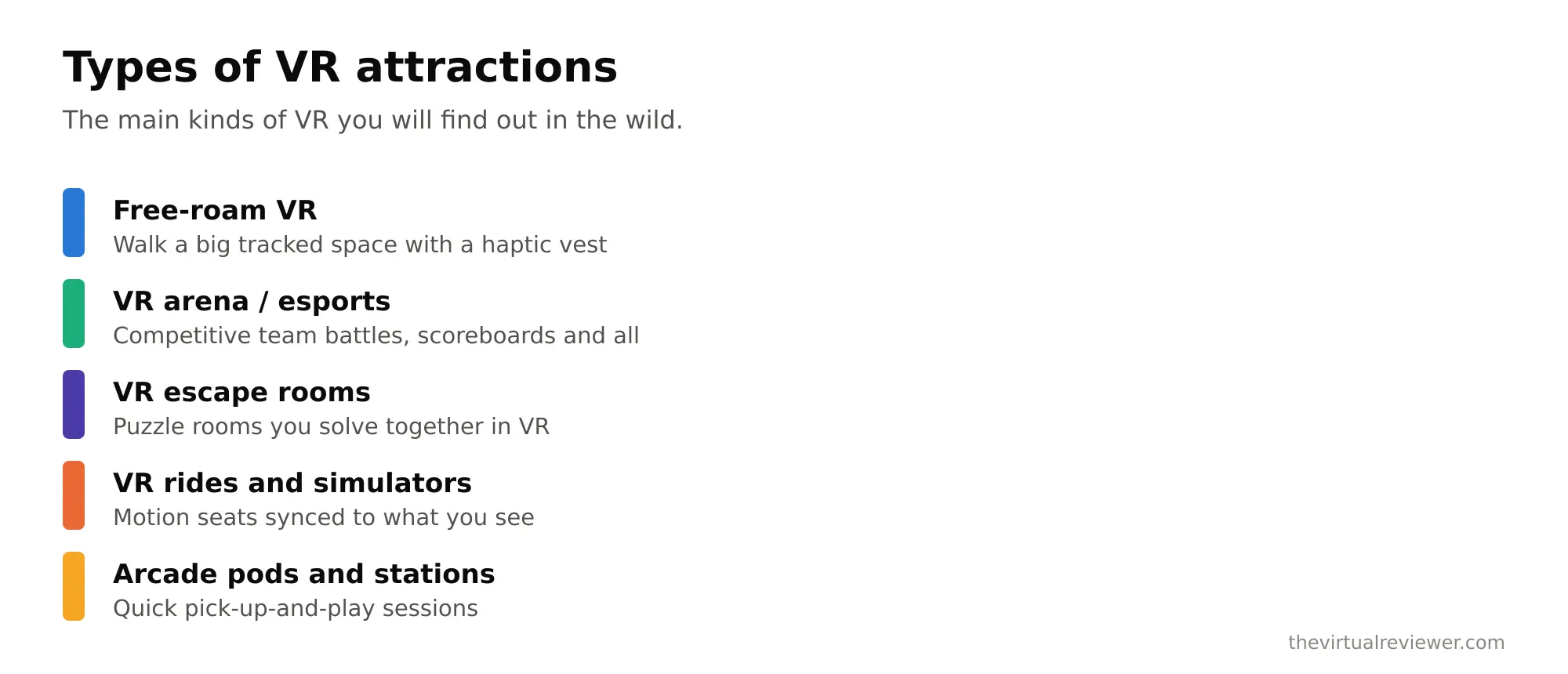
Not every “VR arcade” is the same thing, and knowing the categories saves you from booking the wrong experience for your group. Here is the lay of the land.
| Type | What you do | Group size | Feels like | Typical price |
|---|---|---|---|---|
| Free-roam full-body | Walk untethered in haptic vests and body trackers | 2 to 8 | Living inside a movie | $$$ |
| Free-roam arena | Walk a large open space, often shooter or adventure | 2 to 8 | A team laser-tag video game | $$ to $$$ |
| Escape-room style | Solve puzzles together in a virtual room | 2 to 6 | A VR escape room | $$ |
| Station-based arcade | Play at fixed pods or seats, standing or seated | 1 to 4 | Home VR, but bigger and curated | $ to $$ |
The jump in immersion tracks roughly with the jump in price. Station-based play is the closest to what you can do at home. Free-roam full-body is the thing you cannot replicate no matter how much gear you buy.
Free-roam VR: the experience you cannot get at home
This is the category that makes VR arcades worth leaving the house for, so it deserves the most attention.
Free-roam VR, sometimes called location-based VR, lets you walk untethered through a large physical space while the game world moves with you. There are no cables. You are not confined to a small boundary. You walk, turn, and explore naturally, and when you look to your side your teammate is right there because everyone’s body is tracked in real time.
At the high end, you wear a haptic vest and full-body trackers. This is where it stops feeling like a game and starts feeling like an experience. When my family played free-roam at Sandbox VR in Vegas, we had motion-capture-grade trackers on our hands and legs and vests that let us feel hits land on our bodies. Sandbox builds these with Hollywood-style motion capture cameras and feedback suits so you feel touch, vibration, and impact. You physically flinch when a zombie lunges. There is no home headset on earth that does that.
Free-roam arenas are the other big flavor. Places built around open-space shooters and adventures put a group into a large room, often with backpack PCs or standalone rigs, and turn you loose. When we went to EVA Esports, the arena itself was the tracking system, so the whole floor was your play space. This is the format behind big-name titles too, with experiences like a Cyberpunk 2077 co-op adventure and Zero Latency’s roster built specifically for walk-anywhere group play.
The reason free-roam exists at venues and not in your house is simple. It needs space, staff, and commercial gear you would never buy for a spare bedroom. That is exactly why it stays special.
How a VR arcade visit actually goes
If you have never been, here is the rhythm of a typical booking so nothing surprises you.
You reserve a time slot online, usually for a group, because most arcade experiences are built for teams rather than solo players. You show up a little early. Staff get you into the gear, which at a full-body venue means a vest, trackers, and a headset, and they run you through a quick tutorial so first-timers are not lost. Then you play a single experience that usually runs somewhere in the range of 30 to 45 minutes of active game time, though this varies a lot by venue and format. Afterward, many places have a lounge, a leaderboard, and often food and drinks nearby.
The whole thing is built to be social. You are not each in your own bubble. You are talking, calling out, and laughing at each other the entire time. That is the point, and it is why arcades work so well for birthdays, date nights, family outings, and team events.
How much does a VR arcade cost?
Pricing depends heavily on the format and the city, so treat any number as a starting point rather than a promise.
Station-based arcade play tends to be the most affordable, often billed by the half hour. Free-roam and full-body experiences cost more because you are paying for premium gear, staff, and a produced experience, and they are frequently priced per person for a set session. As a real-world reference point, some free-roam arenas charge in the ballpark of the high twenties per additional player on top of a base reservation, so budgeting somewhere around $30 to $50 per person for a premium free-roam session is a reasonable planning figure in 2026. Always check the specific venue, because deals, off-peak rates, and group packages change the math.
My honest take on value: the cheap station stuff is fine but close to what a home headset does. The money is worth it when you are paying for free-roam full-body, because that is the thing you genuinely cannot get anywhere else.
VR arcade versus home VR
This is the question I get most from parents who already own a headset: if we have VR at home, is an arcade even worth it? Here is the honest breakdown.
- Space. Home VR keeps you inside a small boundary. Free-roam lets you physically walk through the world. This alone changes everything.
- Haptics. At home you feel a controller buzz. At a full-body venue you feel hits across your chest and back through a vest. It is not close.
- Content. Arcades run commercial-only experiences and licensed titles built for group play that never come to home stores.
- Setup. At home you fight lighting, boundaries, and dead controllers. If you are curious about that side, see our guide on how to fix VR tracking issues. At an arcade, staff hand you gear that just works.
- Social. Home VR is often one headset passed around. An arcade puts your whole group in the same world at the same time.
The way I think about it: home VR is your weeknight, low-effort, whenever-you-want option. A VR arcade is the special outing, the thing you drive across town for, the experience that makes non-gamers say “okay, that was incredible.” They are not rivals. They serve different nights.
How to pick the right VR arcade for your group
A few quick pointers so your first visit lands well.
- For a wow-factor family outing, book free-roam full-body. It is the most memorable and the most worth the price.
- For younger kids or nervous first-timers, a station-based arcade or a gentle escape-room-style experience is a softer landing than an intense zombie shooter.
- For a big group or a party, confirm the max players per session up front, since free-roam arenas usually cap around 6 to 8.
- For a food-and-fun combo, a mixed entertainment venue that bundles VR with other attractions can be an easier sell for mixed-age groups.
- Always book ahead. The good experiences sell out on weekends, and walk-ins are a gamble.
If you want to see specific venues, our city guides and venue reviews on the homepage walk through real places we have actually played, with honest notes on what each one does best.
Frequently asked questions
What is the difference between a VR arcade and playing VR at home?
A VR arcade gives you gear and space you cannot have at home: full-body tracking, haptic vests, and rooms big enough to walk through the game. Home VR keeps you in a small boundary with controller-only feedback. Arcades are the special outing, home is the everyday option.
How much does a VR arcade cost per person?
It varies by format and city, but a premium free-roam session commonly lands somewhere around $30 to $50 per person in 2026, while cheaper station-based play can be billed by the half hour. Check the specific venue, since group and off-peak rates change things.
How long does a VR arcade session last?
Most experiences run roughly 30 to 45 minutes of active game time, plus time for gearing up and a tutorial. Plan for about an hour at the venue overall. Session length varies a lot by format and location.
Is a VR arcade good for kids and families?
Yes, and it is one of the best group outings out there. Look for age minimums, which are common on intense titles, and steer younger kids toward gentler adventures or escape-room-style experiences rather than horror shooters.
Do I need to know how to play VR before going?
No. Staff run a quick tutorial and the experiences are built for first-timers. That hand-holding is a big part of what you are paying for, and it is why arcades work for people who have never touched a headset.
The bottom line
A VR arcade is where virtual reality becomes a physical, social, walk-through experience instead of a solo living-room activity. The station-based stuff is fun but close to home VR, while free-roam full-body, with its haptic vests and open rooms, is the thing you genuinely cannot recreate no matter how much home gear you own. If you have never done it, book a free-roam session with your group, and understand going in that you are about to see what VR can really be.
Related reads
- Free-roam VR explained
- VR laser tag how it works and where to play
- Best VR in Madison
- Home VR vs the arcade: is a Quest 3 as good as Sandbox VR