If you wear glasses and you have been putting off buying a headset because you are worried it will pinch your frames or scratch your lenses, I get it. I have worn glasses for most of my adult life, and the first time I strapped into a rig at a location-based arcade I fully expected my glasses to smash into the optics. So let me give you the direct answer up front: the best VR headset for glasses wearers in 2026 is the Meta Quest 3, mainly because it has a real adjustable eye-relief system, an included glasses spacer on the cheaper 3S model, and by far the widest choice of prescription lens inserts on the market. You can wear your regular glasses inside it, or you can skip the glasses entirely with a set of custom inserts.
That said, “best” depends on if you want to keep your glasses on or ditch them. I will walk you through both paths, the real frame-size limits Meta publishes, what the inserts cost, and how the home experience stacks up against the operator-grade headsets you wear at a place like Sandbox VR.
The two ways glasses wearers do VR
There are really only two approaches, and it helps to pick one before you spend a dime.
- Keep your glasses on. You wear your normal frames inside the headset, usually with a spacer that pushes the facial cushion out a few millimeters so nothing presses on your lenses. Cheapest option since you already own the glasses. Downside: bulkier frames can fog, shift, or catch light at the edges.
- Use prescription lens inserts. These are custom lenses cut to your prescription that clip or magnetize directly onto the headset’s own lenses. You go in bare-eyed, no glasses at all. More comfortable, better field of view, less fogging, but you pay for the inserts and you wait a week or two for them to arrive.
For most people who wear VR more than a couple of times a month, I lean toward inserts. For someone just testing the waters, keep your glasses on first and see if you even like VR before you order custom lenses.
Quick comparison: your glasses-friendly options
| Option | How it works | Rough cost (2026) | Best for | Watch out for |
|---|---|---|---|---|
| Quest 3 + your own glasses | Adjust eye relief, slide frames in | $0 extra (own the Quest 3) | Testing VR, occasional use | Frames must fit 142mm wide, 50mm tall or less |
| Quest 3S + included spacer | Snap in the boxed glasses spacer | $0 extra (comes in box) | Budget buyers who keep glasses on | Slightly smaller sweet spot than Quest 3 |
| Quest 3 / 3S + prescription inserts | Custom lenses clip onto headset optics | ~$50 to $80 | Regular users, best comfort | Not interchangeable between 3 and 3S |
| Magnetic quick-swap inserts | Prescription lens snaps on/off a magnetic base | ~$60 to $90 | Shared family headset | Costs more per extra frame set |
Prices reflect what Zenni, Reloptix, VR Wave, and similar sellers were charging in mid-2026. Blake, confirm current pricing before publish since these move around.
Why the Quest 3 wins for glasses wearers
The Quest 3 switched to pancake lenses, which are thinner than the old Fresnel lenses on the Quest 2. That change opened up a bit more room between your face and the optics, which is exactly what a glasses wearer needs. On top of that, the Quest 3 has manual depth-adjustment buttons on the sides. You physically slide the lens assembly closer or farther from your eyes, so you can create clearance for your frames without a spacer.
Meta publishes actual frame limits for wearing glasses inside the headset: your frames should be 142mm or less in width and 50mm or less in height. Most standard adult frames fit under that. If yours are chunky designer frames, measure them first. If they are too big, Meta itself points you toward third-party spacers or prescription inserts.
The Quest 3S, the cheaper sibling, includes a glasses spacer right in the box. It uses older lenses and has a slightly smaller comfortable viewing area, but for a glasses wearer on a budget it is a genuinely good entry point.
Prescription inserts: what to know before you buy
This is the part I wish someone had explained to me sooner. Prescription inserts are the nicest way to do VR in glasses, and the ecosystem in 2026 is mature.
- They are model-specific. Quest 3 and Quest 3S inserts are not interchangeable. Order for the exact headset you own.
- You submit your prescription online. Same numbers your optometrist gives you. Many sellers handle single-vision easily and some handle higher diopters and astigmatism.
- Coatings matter. Look for anti-reflective and anti-scratch as a baseline. Zenni and others offer an anti-fog coating (great if you sweat during active games) or an oil-resistant coating that fights fingerprints. Pick anti-fog if you play anything physical.
- Magnetic quick-swap is worth it for families. Reloptix and a few others use a magnetic base so lenses pop on and off in a second. If your household shares one headset, that saves a lot of fumbling.
Turnaround is usually one to two weeks. Budget roughly $50 to $80 for a solid set, a little more for magnetic quick-swap systems or high-index thin lenses.
The arcade lens: does home VR match the venue?
Here is where my angle is a little different from the usual gadget blog. I have worn glasses inside the free-roam rigs at location-based venues, and honestly the operator headsets are often less glasses-friendly than a well-set-up Quest 3 at home. At a place like EVA Esports, the staff set the headset for you fast so the line keeps moving, and there is not much time to fiddle with eye relief for your frames. It works, but it is a compromise.
At home, you control everything. You dial in the depth adjustment, you order inserts cut to your exact eyes, and you never share a sweaty face cushion with a stranger. So if you loved VR at an arcade but wear glasses, the home Quest 3 with inserts is actually the more comfortable long-term setup for your eyes specifically. The venue still wins on scale, full-body haptics, and physical space to roam. The two are not really competing, they are for different nights.
How to pick
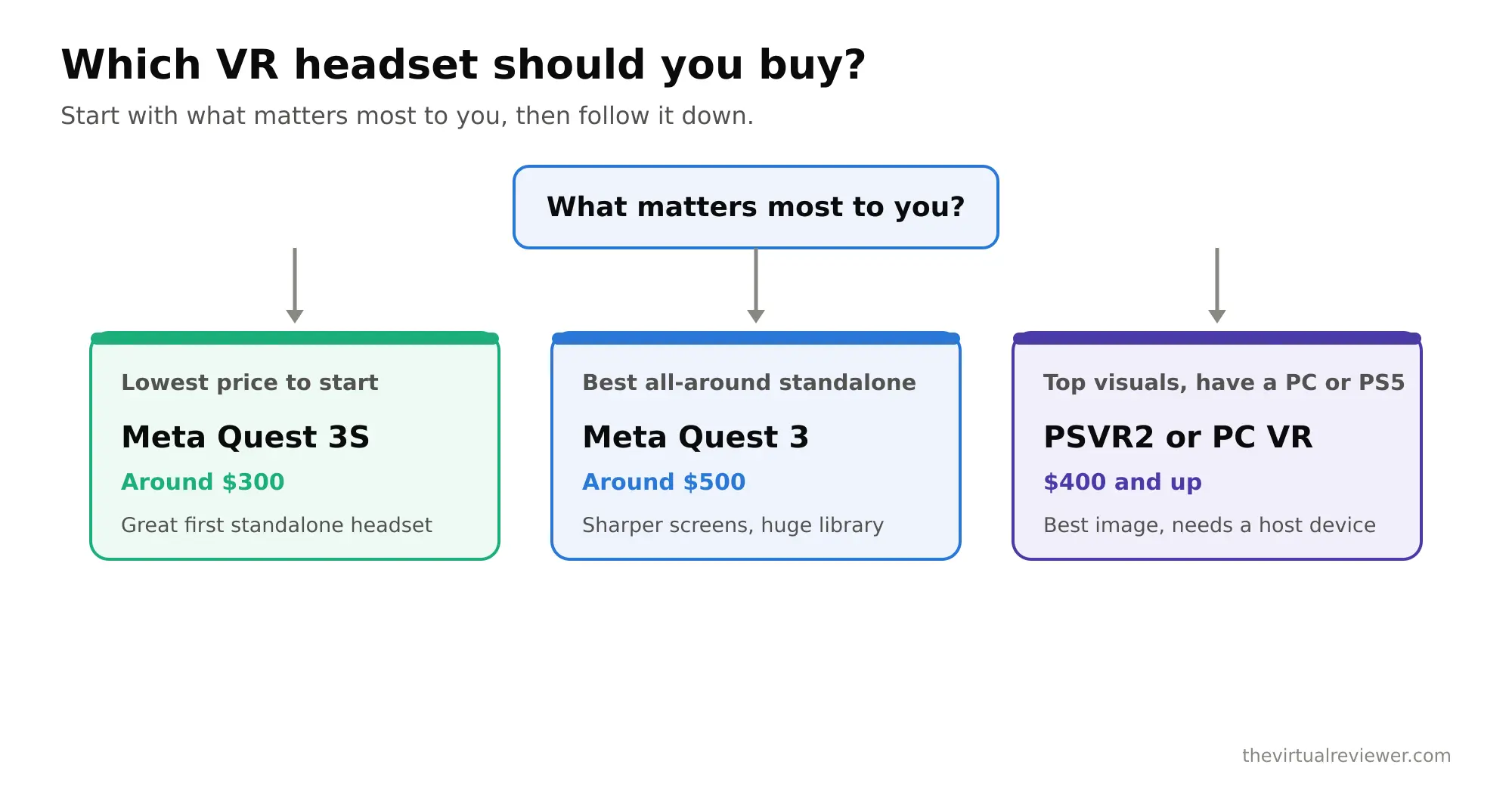
- Just curious and already own glasses? Get a Quest 3S, use the included spacer, keep your glasses on. Lowest cost to find out if you like VR.
- Know you will use it often? Get the Quest 3 and order prescription inserts. Best comfort, best field of view, no fogged-up glasses.
- Shared family headset? Quest 3 plus magnetic quick-swap inserts, one set per person who needs them.
- Big or thick frames? Skip wearing them entirely and go straight to inserts. It is easier than fighting the fit.
FAQ
Can I wear my glasses inside a Meta Quest 3?
Yes. Adjust the eye-relief depth using the side buttons, and keep frames under 142mm wide and 50mm tall. If your frames are larger, use a spacer or prescription inserts instead.
Will my glasses scratch the headset lenses?
They can if frames press directly against the optics, which is exactly why the spacer and depth adjustment exist. Set proper clearance first, or use inserts so your glasses never touch the lenses at all.
Are prescription inserts worth it over just wearing glasses?
For regular use, yes. Inserts give a wider comfortable viewing area, less fogging, no frames shifting mid-game, and a lighter feel on your face. They cost about $50 to $80 and take a week or two to arrive.
Do Quest 3 and Quest 3S use the same inserts?
No. The two headsets have different optics, so their inserts are not interchangeable. Always order for your specific model.
What if I have a strong prescription or astigmatism?
Several sellers, including Reloptix and Zenni, support higher diopters and astigmatism. Check each seller’s prescription range before ordering, and confirm they can do your exact numbers.