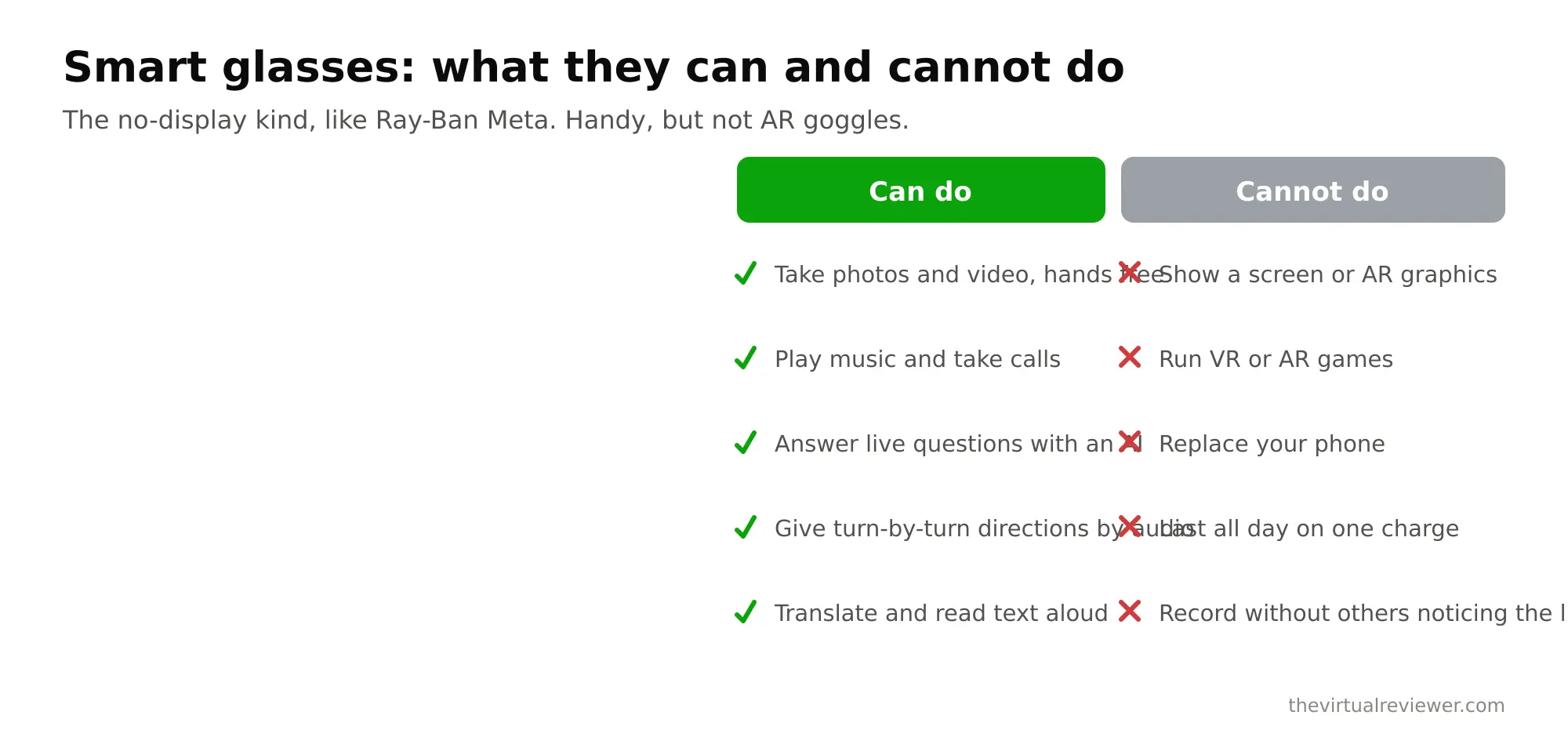
The Oakley Meta HSTN is a pair of sport-focused smart glasses built by Oakley and Meta together, starting at $399, and like the Ray-Ban versions it has no display inside the lenses. It shoots 3K video, plays audio through open-ear speakers, answers questions with Meta AI, and, the part athletes care about, it comes with polarized PRIZM lenses and a bigger, more athletic frame. The name is pronounced like “Houston.” I have played location-based VR at more than 50 real venues, so I will say plainly: these are not a VR headset and will not drop you into a game. They are a camera-audio-AI accessory designed to survive a run, a ride, or a day on the slopes.
If you already looked at the Ray-Ban Meta glasses and thought they seemed a little dressy for your workouts, the Oakley Meta HSTN is Meta’s answer. Let me break down what you get, where reviewers pushed back, and who should actually spend the $399.
Oakley Meta HSTN specs at a glance
| Spec | Oakley Meta HSTN |
|---|---|
| Starting price | $399 (Limited Edition $499) |
| Availability | From August 26, 2025 |
| Display in lens | None (audio, camera, AI only) |
| Camera | 12 MP, up to 3K video |
| Battery (glasses) | Up to 8 hours typical, 19 hours standby |
| Fast charge | About 50% in 20 minutes |
| Charging case | Up to 48 extra hours |
| Lenses | PRIZM, PRIZM Polarized, Clear, Transitions |
| Prescription range | -6.00 to +4.00 |
| Water resistance | IPX4 (splash/sweat resistant) |
Please confirm the current price and lens configurations against Meta’s spec page before publishing, since combos and colorways change.
What the Oakley Meta HSTN gets right
Three things stand out, and they are the three that separate this from the Ray-Ban pairs.
First, the lenses. The HSTN ships with polarized PRIZM lenses by default, and reviewers consistently called out how much they cut glare. Colors pop, the world looks crisper, and for anyone who spends real time outdoors that is a meaningful daily upgrade over standard tinted lenses. You can also get Clear and Transitions options, and prescription support runs from -6.00 to +4.00, so most people can get their real prescription built in.
Second, battery and charging. The glasses are rated up to eight hours of typical use, roughly double the original Ray-Ban Meta, with up to 19 hours on standby. They also fast charge to about 50 percent in 20 minutes, and the case holds up to 48 more hours. For a long day of activity, that runtime is the difference between the glasses being a toy and being reliable gear you actually trust to last.
Third, the fit. The HSTN uses a larger, sportier Oakley frame that reviewers said stays put during hard movement, which is the whole point for runners and cyclists. The 3K camera and improved video stabilization mean your action clips finally look usable rather than like a shaky afterthought.
Where reviewers pushed back
I always want you grounded, so here are the honest knocks from people who tested them.
Fit cuts both ways. Several reviewers noted the frame runs a touch snug at the bridge, snugger than either Ray-Ban Meta generation, so if you have a larger nose you may feel pressure over a long session. The frame also sits lower-profile than big wraparound sport shades like the Sutro, so it does not give you the same full face coverage some athletes want.
On video, the sharper 3K stills impressed, but a few reviewers felt the footage still falls a bit short for serious action use, citing limited color range and frame-rate that does not fully satisfy fast-motion clips. It is great for a social post, less so for polished sports edits.
And the durability rating is the same IPX4 as Ray-Ban Meta, meaning splash and sweat resistant, not waterproof. Meta’s more rugged Oakley Meta Vanguard carries a tougher rating for people who want more protection, so the HSTN is not the pick for extreme conditions.
Reviewers generally landed on this: the HSTN is the best smart glasses for an active lifestyle right now, but the upgrades matter most to serious athletes and power users and may be more than a casual buyer needs.
The VR arcade lens: do these bring the arcade home?
Families who just had a blast at a VR venue often ask if a pair of smart glasses recreates that thrill at home. I get the instinct, and I have to be straight with you: it does not, because these solve a different problem. If your crew loved the haptic vests and free-roam space at Sandbox VR or the arena rigs at EVA Esports, that immersion came from a full headset and body tracking. The Oakley Meta HSTN keeps you fully in the real world and just adds a camera, speakers, and Meta AI.
So these are not a home VR headset and are not trying to be. Where they shine relative to that arcade day is capturing it. Because the HSTN is built for motion, it is the pair I would actually wear to film first-person clips of an active outing, a bike ride to the venue, a hike, a day at the field. A headset covers your face and cannot capture your point of view of the real world at all. I think of them as complementary: the arcade transports your whole body, the glasses document your real life in motion. If you are weighing home VR gear too, our homepage hub has the full library.
Who the Oakley Meta HSTN is for
Buy the HSTN if you are active outdoors and want smart glasses that survive a run, ride, or hike, value the polarized PRIZM lenses and all-day battery, and like a bigger sport frame. For athletes, this is the standout pick in the lineup at $399.
Skip it if you want the dressier everyday look of Ray-Ban Meta, if you have a wider nose bridge that the snug fit might bother, or if you specifically need a display or true waterproofing. And if you were hoping for a VR experience, that is a different device entirely.
Verdict
The Oakley Meta HSTN is the smart-glasses pick I would hand to an active friend without hesitation. Polarized PRIZM lenses, up to eight hours of battery, fast charging, and a frame that stays put during hard movement make it the best option in the line for outdoor and sport use at $399. The knocks are real but narrow: a snug bridge, video that is good rather than pro-grade, and only IPX4 water resistance. Judge it as sporty everyday camera-and-audio glasses, not as VR, and it earns its spot. Just remember there is no screen and no swimming.
FAQ
Does the Oakley Meta HSTN have a display?
No. It is a no-display design. Meta AI responses come through the speakers, and anything visual still happens on your phone.
How much does the Oakley Meta HSTN cost?
Standard configurations start at $399, and the Limited Edition runs $499. Confirm current pricing and lens combos before you buy.
What is the battery life on the Oakley Meta HSTN?
Up to about eight hours of typical use and 19 hours on standby, with fast charging to roughly 50 percent in 20 minutes and a case that holds up to 48 more hours.
How is the HSTN different from Ray-Ban Meta?
Bigger sport frame, polarized PRIZM lenses by default, and longer battery than the original Ray-Ban Meta. The trade-off is a snugger bridge and a less dressy everyday look.
Can the Oakley Meta HSTN replace a VR headset?
No. It has no display and does not run immersive VR. It is for capturing and narrating real life in motion. A home VR headset is the tool for the arcade-style experience.
Related reads
- Ray-Ban Meta vs Oakley Meta HSTN
- Best free Meta Quest 3 games
- Best VR headset 2026
- Home VR vs the arcade: is a Quest 3 as good as Sandbox VR