If you have ever had someone ask you “wait, is that VR or AR or that mixed reality thing?” and watched their eyes glaze over during your answer, this one is for you. What is mixed reality, and how does XR fit with VR and AR? The short version: mixed reality (MR) blends digital objects into your real room so they look like they actually belong there, and XR is the umbrella term that covers all of it. That is it. The rest is detail, and I am going to walk you through the detail the way I explain it to my kids John and Jenette at the dinner table.
I have played virtual reality at more than 50 real venues across the country, from free-roam arenas to full-body haptic setups, and I now cover the home headsets too. So I have seen these terms get thrown around by marketing teams who want to sound futuristic. Let me cut through it.
The one-line definitions
Here is the whole family in one place, no jargon.
| Term | What it means | What you see | Real 2026 example |
|---|---|---|---|
| VR (Virtual Reality) | A fully digital world replaces everything around you | You see nothing from your real room | Beat Saber, Half-Life: Alyx |
| AR (Augmented Reality) | Simple digital info floats over your real view | Real world plus light overlays | Ray-Ban Meta glasses, phone AR filters |
| MR (Mixed Reality) | Digital objects blend into your real room and react to it | Your real room with virtual things anchored in it | First Encounters, Drop Dead: The Cabin on Quest 3 |
| XR (Extended Reality) | Umbrella term for all of the above | Depends which mode | Any headset that does more than one |
If you remember nothing else, remember this line I use all the time: AR adds to your world, VR replaces it, and MR blends the two. XR is just the shopping-bag word that holds all three.
Virtual reality: the full escape
VR is the one most people picture first. You put on a headset, the outside world disappears, and you are standing on a spaceship or a mountain or a zombie-filled street. The headset blocks your real surroundings completely and feeds each eye its own image so your brain reads depth. This is the version I fell in love with, and it is still the deepest form of immersion you can buy.
The best VR I have ever felt was not at home though. It was at location-based venues where the operators add things a living room cannot. At Sandbox VR in Vegas I wore a full-body haptic vest and walked freely through a shared space with my family, feeling hits land on my chest. That is still pure VR, a world that replaces yours, just cranked up with hardware you will not find in a home kit.
Augmented reality: a light layer on the real world
AR keeps you fully in your real world and drops simple digital information on top. Think turn-by-turn arrows on your windshield, a Snapchat filter that gives you dog ears, or a pair of smart glasses that shows you a text message and the time. You stay completely aware of your surroundings the whole time.
The key thing with most AR, and the reason it gets confused with mixed reality, is that the digital stuff usually does not understand your room. A notification floating in your glasses does not know where your coffee table is. It is a layer, not a blend. Products like the Ray-Ban Meta glasses are AR-adjacent, and many do not even have a screen in the lens, they just use audio and a camera. That is a real distinction worth knowing before you spend money.
Mixed reality: where the room becomes the game
Now the star of the show. Mixed reality is what happens when the digital objects do not just float, they understand and interact with your actual physical space. A virtual spaceship crashes through your real ceiling. Zombies climb through your actual living-room window. A virtual chess board sits on your real dining table and stays there when you walk around it.
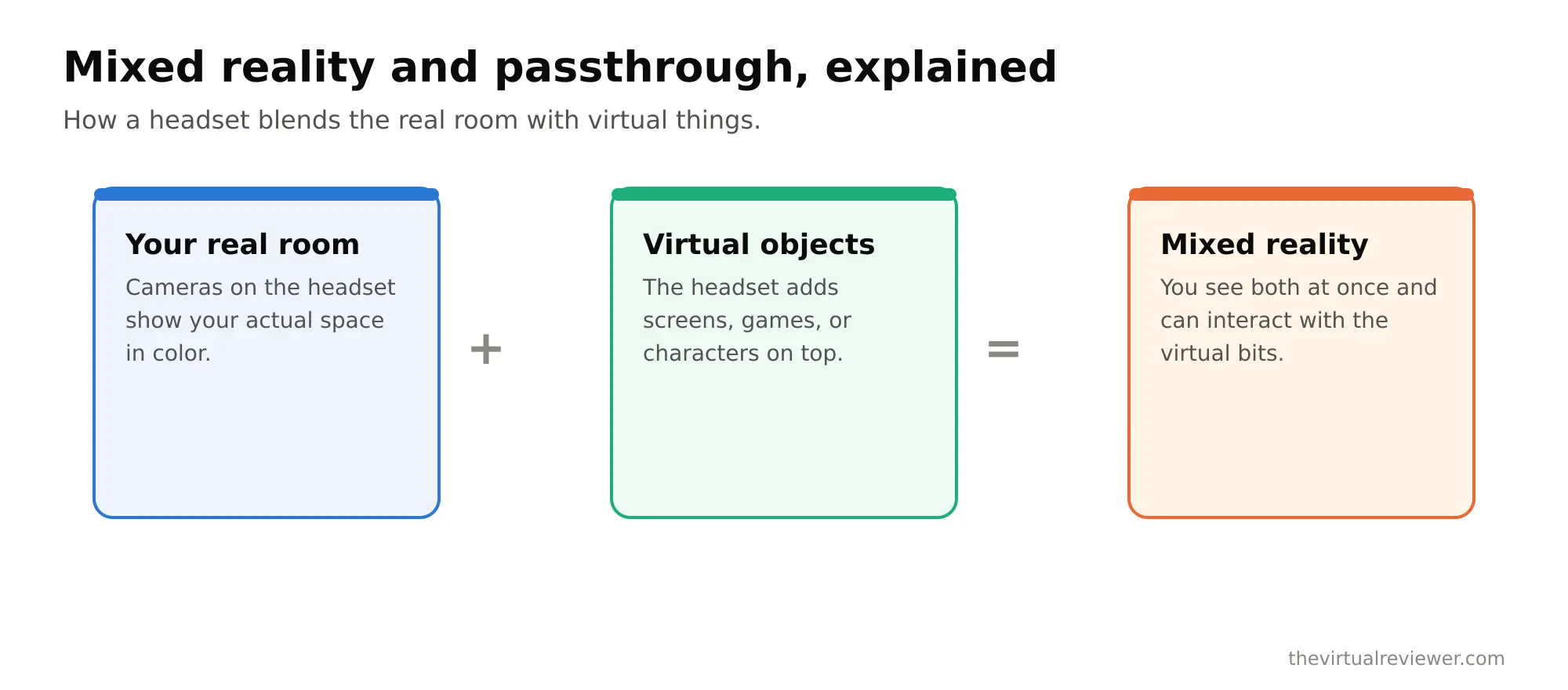
The way most home headsets pull this off in 2026 is called passthrough. Cameras on the front of the headset capture your real room in color and show it to you on the inside screens, then the software layers digital objects into that video and anchors them to your walls, floor, and furniture. On a Quest 3, the headset scans your room so the game knows where your surfaces are. That is why a game like First Encounters can have aliens breach your specific walls, or why Drop Dead: The Cabin can send zombies smashing through your real windows.
I have tried a stack of these. Home Sports turns your den into a pickleball and mini-golf court. PianoVision lays glowing notes over a real MIDI keyboard so you can learn to play. Cubism floats a puzzle in the air in front of your couch. The magic of MR is that you can still see your dog, your kids, and your coffee, so it feels less isolating than full VR. My wife Patty, who gets a little uneasy when she cannot see the room, is far more comfortable in mixed reality than in a full blackout headset.
XR: the umbrella you keep seeing
XR, or extended reality, is not a separate gadget you can buy. It is the industry catch-all for VR plus AR plus MR. When a company says its headset “does XR,” it usually means the thing can switch between a fully virtual mode and a passthrough mixed-reality mode. The Quest 3 is a good example. Beat Saber is VR, blocked out completely. Then you close it, tap passthrough, and your room comes back with digital menus floating in it. Same headset, two modes, all under the XR label.
Analysts have been throwing big numbers around the whole extended-reality category for years, projecting it into the hundreds of billions, so you will see XR in a lot of press releases. Do not let the buzzword scare you. It is just the family name.
So which one do you actually want?
Here is my honest take as a dad who has paid for this stuff.
- If you want to escape into other worlds, big cinematic games, fitness, that jaw-drop feeling, you want strong VR.
- If you want light everyday info, walking around, glancing at messages, taking hands-free photos, you want AR glasses.
- If you want your own home to become the playground and you want to keep an eye on your kids while you play, you want a headset with great MR passthrough.
The good news is that the mainstream headsets in 2026 do VR and MR both, so you are rarely picking just one. The comparison that actually matters is which headset does each mode well, and that is where research pays off before you buy.
FAQ
Is mixed reality the same as augmented reality?
No, though they overlap. Both let you see your real world. The difference is depth of interaction. AR usually floats simple info on top without understanding your space. MR anchors digital objects into your actual room so they sit on your table, hide behind your couch, and react to your walls.
Do I need special glasses for mixed reality, or does a VR headset do it?
Most people experience MR through a VR headset with color passthrough cameras, like the Quest 3 or Apple Vision Pro, not through thin glasses. The headset shows you your real room on its inside screens and layers digital objects into that view. True lightweight MR glasses are still early.
Is XR a type of headset I can buy?
Not exactly. XR is an umbrella term covering VR, AR, and MR together. When a product is marketed as XR, it usually means it can switch between a fully virtual mode and a mixed-reality passthrough mode.
Is mixed reality safer to move around in than full VR?
Generally yes for casual movement, because you can see your real furniture and family through passthrough. That said, always clear your play space. Passthrough is helpful but it is still a camera feed, not your own eyes, so it can misjudge distance.
Can I try mixed reality before buying a headset?
You can try full VR at location-based venues right now, and some arcades are adding MR-style experiences. Playing free-roam VR at a place like EVA Esports or Fixation VR is the fastest way to feel real immersion before you spend on a home kit.
The bottom line
Mixed reality is the one worth getting excited about right now because it meets you in your own home instead of shutting the room out. VR replaces your world, AR adds a light layer to it, MR blends digital objects into it, and XR is the word that covers all three. Once that clicks, every headset ad you read suddenly makes sense. Start from what you want your living room to become, and the term you need picks itself.