Passthrough VR is the feature that lets your headset show you the real room around you through its outside cameras, so you can see your couch, your coffee table, and your kids walking in without taking the headset off. That is the short answer. If you have ever fumbled around blind trying to find your controller on the floor, passthrough is the fix, and on newer headsets it does a whole lot more than just keep you from tripping.
I have played virtual reality at more than 50 real venues, and the fancy free-roam arenas rely on operators and physical space to keep you safe. At home you do not have a staff member watching you, so passthrough is the thing standing between you and your shins. Let me walk you through what it actually is, how it works, and why it changed how my family uses VR in our living room.
Passthrough VR in one sentence
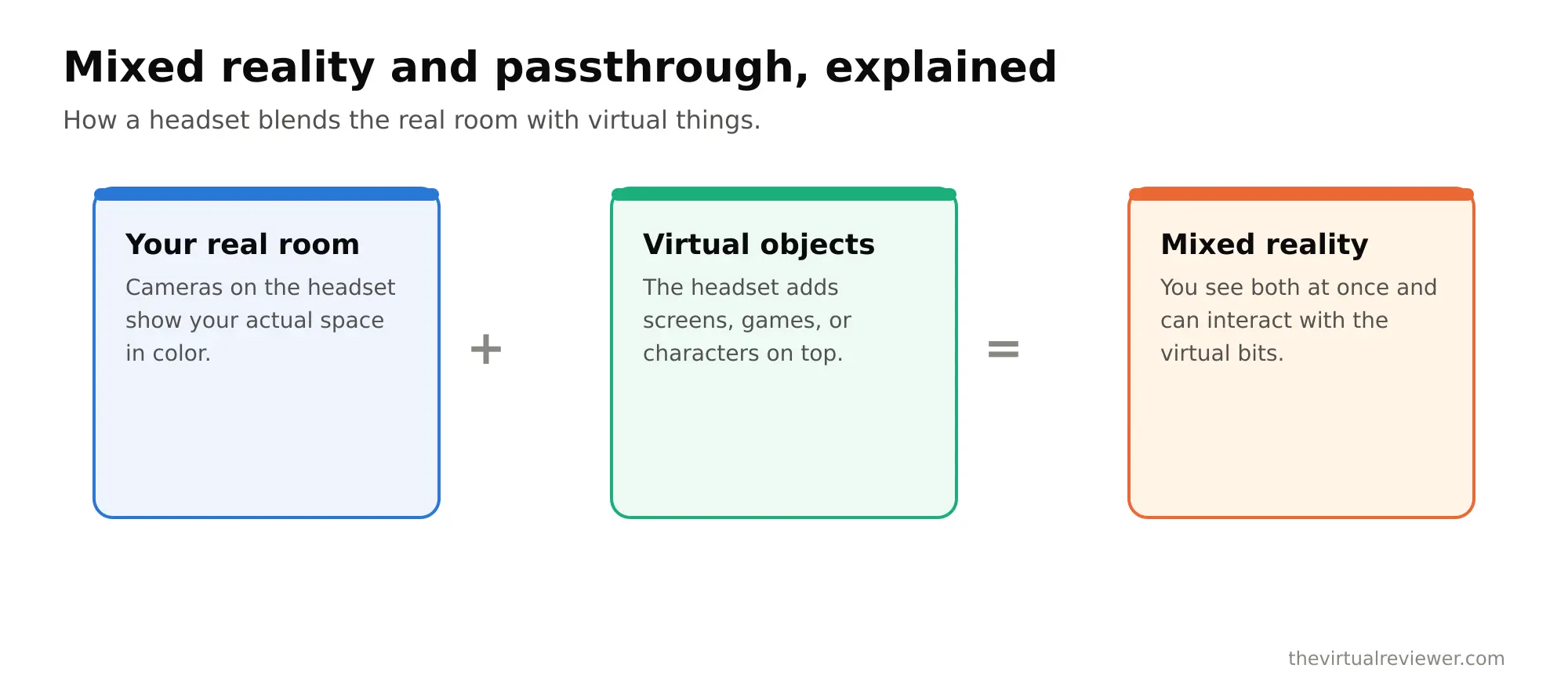
Passthrough uses the cameras on the front of your headset to feed a live video of your surroundings onto the screens inside, so the headset becomes see-through even though it is strapped to your face. Older headsets did this in grainy black and white. The current generation does it in full color, which is why you now hear the phrase color passthrough thrown around so much.
That upgrade from gray to color is the whole reason mixed reality took off. When the camera view looks like your actual room, developers can drop virtual objects into it and your brain buys it.
Passthrough vs full VR vs mixed reality
These three terms get mixed up constantly, so here is how I keep them straight.
| Term | What you see | When you use it |
|---|---|---|
| Full VR (immersive) | A 100 percent virtual world, room blocked out | Games and experiences meant to transport you |
| Passthrough | A live camera view of your real room | Finding controllers, answering the door, drinking coffee |
| Mixed reality (MR) | Your real room with virtual objects added on top | Games and apps that blend both worlds |
Passthrough is the plumbing. Mixed reality is what you build on top of it. A headset needs good passthrough before it can do good mixed reality, which is why the two get talked about together.
How passthrough actually works
The front of a modern headset has a small cluster of cameras. On the Meta Quest 3, two of those are color RGB cameras that capture the world in stereo, meaning one for each eye, so you get a sense of depth instead of a flat picture. That stereo capture is a big deal. The Quest Pro before it only captured color from a single point, so the world looked oddly flat. Two cameras give your eyes the slightly different angles they expect, and that is what makes reaching for a real cup feel natural.
There is also depth sensing in the mix. People assume the little depth projector on the Quest 3 is doing all the heavy lifting, but it mostly maps your room once during setup. The moment-to-moment depth that lets a virtual ball roll behind your real sofa comes from software comparing the views of the tracking cameras, plus Meta’s Depth API that gives apps a live, per-frame read of how far away things are. That is the trick behind occlusion, where a digital object correctly disappears behind a physical one.
One honest caveat: passthrough loves light. Meta says full color passthrough works best in a room with at least about 50 lux, which is roughly soft evening lamp light in a family room. Crank the lights down and the image gets noisy and grainy, with a bit of warping around the edges of objects. I noticed this the first night I tried MR after dark. It works, it just looks rougher.
Why passthrough matters for home VR
Here is the thing that connects passthrough to how I actually think about VR. When my family plays free-roam games at a venue like Sandbox VR, the whole point is total immersion. You wear a haptic vest, you walk a large padded room, and a staff member has cleared every obstacle for you. The same is true in the big arena rigs I tried at EVA Esports. There is no couch to bang into because the whole space is built for VR.
Your living room is not built for VR. That is exactly the gap passthrough fills. Instead of drawing a guardian boundary and hoping the dog does not wander in, you can glance at the real world instantly. Double tap the side of most headsets and the room appears. It is the single biggest reason home VR feels safer and more sociable than it did five years ago, and it is why I stopped nagging the kids to clear the entire room before every session.
Passthrough also makes the headset less isolating. Patty can walk in, I can see her face, we can talk, and I do not have to yank the whole rig off. That sounds small. It is not. It is the difference between VR being a solo cave and being something the family drifts in and out of.
What you can actually do with good passthrough
Once passthrough is sharp and in color, mixed reality apps get genuinely fun. A few real uses my family reaches for:
- Tabletop and room-scale MR games. Games pin virtual boards, targets, or creatures onto your real furniture. The Quest 3’s color cameras and depth make these look convincing rather than gimmicky.
- Virtual monitors and productivity. You can float a big screen on your real wall and still see your keyboard and your coffee. Handy for the work-from-home crowd.
- Fitness and mindfulness. Apps like TRIPP added passthrough features and saw real engagement bumps, because doing calm breathing in your actual living room beats being sealed inside a void.
- Just staying grounded. Even in a fully virtual game, a quick passthrough peek to check on a kid keeps the whole thing relaxed.
Which headsets have good passthrough right now
The two most common home headsets in 2026 are both from Meta. The Quest 3 has the higher-end color passthrough with a hardware depth sensor. The cheaper Quest 3S also does full color passthrough and mixed reality, but it uses different lenses and leans more on software for depth, so the image is a touch softer. Both are standalone, meaning no PC required, and both let you switch to passthrough on the fly. If mixed reality is your main draw, the Quest 3 is the sharper pick. If budget rules, the 3S still gets you into the same MR apps.
How to pick, if passthrough is what you care about
Ask yourself one question: do you want VR that transports you, or VR that blends into your real room? If you mostly want to be dropped into other worlds, passthrough quality matters less and you can save money. If you are excited about mixed reality games, virtual screens, and having the real room visible, prioritize a headset with color passthrough and a depth sensor, and make sure your play space has decent lighting. That combination is what makes the feature shine.
FAQ
Is passthrough the same as augmented reality?
Close, but not identical. Traditional AR, like phone AR or clear glasses, shows the real world directly and adds graphics. Passthrough shows the real world through cameras and screens. The end result feels similar for mixed reality games, but passthrough is camera-based video, not a see-through lens.
Does passthrough drain the battery faster?
Running the cameras and processing the video does use power, so heavy mixed reality sessions can shorten your runtime a bit compared to a simple menu screen. It is not dramatic, but it is real. A battery head strap helps a lot for long MR sessions.
Why does my passthrough look grainy or warped?
Usually low light. Color passthrough needs a reasonably bright room, around 50 lux or more, to look clean. Turn on more lamps and the noise and edge warping shrink noticeably. Dirty or smudged cameras also hurt image quality, so wipe the front of the headset.
Can passthrough replace taking the headset off?
For quick things, yes. You can see well enough to grab a drink, check your phone, or talk to someone. For anything requiring fine detail or reading small text across the room, the camera image is not as crisp as your own eyes, so you will still lift the headset sometimes.
Do all VR headsets have passthrough?
Most current headsets do, but quality varies a lot. Older or budget models had black and white passthrough that was fine for safety but useless for mixed reality. If MR matters to you, check specifically for full color passthrough before buying.
The bottom line
Passthrough VR is the see-through camera view that turns a sealed headset into something you can actually live in for a while. On modern hardware it is in full color, it powers mixed reality, and it is the main reason home VR now feels safe and sociable in a normal living room instead of a cleared-out gym. It will never match the immersion of walking a real free-roam arena, but it does something the arena cannot: it lets VR share space with your everyday life. For my family, that is what made the headset a keeper. If you are still deciding between playing at a venue and buying for home, my venue reviews and city guides are a good next stop.