The Ray-Ban Meta vs Xreal glasses question trips people up because they assume these two do the same thing, and they really do not. Ray-Ban Meta glasses are AI camera glasses with no picture in the lens. Xreal glasses are AR display glasses that project a giant virtual screen in front of your eyes but need to be plugged into a phone or console to do it. One is for capturing your life and talking to an AI. The other is for watching and gaming on a huge private screen. Pick the wrong one and you will be disappointed, so let me sort it out.
I spend most of my time on real VR, the free-roam and haptic-vest kind you get at a good venue, but the glasses category is where a lot of dads are dipping in first because you can actually wear these out of the house. Here is how the two lines really compare in 2026.
Ray-Ban Meta vs Xreal glasses at a glance
| Feature | Ray-Ban Meta (Gen 2) | Xreal One / One Pro |
|---|---|---|
| Category | AI camera glasses | Tethered AR display glasses |
| In-lens display | No | Yes, dual micro-OLED |
| Price | About $379 | $499 (One) / $599 (One Pro) |
| Weight | About 52g | About 84g to 87g |
| Camera | 12MP ultra-wide, up to 3K video | None |
| AI assistant | Meta AI, hands-free | None |
| Display size | N/A | Up to about 147-inch virtual screen |
| Field of view | N/A | About 50 degrees (One Pro up to 57) |
| Needs a phone or console? | No, works standalone | Yes, USB-C to phone, PC, or console |
| Battery | About 8 hours mixed use | Powered by the connected device |
Prices reflect what I could confirm in 2026 and both lines run frequent sales, so check current pricing. There is also a third option worth knowing about, covered below.
The one difference that decides everything
Ask yourself what you want the glasses to do.
If you want to take photos and video hands-free, listen to music, and ask an AI questions while you walk around, that is Ray-Ban Meta. They look like normal Wayfarers, weigh about 52 grams, and have no screen inside the lens at all. Nothing is displayed to you. The intelligence is the camera and the audio and Meta AI in your ear.
If you want a huge private movie theater or gaming screen floating in front of you, that is Xreal. The One and One Pro have real dual micro-OLED displays built into the lenses that throw a virtual screen up to around 147 inches. But they are tethered: you plug them into a phone, a gaming PC, a Steam Deck, or a console over USB-C, and that device does the work and provides the power. On their own they show you nothing.
So it is capture and AI versus display and screen. That is the whole ballgame.
Ray-Ban Meta: the everyday AI camera glasses
The Gen 2 Ray-Ban Meta glasses lean into being wearable all day. They come in the familiar Ray-Ban shapes like Wayfarer and Headliner, weigh around 52 grams so they feel like regular sunglasses, and pack a 12MP ultra-wide camera that shoots up to 3K video. Meta AI handles voice questions, real-time translation, music control, and hands-free capture. Battery life lands around 8 hours of mixed use, enough for a day out.
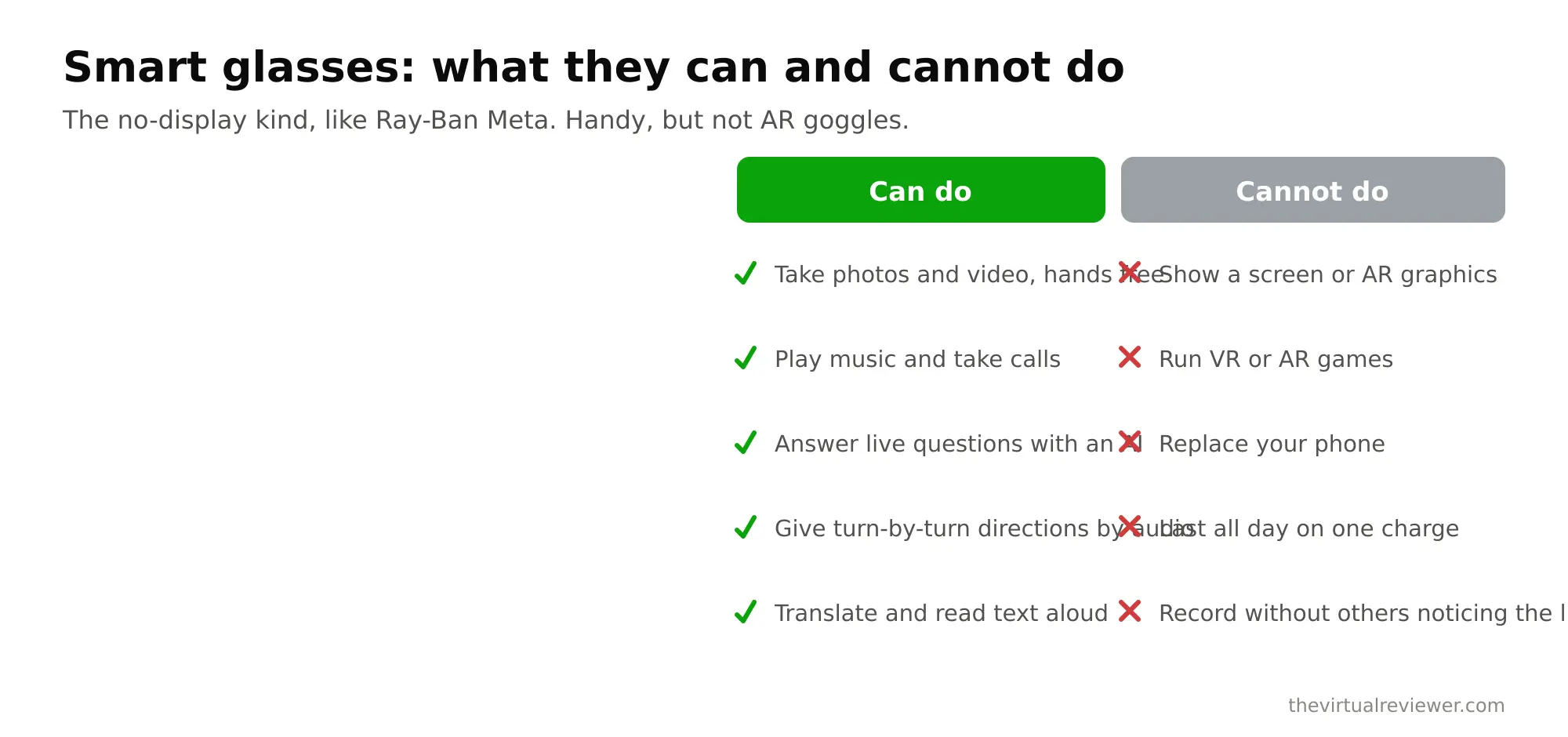
What they cannot do is show you a screen. No navigation arrows in your view, no video playback in the lens, no floating monitor. If that is what you pictured, this is not it.
Xreal One and One Pro: a private big screen you plug in
Xreal makes what many reviewers call the best tethered display glasses you can buy. The One and One Pro use dual 1080p micro-OLED panels, a field of view around 50 degrees on the One and up to 57 on the One Pro, low 3ms latency, and a standout trick: onboard 3DoF anchoring that pins the virtual screen in place so it does not swim around when you turn your head. Plug them into a phone, laptop, Steam Deck, or console and you get a massive personal display for movies, work, or gaming on a plane, a couch, or a hotel bed.
The trade-offs are just as clear. No camera, no AI assistant, and no standalone use. They are a display accessory, so you are stringing a cable to a source device and you are best off stationary or seated.
Do not confuse these with the Meta Ray-Ban Display
Worth flagging because the names overlap. In late 2025 Meta launched a separate product, the Meta Ray-Ban Display, at $799. Unlike the regular Ray-Ban Meta, it does have a small full-color heads-up display in the right lens for texts, directions, and AI prompts, and it ships with an EMG wristband called the Meta Neural Band to control it. That is a different, pricier device than the camera-only Ray-Ban Meta in this comparison, and its tiny HUD is nothing like Xreal’s full-screen cinema view. If someone says “Ray-Ban Meta with a display,” this is what they mean, and it is closer to a notification screen than a media display.
How glasses compare to real VR at a venue
Let me be straight, because this is what I do. Neither of these is virtual reality. I have played full-body, free-roam VR at spots like Sandbox VR and big arcades like Fixation VR, where you wear a haptic vest, physically walk a tracked space, and get fully surrounded. Smart glasses and AR display glasses do not immerse you like that and do not try to.
Ray-Ban Meta is a lifestyle wearable for capturing your day. Xreal is a portable private monitor. Both sit on the light, everyday end of the spectrum, the opposite of strapping into an arena rig. If the thing that hooked you was that full-body venue experience, glasses will not scratch that itch, and a standalone VR headset or another venue trip is the better move. You can browse our venue write-ups on the homepage to plan one. Glasses are for the in-between moments; the venue is the main event.
Who should buy which
Buy Ray-Ban Meta (Gen 2) if you want stylish everyday glasses that capture hands-free photo and video, play audio, and run Meta AI, and you do not need anything shown in the lens. Around $379.
Buy Xreal One or One Pro if you want a huge private screen for movies, work, and gaming that you plug into your phone, PC, or console. Around $499 to $599, tethered, no camera or AI.
Look at the Meta Ray-Ban Display instead if you specifically want a small heads-up display for notifications and directions in a Ray-Ban form factor, and you are fine paying $799 for it plus wearing the Neural Band.
FAQ
Do Ray-Ban Meta glasses have a display in the lens?
No. The standard Ray-Ban Meta glasses have a camera, speakers, and Meta AI, but nothing is shown in the lens. If you want a heads-up display in a Ray-Ban frame, that is the separate Meta Ray-Ban Display at $799, which includes a small HUD and a control wristband.
Do Xreal glasses work on their own?
No. Xreal One and One Pro are tethered AR display glasses. You plug them into a phone, laptop, Steam Deck, or console over USB-C, and that device powers them and provides the content. On their own they do not display anything.
Which is better for watching movies or gaming?
Xreal, clearly. It projects a large virtual screen, up to about 147 inches, with dual micro-OLED displays and low latency, ideal for movies and gaming from a connected device. Ray-Ban Meta has no screen at all.
Which glasses are better for everyday wear?
Ray-Ban Meta. At about 52 grams in classic frame styles with around 8 hours of battery, they look and feel like normal sunglasses. Xreal glasses are heavier, tethered, and meant for seated screen time rather than all-day wear.
Can either replace a VR headset or a venue trip?
No. Neither immerses you the way VR does. Venues like Sandbox VR and Fixation VR add haptic vests and free-roam tracked space, and even a home VR headset surrounds you far more than glasses do. Think of these as light everyday devices, not VR.
The bottom line
Ray-Ban Meta vs Xreal glasses comes down to capture-and-AI versus display-and-screen. Ray-Ban Meta is the everyday wearable that photographs your life and talks back through Meta AI, no screen in sight. Xreal One and One Pro are the plug-in private cinema for movies, work, and gaming. Neither is VR, and if the full-body venue experience is what you are chasing, keep an arcade night on the calendar and treat these as the light, wear-anywhere tools they are.