Ray-Ban Meta is Meta’s line of camera-and-audio smart glasses that look like normal Ray-Bans and, key point, have no display inside the lenses. The original Ray-Ban Meta launched on October 17, 2023 at a starting price of $299, and now that a newer Gen 2 exists, the first-generation pairs have dropped in price and become one of the better tech deals for families. I have played location-based VR at more than 50 real venues, so let me be clear up front: these are not a VR headset. They will not put you inside a game. They are a genuinely useful everyday accessory that takes hands-free photos, plays audio, and answers questions through Meta AI.
I want to help you sort out two things in this review. First, what the Ray-Ban Meta glasses actually do well and where they fall short. Second, the question a lot of shoppers have right now: with the discounted Gen 1 sitting next to the pricier Gen 2, which one makes sense for you.
Ray-Ban Meta specs at a glance
| Spec | Ray-Ban Meta (Gen 1) |
|---|---|
| Launch date | October 17, 2023 |
| Starting price | $299 (often discounted now) |
| Display in lens | None (audio, camera, AI only) |
| Camera | 12 MP, up to 1080p video |
| Storage | 32 GB on device |
| Battery (glasses) | About 4 hours typical, up to 6 mixed |
| Charging case | About 24 extra hours |
| Weight | About 48g |
| Styles | Wayfarer, Headliner, Skyler |
| Assistant | Meta AI, hands-free voice |
Please confirm the live price and any bundle before publishing, since Gen 1 pricing has been moving as retailers clear stock.
What Ray-Ban Meta does well
The core idea is simple and it works. There is a 12 MP camera in the frame and a button on the temple, so you capture a photo or short video from your own point of view without ever raising a phone. As a dad, this is the feature that sold me on the whole category. My hands are usually holding a kid, a bag, or a juice box, and having the camera on my face means I catch moments I used to fumble and miss.
The audio is the other daily-use win. Open-ear speakers pipe podcasts, music, and phone calls to your ears without blocking out the world, which matters when you are watching kids at the park. A five-microphone array picks up your voice for calls and voice commands, and callers generally told me I sounded clear outdoors. You also get 32 GB of onboard storage for your captures and the ability to livestream to Facebook and Instagram, which some parents use for grandparents who cannot be there in person.
Meta AI rounds it out. You can ask hands-free questions, and after a 2024 update the glasses gained multimodal smarts, meaning the assistant can reason about what the camera sees. Ask what a landmark is or to identify something in front of you and it answers through the speakers. Just remember every answer is audio, because there is no screen.
Where Ray-Ban Meta falls short
The honest weak spot on the original is battery. Real-world life lands around four hours, closer to six with light mixed use, and heavy photo-and-video days drain it faster. The folding case adds roughly 24 more hours across several top-ups, so you are rarely fully dead, but you will be popping them in the case more than you would like. This is the single biggest reason someone might step up to the newer generation, which roughly doubles the runtime.
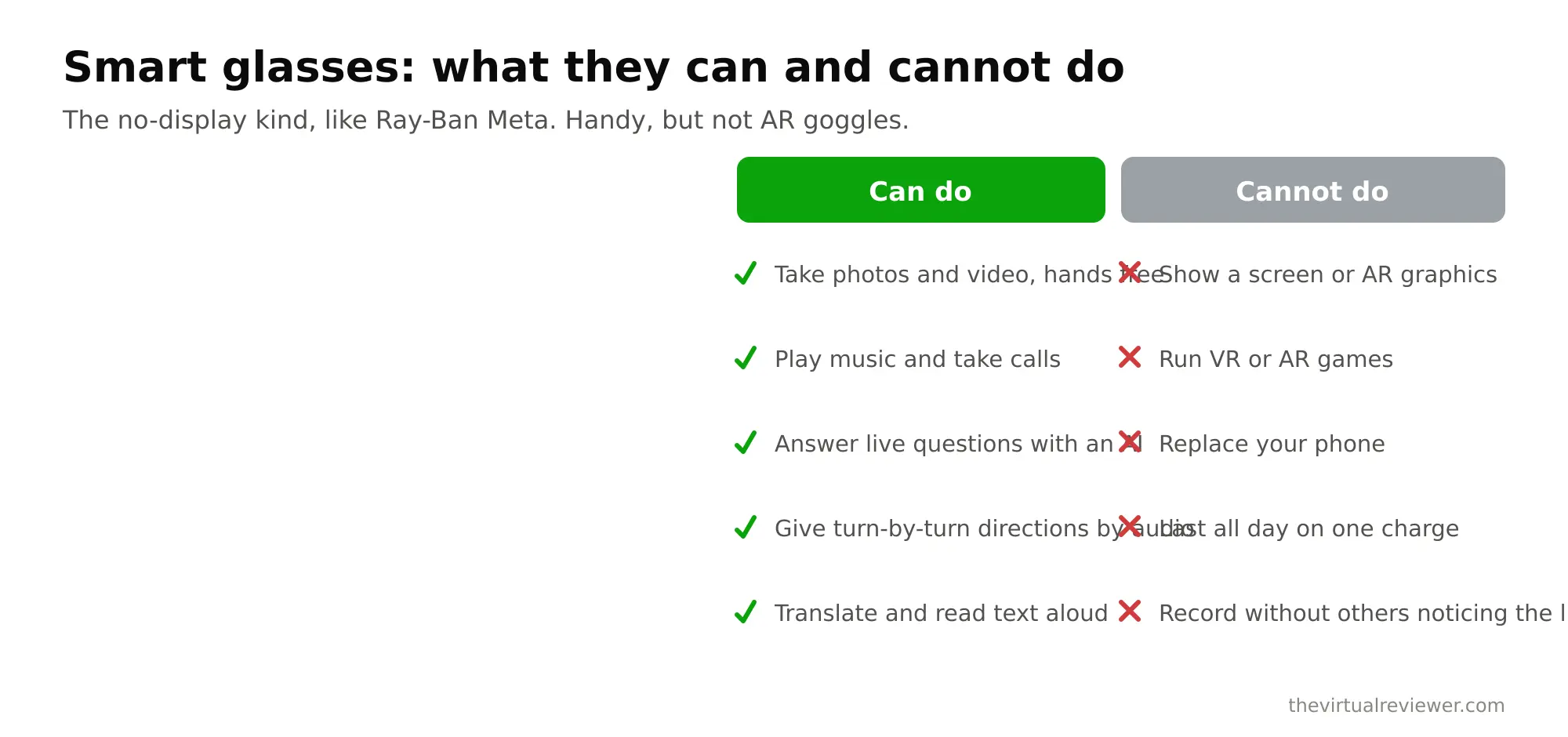
The other limits are inherent to the category, not flaws exactly. There is no display, so texts, maps, and video still live on your phone. The speakers leak a bit at high volume, so they are not ideal for a silent room. And filming near other people always calls for basic courtesy, even with the little capture light on.
Gen 1 vs Gen 2: which Ray-Ban Meta should you buy?
This is the real decision in 2026. The original Ray-Ban Meta and the newer Gen 2 look nearly identical and share the same everyday superpower. The differences that matter are camera and battery.
Gen 2 shoots up to 3K video versus 1080p on Gen 1, and it lasts up to about eight hours per charge versus roughly four. If you shoot a lot, travel often, or want the sharpest clips, the extra money for Gen 2 is easy to justify. If you are a lighter user who mostly wants hands-free snapshots, audio, and Meta AI, the discounted Gen 1 delivers the same core experience for less, and I think it is one of the smarter buys in the space right now. I break the newer model down in detail in our Ray-Ban Meta Gen 2 review if you want the side-by-side. There is also a sportier Oakley-branded option covered in our Oakley Meta HSTN review for outdoor and active folks.
The VR arcade lens: do smart glasses replace a headset?
Families who just had a great day at a VR venue often ask me if a pair of these brings the fun home. I love that instinct, but I have to keep it real. If you strapped into a haptic vest and roamed a free-roam arena at Sandbox VR, that immersion came from a full headset and body tracking. Ray-Ban Meta does the opposite job. It keeps you planted in the real world and just adds a camera, speakers, and a voice assistant.
So no, these do not replace a headset, and they are not trying to. What they are perfect for is capturing the day. Wearing Ray-Ban Meta into an arcade like Immersive Gamebox lets you film your kids’ faces from your own eyeline while everyone plays, something a face-covering headset simply cannot do. I think of the glasses and a home VR headset as two different tools for two different goals: one documents real life, the other transports you out of it. Our homepage hub has the full comparison library if you are weighing both.
Who Ray-Ban Meta is for
Buy the Ray-Ban Meta if you want easy hands-free photos and video, like audio and calls without earbuds, and want glasses that read as normal Ray-Bans. On the discounted Gen 1, it is a strong value pick for casual users. Step up to Gen 2 if the four-hour battery and 1080p ceiling would bother you.
Skip it entirely if you specifically need a display in your vision or you were hoping for a VR-style experience. Those are different products.
Verdict
Ray-Ban Meta nailed the everyday smart-glasses idea: a good camera and solid audio in a frame nobody mistakes for tech. The original’s short battery is its real weakness, but with Gen 1 now discounted it has become one of the best-value ways into the category, and for lighter users the difference from the pricier Gen 2 will not be worth the gap. Judge these as a hands-free point-of-view camera and a comfortable audio setup, not as VR, and they are genuinely easy to enjoy. Just go in knowing there is no screen and no swimming.
FAQ
Does Ray-Ban Meta have a display?
No. The Ray-Ban Meta glasses are a no-display design. Meta AI answers come through the speakers, and anything visual still happens on your phone.
How much are Ray-Ban Meta glasses?
The original launched at $299 and is frequently discounted now that Gen 2 exists. Confirm the current retailer price, since it has been moving.
What is the battery life on the original Ray-Ban Meta?
About four hours of typical use, up to roughly six with lighter mixed use, plus about 24 more hours from the folding charging case.
Should I buy Gen 1 or Gen 2?
Get the discounted Gen 1 if you are a casual user who mostly wants photos, audio, and Meta AI. Step up to Gen 2 for its 3K camera and roughly eight-hour battery if you shoot a lot or travel often.
Can Ray-Ban Meta replace a VR headset for gaming?
No. These have no display and do not run immersive VR. They are for capturing and narrating real life. A home VR headset is the tool for the arcade-style experience.
Related reads
- Ray-Ban Meta vs Xreal glasses
- Ray-Ban Meta vs Oakley Meta HSTN
- Best VR headset 2026
- Home VR vs the arcade: is a Quest 3 as good as Sandbox VR